
How Often Should You Replace Your Water Filter?
By late August, the water filter in your fridge has been through its busiest stretch of the year. Summer is when tap water works hardest: warmer source water, seasonal chlorine adjustments, algae season taste and odor, and a household drinking more water than in any other season. If there is a natural moment to ask whether your cartridge is actually still working, this is it.
The honest answer starts with a unit change. Water filters are not really rated in months. They are rated in gallons, and the calendar sticker on the box is a stand-in for how much water has moved through the media. Two households can install the same cartridge on the same day and reach the end of its life six weeks apart.
Here is the simple math, what actually happens inside a filter that stays in service too long, and the two situations where the age of the cartridge does not matter at all.
Filter life is measured in gallons, not months
Every honest filter carries a rated capacity: the volume of water its contaminant reduction claims were tested over. Epic's Pure XP Pitcher filter, for example, is rated for 100 gallons of filtration. Per Epic's published guidance, that works out to roughly 3 to 4 months at normal use, 4 to 6 months at light use, and 2 to 3 months for heavy users.

The math takes about ten seconds. Estimate how many gallons your household draws through the pitcher each day, then divide the rated capacity by that number. A family running 2 gallons a day through a 100 gallon cartridge reaches the end in about 7 weeks. Someone filling a single bottle each morning might stretch the same cartridge past the 4 month mark. Neither household is wrong. The gallons are the unit; the months are an estimate.
Under-sink systems run on the same logic with bigger numbers. Epic's Smart Shield Max is rated up to 750 gallons per filter, which is why under-sink filtration tends to feel lower maintenance: the swap simply comes around less often.
What actually happens inside an old filter
Activated carbon works by adsorption. Contaminants stick to a finite surface area inside the media, and once those binding sites fill, water keeps flowing while reduction quietly fades. Water treatment engineers call that point breakthrough, and it is the reason capacity ratings exist in the first place.
The tricky part is that breakthrough is polite. Chlorine taste and odor are often the last things a tired cartridge loses its grip on, so water can taste perfectly fine after the filter has used up its capacity for the contaminants you actually bought it for. Taste only works as a signal in one direction: if chlorine flavor is creeping back, the cartridge is definitely done. If the water still tastes clean, that is not proof of anything.

There is also a biological reason not to let a cartridge linger. Carbon filters are not designed to remove bacteria, and the moist, nutrient-collecting interior of a used cartridge is comfortable real estate for them. A 2017 study in Environmental Science: Water Research and Technology found that after carbon block point-of-use filters had processed about 85 percent of their rated volume, downstream bacterial plate counts plateaued at levels up to 100 times higher than the incoming water. Related testing published in the International Journal of Hygiene and Environmental Health found the same colonization pattern in carbon block filters used on private wells. None of this makes an old filter a health emergency on municipal water, but it does mean a forgotten cartridge can leave water measurably worse than the tap it came from.
The signals worth trusting
Between fresh install and breakthrough, three signals are worth acting on:
- Returning taste or odor. Chlorine flavor coming back is the clearest replace-now signal a carbon filter gives you.
- A slowing pour. As the media loads up with captured particles, flow drops. A noticeably slower filter is a filter near the end.
- The gallon math says so. If your daily draw times the days installed has passed the rated capacity, replace it regardless of how the water tastes.
The advisory rule: sometimes age does not matter
Two situations reset the clock immediately, whatever the cartridge's age.
The first is any drinking water advisory or contamination event. This month in Campbell County, Tennessee, fuel-tainted runoff reached the intake that supplies Caryville and Jacksboro, and residents were told not to use tap water at all until testing cleared it. When the all-clear came, it came with homework: flush your household plumbing. Public health guidance adds a step many people miss, which is replacing point-of-use filter cartridges after an advisory, because an exposed cartridge may have caught and held some of whatever prompted the warning. CDC guidance for restoring water systems after disruptions takes the same position: flush first, then install new filters.
The second is a wetted cartridge that sat unused. A filter that has been through a pause, a vacation, or a move keeps its clock running even when no water is flowing. Sealed, dry, unopened spares store well. A wet cartridge does not.
An end of summer reset
If you cannot remember when you last changed your filter, the end of the heavy season is the natural reset point. Swap the cartridge, wash the pitcher itself with warm soapy water while you are at it, and put the next swap on the calendar using your own gallon math instead of a guess.
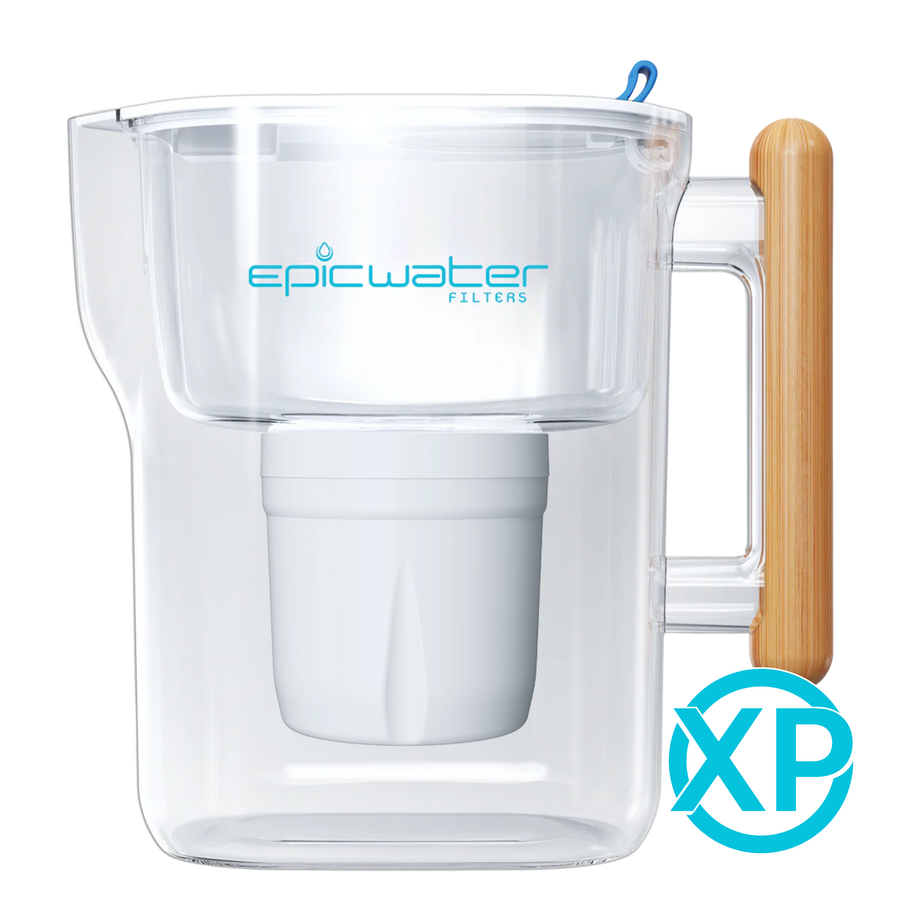
It is also worth knowing what is in the water on the other side of the filter. Epic's free What's in Your Water tool shows the contaminants reported in your zip code, which makes the replacement habit feel less abstract: you can see exactly what the fresh cartridge is there to reduce. And if the pitcher on your shelf is older than you want to admit, the Pure XP Pitcher is rated for 100 gallons per cartridge, is NSF certified to Standard 42 and NSF/ANSI/CAN 372 for material safety, and publishes its independent contaminant reduction testing so you can see what a fresh filter is tested to do.
A water filter is a consumable by design. The cartridge doing its job is the product working, and the swap is the moment the protection starts over. Gallons over guesswork, every time.
Aktie:
Why Does My Water Smell Like Rotten Eggs? A Sink-by-Sink Guide
What to Do During a Boil Water Advisory