
Is Alkaline Water Better? What pH Does and Does Not Tell You
Alkaline water has moved from wellness-store curiosity to default gas station shelf item, usually with a big pH number on the label and a long list of implied benefits behind it. Higher pH, the pitch goes, means better hydration, less acidity, more balance.
This summer, the research community took a careful look. A narrative review published in June 2026 in Frontiers in Medicine walked through the human studies behind the claims and landed on a conclusion worth reading twice: alkaline water has limited clinical utility, its measurable effects are modest and context-specific, and those effects appear to come more from the minerals in the water than from the pH itself.
Here is what that means in practice, and what is actually worth checking about your water instead.

What alkaline water actually is
Alkaline water is simply water with a pH above neutral 7, typically in the 8 to 10 range. It gets there one of two ways: naturally, when groundwater picks up bicarbonate, calcium, magnesium, and potassium from carbonate-rich rock, or artificially, when an ionizer machine splits tap water into alkaline and acidic streams with an electric current.
For comparison, most municipal tap water runs close to neutral. The EPA's guideline for public systems is a pH between 6.5 and 8.5, and even that is what the agency calls a secondary standard: a non-enforceable guideline about taste, corrosion, and aesthetics, not a health-based limit. Notice what that means: plain tap water at the top of the normal range already overlaps the bottom of the "alkaline" range. The number itself is not exotic.
What the 2026 review actually found
The Frontiers in Medicine review, from a team at the Royal College of Surgeons in Ireland's Medical University of Bahrain, sorted the evidence into what holds up and what does not.
What holds up is narrow. The most consistent findings involve reflux: water at pH 8.8 was shown in lab studies to inactivate pepsin, the enzyme that irritates the throat during reflux, and some patients report symptom improvement. There are also small, short-term effects on hydration markers and urinary pH, mostly with bicarbonate-rich mineral waters, and some bone-marker findings that track with calcium content rather than pH.
What does not hold up is the marketing. In the review's words, claims of systemic alkalinization, enhanced immunity, anti-aging, and disease prevention are not supported by robust clinical evidence. The authors' bottom line: alkaline water should not be routinely recommended in primary care, and people with kidney disease, people on acid-suppressing medication, pregnant women, and children should be cautious with it.
One more detail from the literature deserves a spotlight. A published comparison of commercial alkaline waters found that five of six brands measured a lower pH than the label advertised. Even if you buy the premise, the number on the bottle may not survive a meter.
Your body already manages its pH
The reason the big claims keep failing in studies is basic physiology. Blood pH is held in a tight band of 7.35 to 7.45 by your kidneys, lungs, and blood buffering systems, around the clock, regardless of what you drink. Anything you swallow meets stomach acid within seconds, and the stomach responds to alkaline input by secreting more acid to restore its environment.
So a pH 9 water does not make you a pH 9 person. In healthy people, it does not move systemic pH at all. That is not a flaw in the product. It is your body working.

pH is not purity
Here is the part we care about as a filtration company, because it is where the marketing does real damage: a pH number tells you nothing about what is in the water.
Lead from old plumbing, PFAS, chlorine byproducts, microplastics: none of it shows up on a pH meter. The US Geological Survey has estimated that at least 45% of US tap water contains one or more PFAS compounds. Water can read a spa-perfect 8.5 and still carry every one of those. A pH pen, like the TDS meters we have written about before, measures one narrow thing and gets sold as a proxy for "quality."
If the goal is healthier water, the question is not "what is the pH?" It is "what is in it?"
What to check instead
Start free. Your utility publishes an annual water quality report every July that lists what was detected at the treatment plant, and our What's in Your Water lookup summarizes common concerns by zip code. If you are on a private well, or you need a real answer about lead or PFAS at your own tap, use a state-certified lab. We steer people away from home test strips for the same reason we steer them away from pH pens: the questions that matter are parts-per-billion questions, and a color chart cannot answer them.
Then match the fix to the finding, using claims you can verify. Certifications are checkable. Published, independent lab results are checkable. Vibes are not.
Where a filter honestly fits
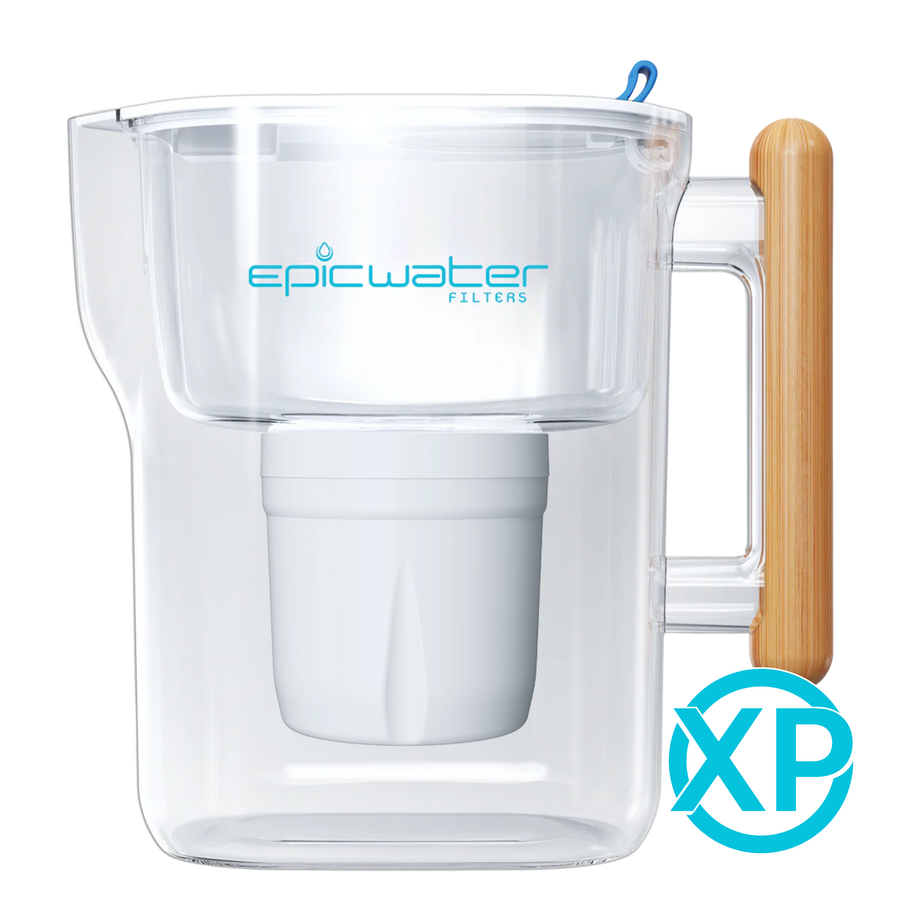
A carbon block filter is not an alkalizer, and we will not pretend otherwise. Epic filters are not designed to change your water's pH. What carbon block filtration does is mechanical capture and adsorption: our Pure XP is NSF certified to NSF/ANSI 42 for chlorine taste and odor reduction and material safety, certified to NSF/ANSI/CAN 372 for lead-free materials, and independently lab tested to reduce 99.9% of lead against NSF/ANSI 53 criteria, PFOA and PFOS against NSF P473 criteria, and over 99.9% of microplastics.
And the minerals? They stay. Dissolved calcium and magnesium pass through a carbon block, which is exactly what the 2026 review suggests you should want, since the modest benefits in the alkaline-water literature trace back to minerals, not pH. Filter out the things you do not want, keep the taste you do, and let your kidneys run the pH desk. They have never lost.
If you enjoy alkaline water's taste, drink it. Taste is a fine reason. But if you are buying it as a health upgrade, the evidence says you are paying for a number that your stomach erases on arrival, while the things worth removing from water sail past the pH meter entirely.
Aktie:
Why Does My Water Smell Like Rotten Eggs? A Sink-by-Sink Guide
What to Do During a Boil Water Advisory