

Well Water and Drought: What to Test, What a Filter Can Do
Much of the country spent this summer in drought. North Carolina's dry stretch is finally easing after months of low streams and shrinking reservoirs, while Massachusetts has kept its Northeast region at a Critical Drought level since late May and has asked private well owners with failing wells to contact their local boards of health. If your drinking water comes from a city system, a treatment plant operator watched those conditions daily and adjusted for you. If it comes from a private well, nobody did. That job is yours.
It is a bigger club than most people realize. More than 43 million Americans, about 15 percent of the population, rely on a private well for drinking water, according to the US Geological Survey. Those wells are not covered by the federal Safe Drinking Water Act, so there is no required testing, no annual report in the mail, and no utility on the hook when something changes. A drought is exactly the kind of event that makes that arrangement matter.
What a dry summer does to a well

Drought works on a well from two directions at once. The obvious one is quantity: months of low rainfall pull the water table down, and shallow or older dug wells are usually the first to struggle. A well has effectively run dry when the water level drops below the pump intake. Falling pressure and sputtering taps are the early warnings, and this summer North Carolina well contractors reported calls from homeowners whose wells suddenly turned discolored or quit after decades without a problem.
The quieter change is quality. With less water in the ground, there is less dilution for whatever is already down there. A national study by the US Geological Survey and the Centers for Disease Control and Prevention estimated that the number of people drinking from wells with elevated arsenic, which occurs naturally in many aquifers, could rise from about 2.7 million in normal conditions to about 4.1 million during drought. In North Carolina this August, a routine well check observed by WRAL found elevated nitrate and more acidic water than a sample from the same home a year earlier. One data point cannot prove the drought caused it, and the experts involved said so, but it is exactly the kind of shift that testing exists to catch.
There is also a recovery trap. The first heavy rains after a drought wash months of accumulated sediment and surface pollutants toward drinking water sources, and they can stir up wells that sat low all summer. Public utilities adjust for this in real time: one North Carolina utility increased its activated carbon dosing this summer as PFAS levels rose in a shrinking reservoir, and the town of Hillsborough added carbon when low river flows and algae gave its water an earthy taste. A well owner has no operator making those moves. The honest equivalent is simple: test after conditions change, not just during the dry stretch.
What to test, and how to do it right
The Environmental Protection Agency recommends private well owners test at least once a year for total coliform bacteria, nitrate, total dissolved solids, and pH, and sooner any time the water changes in color, odor, or taste, or the well changes behavior, like a sudden pressure drop. After a drought summer, that yearly test is not a formality. It is the whole ballgame.

Two practical notes on doing it well. First, many local health departments offer free or low-cost testing for the common contaminants, so start there. For anything beyond the basics, arsenic, heavy metals, or PFAS, use a state-certified laboratory. Second, skip the home test strips. We say this as a company that would happily sell you something else: strip kits are built for rough pool-water questions, not for the parts-per-billion answers that matter for arsenic, lead, or PFAS, and a false all-clear is worse than no test at all. If part of your household is on city water, our What's in Your Water tool shows what your utility reports for your zip code, but a private well never appears in that data. Only a lab can speak for it.
The chlorine aftertaste nobody warns you about
Here is a well-specific moment where a carbon filter is exactly the right tool. After repairs, a new pump, a flood, or a bacteria hit, wells are commonly shock chlorinated: a strong chlorine solution sits in the well and plumbing for 12 to 24 hours, then gets flushed. University extension guidance notes the chlorine taste and smell can linger in the system for 7 to 10 days afterward. Adsorbing chlorine taste and odor is the job carbon filtration is certified for, and it is the same reason utilities keep activated carbon on hand for taste and odor events.
Where a filter honestly fits, and where it does not
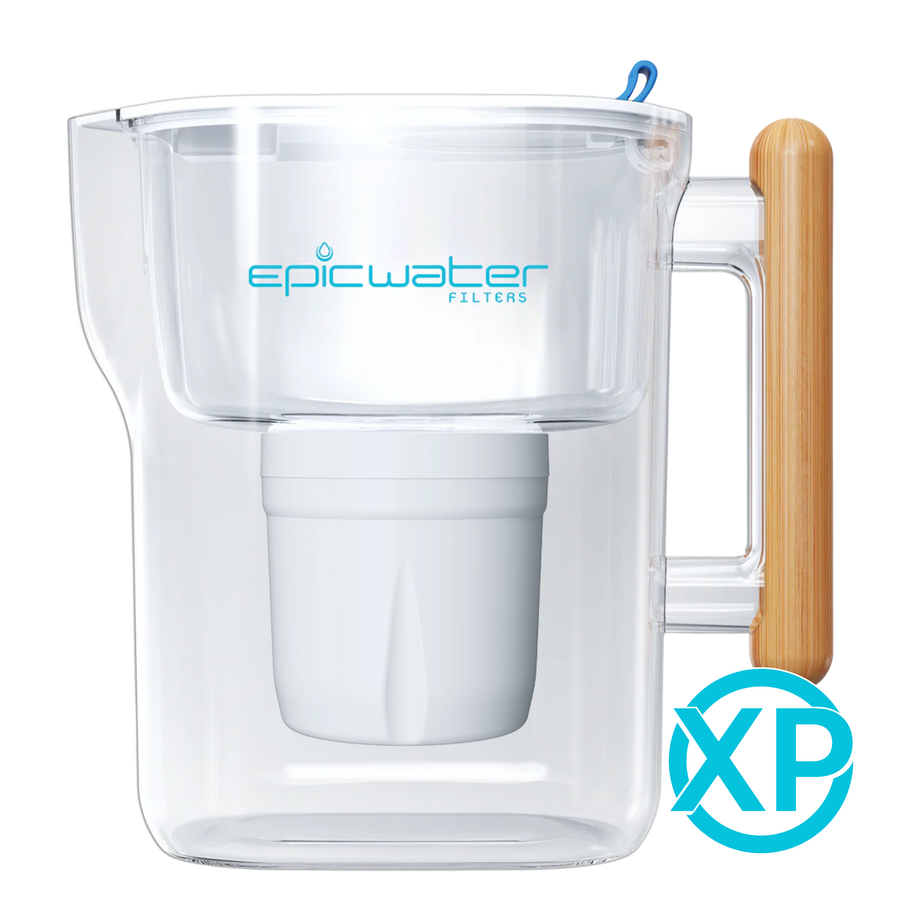
Once a lab has told you what is actually in your well, match the tool to the result. A carbon block filter like our Pure XP pitcher is the everyday polish for a tested well: it is NSF certified to Standard 42 for chlorine taste and odor and to NSF/ANSI/CAN 372 for lead-free materials, and it is independently lab tested to reduce 99.9 percent of lead and to reduce PFOA and PFOS when tested against the NSF P473 protocol. Activated carbon also adsorbs many VOCs and trace organics. On a well, that covers the post-shocking chlorine weeks, taste and odor swings, and an extra layer against chemical contaminants in the glass you actually drink.
And here is the plain part. A standard carbon filter, ours included, is not designed to remove nitrate, is not a reliable arsenic treatment, and is not designed to remove bacteria or viruses. Elevated nitrate calls for reverse osmosis, ion exchange, or distillation. Arsenic calls for a dedicated system sized to your lab number. A bacteria hit calls for disinfection and a retest, not a pitcher. Boiling does not rescue you from the chemical side either, since boiling water off concentrates nitrate and metals in what remains. A filter also cannot fix quantity: if the well is running dry, that conversation is with a licensed well contractor.
The bottom line
A drought summer is the year to take the yearly test seriously. Look up what your county health department offers, pull a sample after the rains return, send the hard questions to a certified lab, and treat to the result. If the result says your well is in good shape, a carbon block filter is the honest finishing step for taste, chlorine, and everyday chemical polish. If the result says something bigger, you will be glad you found out from a lab instead of from your tap.
Aktie:
Hurricane Season Water Prep: How Much Water to Store and What a Filter Can Do
Why Is My Tap Water Brown? Hydrant Flushing, Rust, and What to Do