
Arsenic is the contaminant that tells you nothing. It has no taste, no color and no smell at any concentration, so a glass holding ten times the federal drinking water limit looks exactly like a glass holding none. If your water comes from a private well, nobody is checking it for you.
Arsenic returned to national coverage at the end of October. The Grand Canyon Trust published an analysis of 40 groundwater monitoring wells in the Grand Canyon region, built from 32 years of sampling records held by the U.S. Geological Survey and the Arizona Department of Environmental Quality. Four wells showed average arsenic above the federal drinking water limit, three of them inside the Pinyon Plain uranium mine. The mine’s operator disputes the analysis.12
Those are mine monitoring wells, not anyone’s kitchen tap, and the argument over what caused the readings is still open. It is a useful prompt anyway: the ordinary version of this problem has nothing to do with mining. Most arsenic in American groundwater was already in the rock.
Where arsenic in a well comes from
EPA lists the sources of arsenic in drinking water as erosion of natural deposits, runoff from orchards, and runoff from glass and electronics production wastes. The maximum contaminant level for public water systems has been 0.010 milligrams per liter, or 10 micrograms per liter, since 2006, and the health goal behind it is zero. Long-term exposure above the limit is associated with skin damage, circulatory problems and a possible increased risk of cancer.3
The geology makes this a well-by-well question rather than a regional one. Minnesota’s health department explains that arsenic occurs naturally in the state’s rock and soil, dissolves into groundwater, and was spread unevenly by glacial movement, which is why two wells a short distance apart can return very different results.4

Nobody tests a private well except you
A public water system has to sample for arsenic against that standard and report the result. A private well carries no such requirement. The U.S. Geological Survey and the Centers for Disease Control and Prevention modeled the gap from more than 20,000 domestic wells and estimated that about 2.1 million people were drinking above the public-system limit, out of roughly 44 million in the lower 48 states who rely on domestic wells.6
Conditions move the number. A later USGS study simulated drought and found the exposed population rising from about 2.7 million under normal conditions to about 4.1 million. Its authors were direct about the limit of that work: a model cannot tell you what is in any individual well.7

How to get a real answer
A laboratory test is the only way to know. Use a state-certified or accredited drinking water laboratory, ask for arsenic by name, and use the bottle and instructions the lab supplies. EPA’s private well guidance recommends annual testing, more often when young children, older adults or someone pregnant or nursing lives in the home, and promptly after flooding, construction or well repairs. Arsenic will not appear in a basic bacteria and nitrate panel unless you ask.8
Ask one further question when the result arrives: which form of arsenic is present. Massachusetts’ public health guidance notes that arsenic 3 usually has to be oxidized to arsenic 5 before many systems will remove it, and that several adsorptive media handle arsenic 3 poorly or not at all. That detail decides whether a system you are quoted will work on your water.9
Read EPA’s private well guidance
Find a certified drinking-water lab
For area-level background, Epic’s What’s in Your Water lookup shows reported contaminants in your area. It is not a test of your own tap, and for a private well it is no substitute for one.
What removes arsenic, and what does not
Minnesota’s health department lists the methods that work: reverse osmosis, distillation, adsorptive media, anion exchange, oxidation filtration, and chlorination or ozonation followed by filtration. It advises a system certified by an independent organization, installed by a licensed contractor, then periodic testing of the treated water.4
The list of things that do not work is shorter and more surprising. Conventional water softeners and activated carbon filters alone will not remove arsenic, and neither will sediment filters. Boiling makes it worse, because the arsenic stays behind and concentrates as water evaporates. Ohio’s health department reaches the same three conclusions independently.45
That last point is one we have to be plain about. Epic’s Pure XP and Nano XP filters are carbon block cartridges in a pitcher or a bottle. Their official NSF listings cover Standard 42 for material safety and NSF/ANSI/CAN 372 for lead content, and their reduction figures, including lead under the NSF/ANSI 53 protocol and PFOA and PFOS under the NSF P473 protocol, come from independent testing. None of that is an arsenic claim, and we are not making one.101112
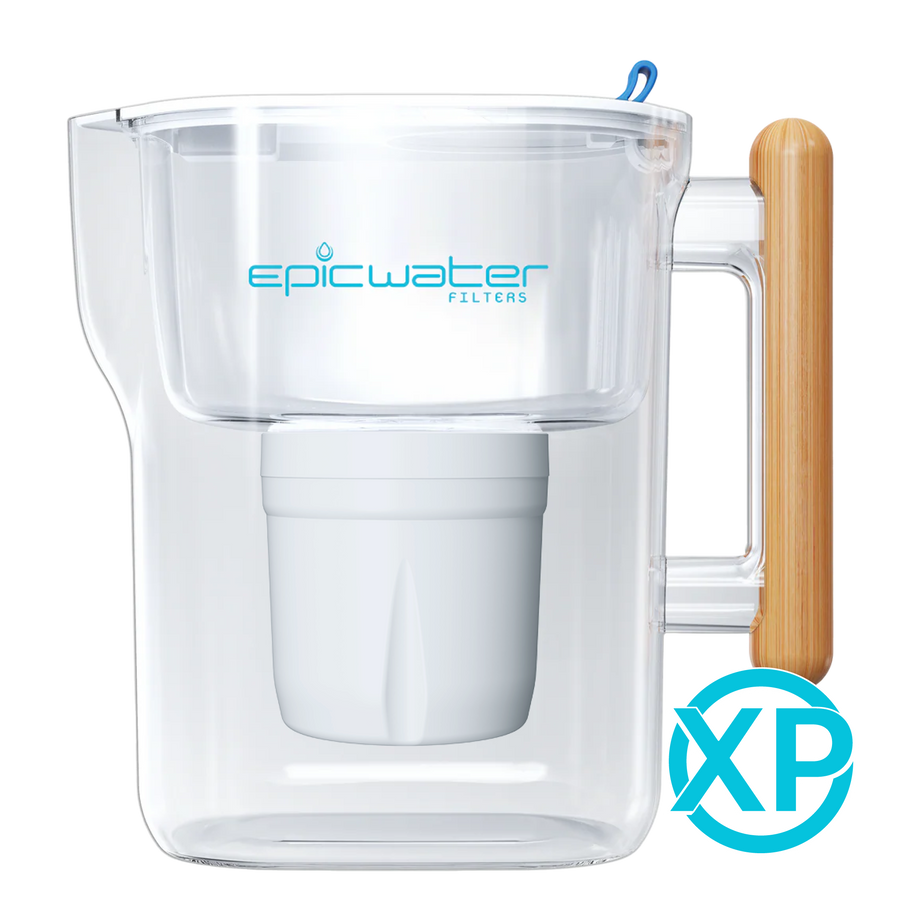
If your water is treated municipal supply and your concern is taste, chlorine, lead or PFAS rather than arsenic, Epic’s pitchers, dispensers and bundles are worth a look. Read the documentation for the exact filter against your own test result first.
Questions about arsenic in well water
Can I taste or smell arsenic in my water?
No. Minnesota’s health department states it plainly: you cannot taste, see or smell arsenic in water. That holds at high concentrations as well as low, so a laboratory test is the only way to find out.
Does boiling water remove arsenic?
No, and it moves in the wrong direction. Boiling drives off water and leaves the arsenic behind, so the concentration goes up. Boiling is for microbiological hazards during an advisory, not metals.
Do carbon or pitcher filters remove arsenic?
Activated carbon filters alone do not, according to both the Minnesota and Ohio health departments. A pitcher would only apply if that specific product were certified for arsenic reduction, which is uncommon. Check the certification for the exact model rather than assuming the category covers it.
Does a water softener handle it?
A conventional softener does not. Anion exchange is a different process that is used for arsenic, and it is installed and maintained differently even though the equipment looks similar.
My water comes from a city utility. Does this apply to me?
Public systems monitor arsenic against the 0.010 milligrams per liter standard and report their results, so the answer should be in your annual water quality report. Ask your utility if you cannot find the arsenic line. The gap here is the private well, which has no such reporting.
Is a filter certified for lead also good for arsenic?
No. Reduction claims are contaminant by contaminant, each tested under its own protocol. A lead certification says nothing about arsenic, and neither does a certification for material safety or for lead content in the filter’s own components.
Sources & references
Reviewed November 2, 2026
- Inside Climate News / Most wells around the Grand Canyon with high arsenic levels are at a uranium mine ↗October 28, 2026. The Grand Canyon Trust analysis, the wells above the federal limit, and the operator’s response.
- KUER and KNAU / Analysis finds unusually high arsenic levels at uranium mine near Grand Canyon ↗October 30, 2026. Independent confirmation of the 40 wells and the 32 years of USGS and state monitoring data.
- EPA / National Primary Drinking Water Regulations ↗The arsenic maximum contaminant level of 0.010 mg/L, the health goal of zero, the listed sources and health effects.
- Minnesota Department of Health / Arsenic in well water ↗No taste, color or odor; the new-well detection and exceedance figures; the treatment methods that work and those that do not.
- Ohio Department of Health / Arsenic treatment and removal for private water system wells ↗Independent confirmation that softeners, activated carbon filters, sediment filters and boiling are ineffective for arsenic.
- USGS and CDC / Estimating the high-arsenic domestic-well population ↗The modeled estimate from more than 20,000 domestic wells, and the size of the domestic-well population.
- USGS / Drought may lead to elevated levels of naturally occurring arsenic in private domestic wells ↗The normal-conditions and drought exposure estimates, and the authors’ note that a model cannot predict a single well.
- EPA / Protect your home’s water ↗Private well testing frequency, the baseline panel, certified laboratories and local health department guidance.
- Massachusetts Department of Public Health / Arsenic in private well water FAQs ↗Arsenic 3 and arsenic 5, the oxidation step, and the limits of several adsorptive media.
- NSF / Official Standard 42 component listing ↗Epic filter certification for material safety requirements only.
- NSF / Official Standard 372 listing ↗Lead-content certification of the listed filter components.
- Epic Water Filters / Testing documents ↗Independent performance reports, data sheets and certification resources for the exact filter.
Arsenic levels vary well by well and change over time, so no article can tell you what is in your water. Use a state-certified or accredited laboratory and follow your state or local health department’s guidance. The well head and sample bottle photographs are generated editorial illustrations.
Condividi:
Can You Use Tap Water in a Humidifier? What EPA Actually Says
Your Lead Pipe Is Being Replaced. What to Do Next.