
What Does TDS in Water Mean? Why the Number Is Not a Safety Score
If you have ever dipped a little digital pen into a glass of water and watched it flash a number, you have used a TDS meter. They are cheap, they feel scientific, and they are one of the most misunderstood tools in home water. A low number gets read as clean and a high number as dangerous, and neither reading actually tells you that. Understanding what TDS is, and what it is not, will save you money and a fair amount of worry.
What TDS actually measures

TDS stands for total dissolved solids: the combined amount of minerals, salts, and metals dissolved in your water, usually reported in parts per million, or ppm. Here is the catch. A TDS meter does not actually see any of those substances. It passes a small electrical current through the water and estimates the total from how well the water conducts electricity, then shows you a single number on a screen.
Most of what that number represents is ordinary, harmless minerals, chiefly calcium and magnesium. Those are the same minerals that give spring water its taste and that your body uses every day. In other words, a big share of your TDS reading is not contamination at all. It is the natural mineral content of the water, and there is nothing wrong with it.
Why a low reading does not mean safe

This is where the meter misleads people most. A low TDS reading only means there are fewer dissolved minerals in the water. It says nothing about whether the water is free of the contaminants that actually matter for health.
The pollutants people worry about most, including lead, PFAS forever chemicals, pesticides, and pharmaceuticals, show up in tap water at trace concentrations that are far too small to move a TDS meter. Some of them do not carry an electrical charge at all, so a conductivity reading cannot register them even in theory. A 2023 United States Geological Survey study estimated that at least one PFAS compound is present in roughly 45 percent of the nation's tap water, and none of it would nudge a TDS pen.
So the number cuts both ways. Water can read a clean-looking 40 ppm and still contain a real health concern, while mineral-rich water can read several hundred ppm and be perfectly safe to drink. The EPA lists a guideline of 500 ppm for TDS, but that is a secondary, non-health standard about taste and appearance, not safety. Plenty of celebrated spring and mineral waters sit well above it. There is simply no single healthy TDS target to chase.
Why your carbon filter does not change the number
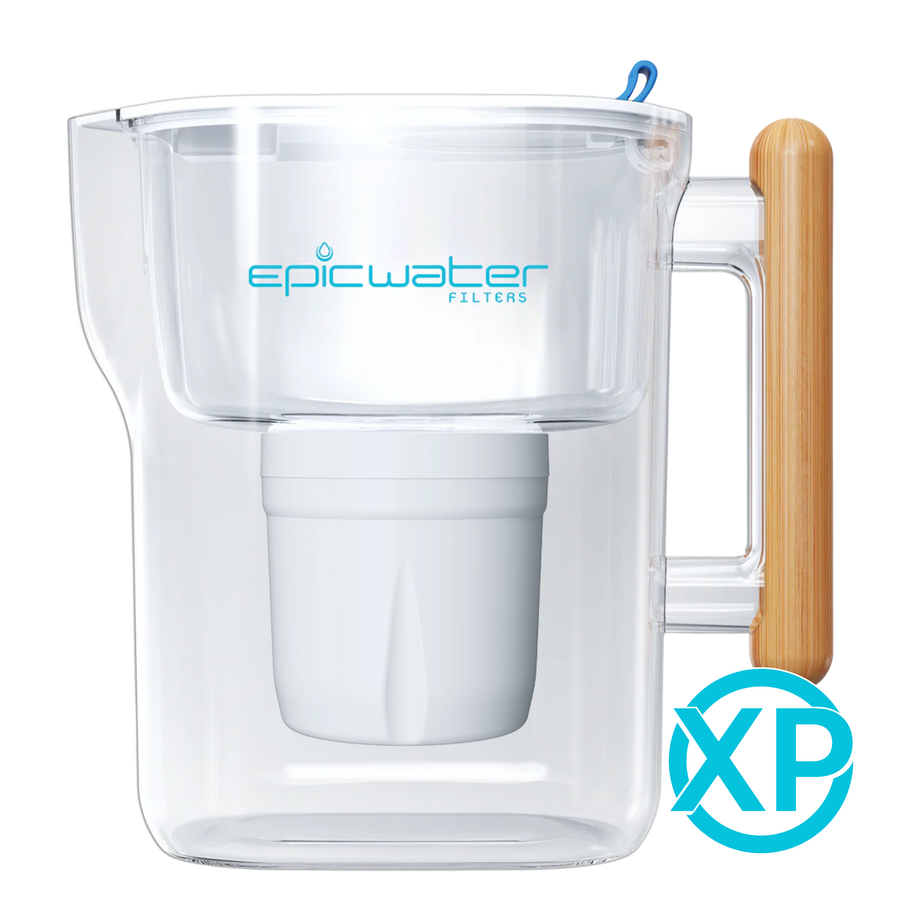
Here is a question Epic hears often: I filtered my water and the TDS number barely moved, is my filter broken? The answer is no, and understanding why is the whole point. It is also, not coincidentally, the pitch a reverse-osmosis salesperson uses to make a carbon filter look useless.
Activated carbon works by adsorption. As water passes through the carbon, chlorine and organic chemicals stick to the carbon's enormous internal surface and are held there. Dissolved minerals like calcium and magnesium are not organic chemicals, so they do not adsorb. They flow straight through, which is exactly why a TDS meter shows little or no change after carbon filtration. That is the filter working as designed, not failing.
Only reverse osmosis or distillation strips minerals aggressively enough to drop a TDS reading, and they do it by removing the beneficial minerals along with everything else. A carbon block takes a different approach: it reduces the chemistry you do not want and leaves the minerals you do. Epic's Pure XP is a carbon fiber block, NSF certified to Standard 42 for chlorine taste and odor and to NSF/ANSI/CAN 372 for lead-free materials, and it is independently lab-tested to reduce 99.9 percent of lead and tested against the NSF/ANSI P473 protocol for PFOA and PFOS. Its lead and PFAS results are independently tested rather than NSF certified, a distinction worth keeping clear. All of that happens whether or not a TDS pen ever twitches, because the pen is measuring the wrong thing.
How to actually check your water
If a TDS meter cannot tell you what is in your water, what can? Start with the free report you already have a right to. Every community water system publishes an annual Consumer Confidence Report that lists the contaminants it detected and at what levels. That single document tells you far more than a conductivity pen ever will.
For concerns that a utility report cannot capture, such as lead, use a certified laboratory test of your own tap. Lead often enters after the water leaves the treatment plant, from older service lines or home plumbing, so only a test at your faucet reflects what you are actually drinking. Once you know what you are dealing with, match a filter to those results rather than to a number on a meter. If you want a quick starting point for your area, Epic's What's in Your Water tool is a useful place to begin.
The simple takeaway
A TDS meter counts dissolved minerals, most of them harmless, and it cannot see the contaminants that matter for your health. A low reading is not a grade of clean, a high reading is not an alarm, and a carbon filter is not supposed to change the number at all. Read the meter for what it is, a rough measure of mineral content, and judge your water by your utility report, a certified test, and a filter matched to what you actually want to reduce.
Aktie:
Pesticides in Tap Water: Why Summer Is Peak Season
Counterfeit Water Filters: How to Tell If Yours Is Real