

Are Refrigerator Water Filters Enough? What They Remove, What They Miss
A refrigerator water filter makes your water taste better, so it is natural to assume it makes your water safe. Those are two different claims. Most fridge filters are a simple activated carbon cartridge, and carbon is genuinely good at what it targets, but what any given cartridge is actually tested to reduce varies a lot. This is the calm version: what refrigerator water filters really remove, what they quietly miss, and how to know when it is time to reach for something more capable.

What a refrigerator water filter actually does
Nearly every refrigerator filter is an activated carbon cartridge. Carbon works by adsorption, meaning contaminants stick to the huge internal surface area of the carbon as water flows through. It is very effective at reducing chlorine taste and odor and many common organic chemicals, which is exactly why filtered water from the fridge usually tastes noticeably cleaner than water straight from the tap. That improvement is real, and for a lot of households it is the main thing they wanted.
Better cartridges go further and are tested to reduce health-related contaminants such as lead and certain cysts. The catch is that you cannot tell which category your filter falls into by taste. A cartridge that only improves flavor and a cartridge that also reduces lead can produce water that tastes identical. The only reliable way to know the difference is the certification printed on the box.
Read the certification, not the word "filtered"
Independent certifications from NSF or the Water Quality Association exist precisely so you do not have to take the word filtered on faith. It helps to know what the common standards actually mean:
- NSF/ANSI Standard 42 covers aesthetic effects like chlorine taste and odor. This is what most basic fridge filters claim.
- NSF/ANSI Standard 53 covers health-related contaminants such as lead, certain cysts, and some VOCs.
- NSF/ANSI Standard 401 covers a set of emerging contaminants, including some pharmaceuticals.
A filter certified only to Standard 42 can genuinely improve taste while doing nothing that has been tested for lead, and that is completely normal and legal. So the useful question is not "is my fridge filter good," it is "what is this specific cartridge tested to reduce, and does that match what is actually in my water." Answer that and a fridge filter goes from a vague comfort to a tool you understand.

What refrigerator filters do not remove
There are contaminants that standard carbon simply is not built to handle at all, no matter how new the cartridge is:
- Fluoride and total dissolved solids pass through carbon and require reverse osmosis or distillation.
- Nitrate also passes straight through carbon and needs reverse osmosis or ion exchange.
- Living microbes like bacteria, viruses, and parasites are not carbon's job, which is why a fridge filter is never a substitute for a boil water notice.
This matters because the contaminants that make headlines are often the ones a basic filter was never tested for. The US Geological Survey estimates that at least 45 percent of US tap water contains one or more PFAS, the so-called forever chemicals. A cartridge that only claims taste and odor tells you nothing about whether it touches PFAS. The point is not to panic. It is to match the contaminant you care about to a filter that has actually been tested to reduce it. If you are not sure what is in your water, Epic's What's in Your Water tool and your utility's annual water quality report are both good starting points.
The step almost everyone skips
Even a well-certified filter only performs if you replace it. Most refrigerator cartridges are rated for about six months or a set number of gallons, and this is the most commonly neglected step in home filtration. A carbon filter does not fail loudly. As it reaches the end of its capacity it simply stops adsorbing well, a point called breakthrough, and water can begin passing through carrying more of what the filter used to catch. A neglected cartridge can even become a spot for biofilm to grow. The reduction numbers on the box only hold if you change the filter on schedule with genuine media.
When a fridge filter is fine, and when to upgrade
A refrigerator filter is a reasonable choice when your main goal is better taste, your water quality report is clean, and you actually keep the cartridge changed on time. Where it falls short is control. You are limited to whatever cartridge fits your fridge, its certifications may be modest, and it is easy to forget.
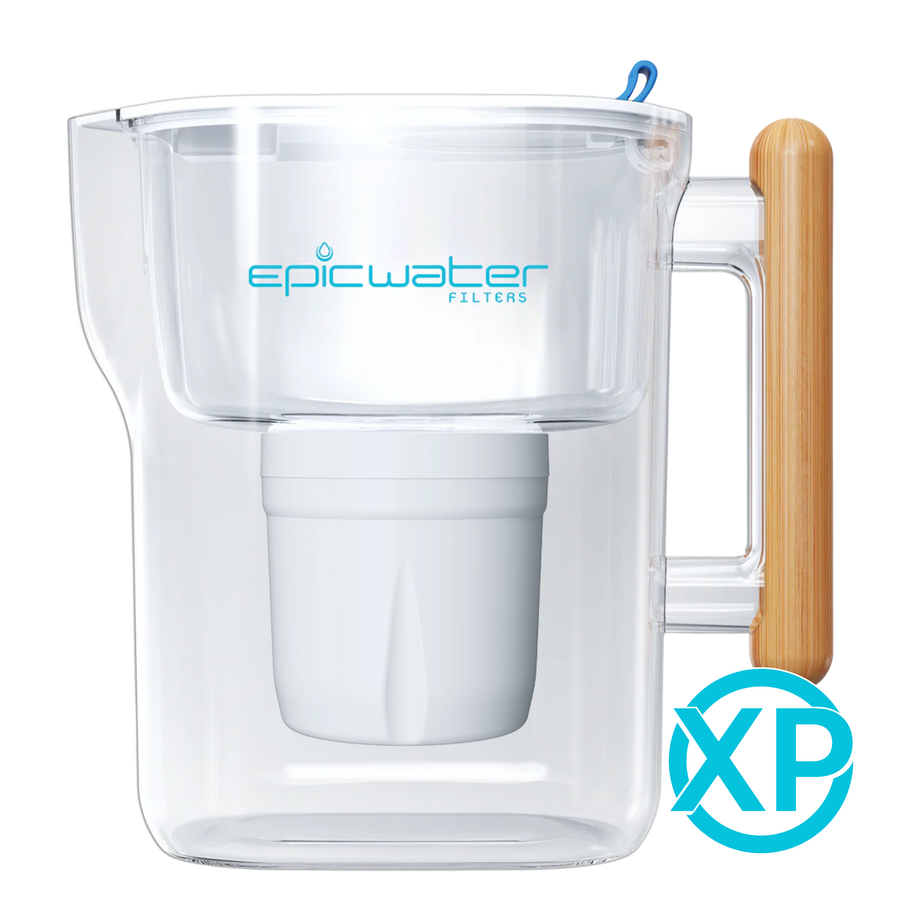
If your report flags lead, if PFAS is a concern in your area, or if you simply want claims you can verify, a dedicated filter lets you choose the exact filtration you want. Epic's Pure XP is a carbon fiber block that is NSF certified to Standard 42 and NSF/ANSI/CAN 372, and independently lab-tested to reduce 99.9 percent of lead and tested against the NSF P473 protocol for PFOA and PFOS. For a natural upgrade from a fridge dispenser, the Smart Shield Max sits under the sink and delivers cold filtered water on demand, rated up to 750 gallons per filter. And the Nano XP adds microbiological and microplastics reduction, independently tested to reduce over 99.9 percent of microplastics.
The honest boundary is the same for all of them. No point-of-use carbon filter removes fluoride or total dissolved solids, and none is a substitute for a boil water notice, so follow your utility during any advisory. Beyond that, the path to confident water is simple: find out what is in your water, match it to a filter with certifications and testing for those specific contaminants, and replace the media on schedule. That turns filtered from a vague comfort into a decision you can trust.
Condividi:
Algae Blooms and Your Tap Water: What Cyanotoxins Mean
Lead in School Drinking Water: A Back-to-School Guide for Parents