
Is Filtered Tap Water Safe for Baby Formula? What a Filter Can and Cannot Do
If you are mixing powdered formula, you have probably stood at the sink and wondered whether your tap water is good enough for your baby. The reassuring answer, from the Centers for Disease Control and Prevention, is that most families can safely prepare powdered infant formula with their own tap water. This is not a reason to panic or to default to expensive bottled water. It is a reason to check a few specific things, because a baby drinks a lot of water relative to their body weight, and formula is mostly water.
The honest version of this topic comes down to three considerations: lead, nitrate, and fluoride. A home carbon filter is a strong, genuine help with one of them, and it cannot touch the other two. Knowing that difference is what keeps you from trusting a filter to do a job it was never built for.

Start with what is reassuring
Public water systems test the water they deliver and publish an annual water quality report, sometimes called a Consumer Confidence Report. If you are on a public supply, that report is the first place to look for lead and nitrate results in your area. If you are on a private well, no utility is testing for you, so what is in your groundwater is unknown until you have it tested. That single distinction, public versus private, shapes most of the advice that follows.
For a typical home on a tested public supply with no known problems, filtered cold tap water is a reasonable, lower-cost everyday choice for formula. The goal here is not to scare you off the tap. It is to make sure you know your water first, then choose a filter that honestly matches the risk.
The three things that actually decide it
Lead: the strong fit for a filter
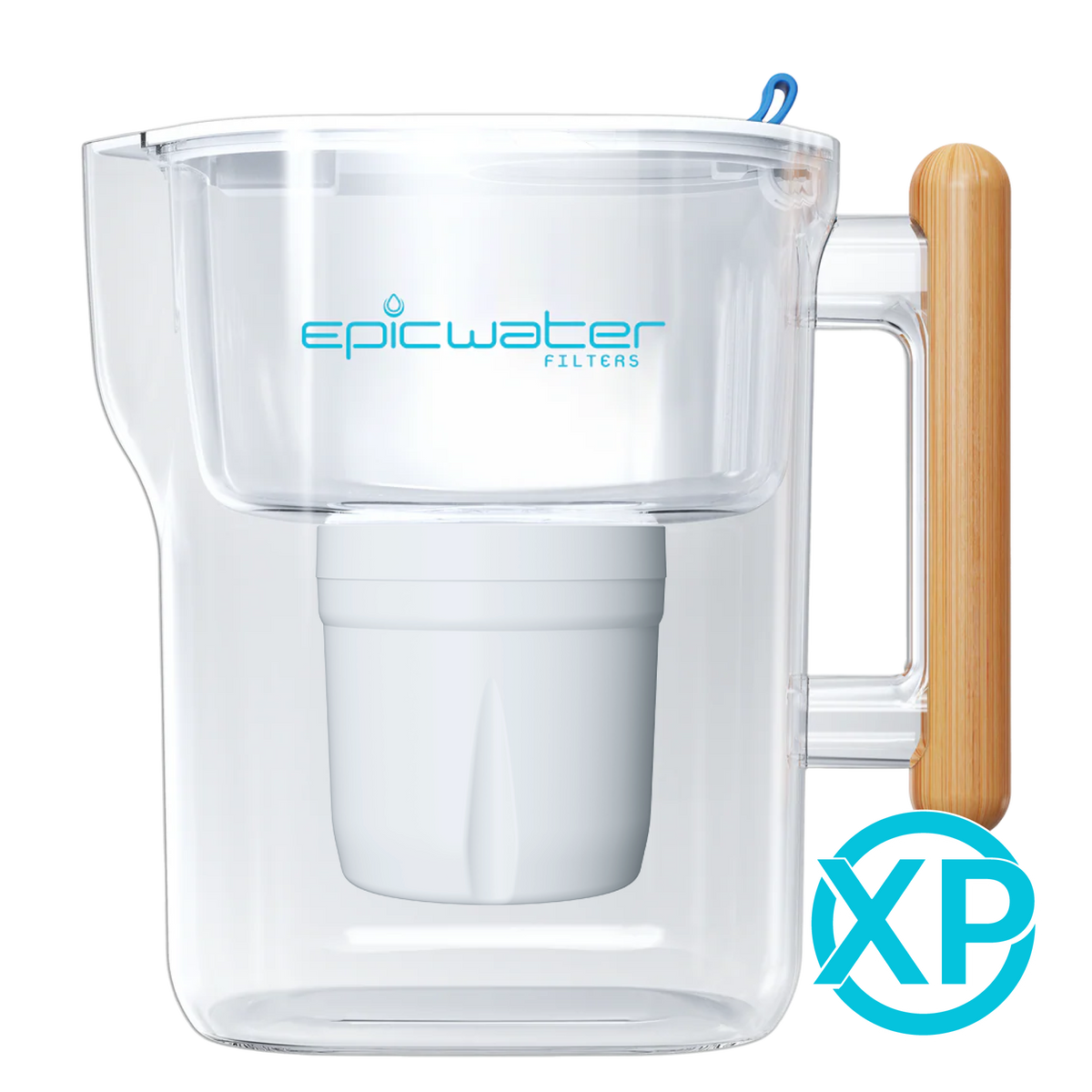
Lead has no safe level, and infants and pregnant people are among the most vulnerable. Lead usually enters water not at the treatment plant but from older service lines and household plumbing, which is why it can appear at your tap even when your utility reports clean water leaving the plant. This is exactly the kind of contaminant a good carbon block filter is designed to reduce at the point of use. Epic's Pure XP is independently lab-tested to reduce 99.9% of lead, evaluated against the NSF/ANSI 53 criteria. The practical routine is simple: draw cold water, run it through the filter, and use that for mixing formula.
Two honest notes belong with that number. A point-of-use filter reduces lead at your tap, but it does not replace a lead service line or your utility's corrosion control. And the EPA notes that a properly used, lead-certified filter can help protect you when drinking, cooking, and making baby formula, which is precisely the use case here.

Nitrate: the honest gap
This is the most important point on the page, and it is the one most filter marketing quietly skips. A standard carbon pitcher does not remove nitrate. Nitrate is the contaminant most dangerous to infants under six months, because it can interfere with the blood's ability to carry oxygen, a condition sometimes called blue baby syndrome. Nitrate often comes from agricultural runoff and is a particular concern for private wells near farmland.
Removing nitrate takes reverse osmosis or ion exchange, not carbon. So if you are on a well, or you live near agriculture, test your water for nitrate before you rely on any filter, and talk to your pediatrician if the level is elevated. We would rather tell you that plainly than let a carbon filter imply a protection it does not provide.
Fluoride: the gentle consideration
Fluoride is the mildest of the three. Fluoridated tap water can be used to make formula, and for many families that is perfectly fine. The nuance is that infant formula already contains fluoride, so mixing it with fluoridated water can slightly raise the chance of mild dental fluorosis, which shows up as faint white marks on the teeth. If that is a concern for you, it is worth knowing that a carbon filter does not remove fluoride either, so reducing it would take reverse osmosis or a low-fluoride water source. This is a good question for your pediatrician, who can weigh it against the real benefits of fluoride for developing teeth.
Why the stakes are higher for a baby
An infant on formula takes in far more water per pound of body weight than an adult, because formula is mostly water. Whatever is in that water is effectively concentrated for the smallest person in the house. That is why the honest boundaries matter more here than almost anywhere else, and why a filter's real strengths and real limits both deserve a clear label.
Lead is also a live concern in 2026, not a historical one. Water systems have entered the lead-service-line replacement decade, and a new five-year cycle of mandatory lead testing in schools began on July 1, 2026. For parents, that steady drumbeat of lead-at-the-tap news is a good reminder to filter cold water for formula and to read your annual report.
A calm routine for making formula water
Here is the whole thing in order, without the fear:
- Know your water source. On a public system, read your annual water quality report for lead and nitrate. On a private well, test regularly for nitrate and bacteria, neither of which a carbon filter fixes.
- Filter cold water. Always draw cold water, then run it through a lead-reducing carbon filter. Never mix formula with hot tap water, which can carry more lead from pipes.
- Do not lean on boiling for chemicals. Boiling kills germs but does not remove lead or nitrate, and long boiling can concentrate them. During a boil water advisory, follow your utility or use ready-to-feed formula, because a carbon pitcher is not a microbiological purifier.
- Ask your pediatrician. Bring any well, nitrate, or fluoride question to your pediatrician for infant-specific advice.
You can check your local picture quickly with Epic's What's in Your Water tool, then decide what to filter for.

What a carbon filter honestly does, and what it does not
It helps to separate what a carbon filter is certified for, what it is tested for, and what it simply does not do. Pure XP is a carbon fiber block that is NSF certified to Standard 42 for chlorine taste and odor and to NSF/ANSI/CAN 372 for lead-free wetted materials. Its 99.9% lead reduction is independently lab-tested and evaluated against NSF/ANSI 53, and its results against the NSF/ANSI P473 protocol for PFOA and PFOS are likewise independently tested rather than NSF certified. We keep that certified-versus-tested line clear on purpose, because for a baby you deserve to know exactly what is proven.
Just as important is the honest list of what carbon does not do. It does not remove nitrate. It does not remove fluoride. And it is not a microbiological purifier, so it is never a substitute for boiling during a boil water advisory. Epic's Nano XP adds microbiological and microplastics reduction and intentionally retains fluoride, which makes it a useful backup pick but not a fluoride-reduction tool. If reducing fluoride or nitrate is your goal, that is reverse osmosis territory, and we would rather say so than let a pitcher imply otherwise.
Bottled or nursery water instead?
Not automatically. Bottled and nursery waters are not guaranteed to be cleaner than a tested tap supply, and their fluoride content varies, so they are not a shortcut around knowing your water. For everyday use, filtered cold tap water from a tested public supply, run through a lead-reducing filter, is a reasonable and far less expensive option. The point is not the label on the container. It is whether you know what is in the water, and whether the filter you chose actually addresses it.
The bottom line
For most families, filtered tap water is a safe, sensible choice for baby formula. A carbon filter like Pure XP is a genuine help with lead and chlorine, backed by independent testing. It is not a nitrate solution, not a fluoride solution, and not a purifier during a boil advisory. Know your source, filter cold water, and bring anything unusual to your pediatrician. That is the calm, honest way to make formula water you can trust.
Condividi:
Counterfeit Water Filters: How to Tell If Yours Is Real
Is It Safe to Drink Water Left in a Hot Car?