

Last week an advocacy group published a number that landed in a lot of local news: PFAS turned up in water systems serving roughly 197 million people, about 23 million more than federal testing had previously identified.1
If your town appeared on that map, the natural next move is to pull up your utility's annual report and find the part where it admits the problem. You will usually not find one. The report will say the system met every federal standard, and it will be telling the truth.
Two honest documents can describe the same water and disagree, because drinking water carries two kinds of number. Only one of them is a law.
The limit and the goal are different numbers
Before EPA regulates a contaminant it sets a Maximum Contaminant Level Goal: the level at which no known or anticipated adverse health effect would occur. The goal is non-enforceable, and EPA says plainly that it considers only public health, not the limits of detection or treatment technology.2
Then comes the number that counts legally. The Maximum Contaminant Level is the enforceable standard, set as close to the goal as feasible, taking cost into consideration and using the best available technology examined under field conditions.2 The goal answers a health question. The limit answers an engineering and affordability question, and a utility reporting compliance is reporting against that one.3

Sometimes the two numbers match, and sometimes they do not
The gap is not uniform, which is the part worth internalizing. For nitrate, EPA's goal and its enforceable limit are both 10 milligrams per liter.3 The effect driving nitrate regulation is acute rather than cumulative, so the limit sits exactly where the goal does. A nitrate result comfortably under 10 means what you hope it means.
For arsenic the two part company, as the panel below shows.3
PFOA and PFOS follow the same shape: a goal of zero against an enforceable limit of 0.0000040 milligrams per liter, the four parts per trillion figure from the headlines.3 A goal of zero is not a prediction that zero is achievable. It marks where the evidence points, with cost deliberately left out.
Why a map says contaminated and a report says compliant
Advocacy databases generally do not compare your water to the legal limit. They compare it to a health guideline, and say so. The largest states that its guidelines are non-enforceable, that most reflect public health goal values from California's Office of Environmental Health Hazard Assessment, and that only the federal limit is enforceable.4
Last week's headline figure works the same way. Coverage noted that it counted systems where PFAS were detected, not systems exceeding a federal standard.1 Detection, exceedance and harm are three separate thresholds. A map measuring the first is not claiming the third.
Neither instrument is dishonest. They are calibrated for different jobs. A related trap sits opposite: a line reading 'not detected' describes a laboratory's reporting limit, not absolute zero, as we covered in how that line gets made.
Where the system's numbers stop
Every figure above describes a water system, sampled where the utility is required to sample. Your home sits downstream of all of it, which is why a lead question is answered at your tap rather than at the plant.

Your Consumer Confidence Report is the right starting document. It lists what was detected, the enforceable limit, and in most formats the health goal alongside it.5 Read the goal column deliberately. Almost nobody does, and it explains the gap between your utility and the map.
Find your water quality report
If one result bothers you, or you are on a private well with no report, a state certified laboratory can test your own tap for the contaminant you care about.6 We have covered arsenic in well water, nitrate warnings for infants and disinfection byproduct notices if one of those is the line giving you pause.
Find a certified drinking-water lab
For area-level background, Epic's What's in Your Water lookup is a reasonable place to start. It describes an area, not your own tap.
What a filter is, in this picture
A point of use filter is a personal margin. It sits past everything a utility controls, and lets a household sit closer to the health goal than the law requires, for the contaminants that filter has been tested against.
The limits deserve equal clarity. A pitcher is not a treatment plant, does not address bacteria, and does not replace a boil water advisory. It does nothing about nitrate or arsenic. If one of those is your issue, a carbon pitcher is the wrong tool and we would rather say so than sell you one.
The distinction in this article applies to filters too. Pure XP and Nano XP are listed by NSF under Standard 42 for material safety and NSF/ANSI/CAN 372 for lead content.78 Those certify materials, not contaminant reduction. Reduction performance is documented separately in independent testing: lead at 99.9 percent under the NSF/ANSI 53 protocol, PFOA and PFOS under the NSF P473 protocol, and over 99.9 percent of microplastics.9
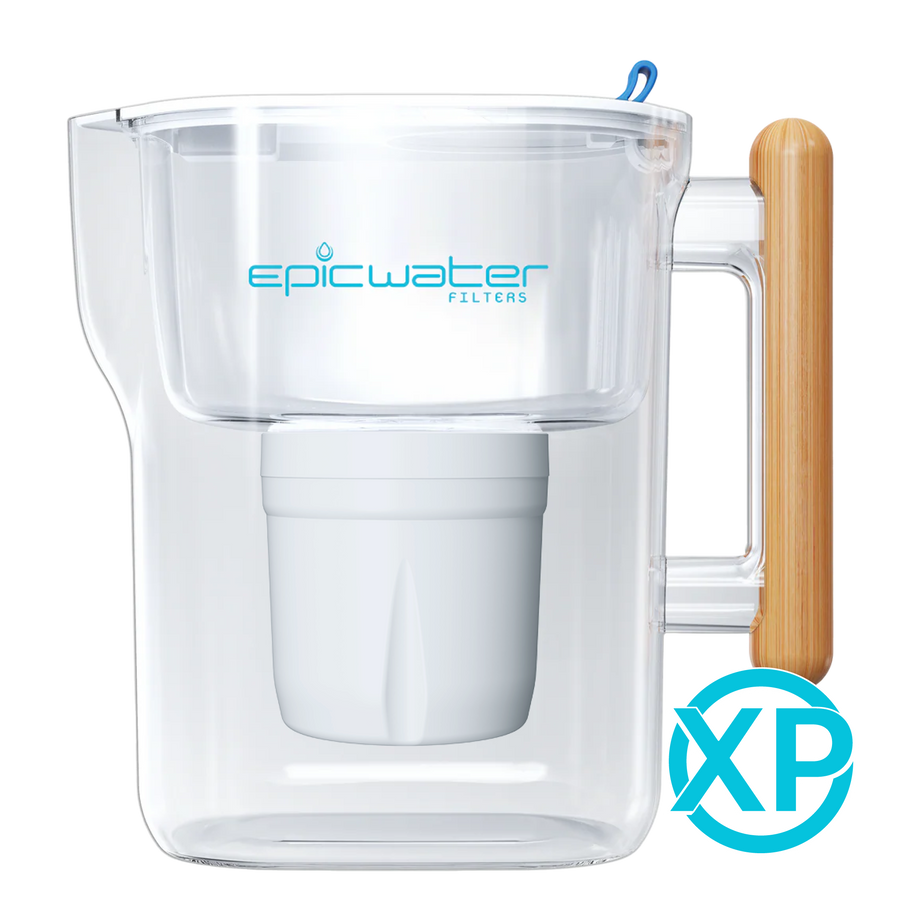
If a pitcher or dispenser fits your household, explore Epic's pitchers, dispensers and bundles, and read the documentation for the exact filter. If you are weighing a pitcher against a different category of equipment, our comparison of reverse osmosis and pitcher filters covers the trade-offs.
Questions about limits and health goals
Is my water safe if it meets every federal standard?
Meeting the standard means the system is within the enforceable limit, which EPA sets as close to its health goal as feasible given cost and technology. For nitrate the limit and the goal are the same number. For arsenic and the regulated PFAS, the goal is zero and the limit is higher. Compliant is not the same statement as equal to the health goal.
What is the difference between an MCL and an MCLG?
The MCLG is a non-enforceable health target set on public health alone. The MCL is the enforceable standard, set as close to that goal as feasible with cost considered. Only the MCL can be violated.
Why does an online database say my water is contaminated?
Most compare detected levels to non-enforceable health guidelines rather than the legal limit, and say so in their methodology. Above a health guideline is not the same as in violation of federal law.
Does a detection mean my utility broke a rule?
No. Detection means a laboratory measured the substance above its reporting limit. An exceedance means the level was above the enforceable standard. Coverage of the 197 million figure made the point: the analysis counted detections, not exceedances.
Can a filter close the gap between the limit and the goal?
For contaminants a filter has been tested against, it can reduce what reaches your glass. It cannot help with contaminants it was not designed for, and a material safety certification is not a certified reduction claim. Match documented performance to the contaminant in your report.
Sources & references
Reviewed November 9, 2026
- WRAL / Forever chemicals found in water serving 197 million as EPA eyes rollbacks, November 6, 2026 ↗Reports the analysis of state and federal testing data, the 23 million increase, and that it counts detections rather than exceedances.
- EPA / How EPA regulates drinking water contaminants ↗Defines the non-enforceable MCLG and the enforceable MCL set as close to it as feasible, with cost taken into consideration.
- EPA / National Primary Drinking Water Regulations ↗The official table of MCLG and MCL values, including arsenic, nitrate, PFOA and PFOS.
- Environmental Working Group / Tap Water Database methodology ↗States that its health guidelines are non-enforceable and that most reflect California OEHHA public health goal values.
- EPA / Consumer Confidence Reports ↗How to find the annual water quality report for your own water system.
- EPA / Certified drinking water laboratories ↗State certification programs and laboratories for testing water at your own tap.
- NSF / Official Standard 42 component listing ↗Epic filter components certified for material safety requirements only.
- NSF / Official NSF/ANSI/CAN 372 listing ↗Lead content certification of the listed filter components.
- Epic Water Filters / Testing and certification documents ↗Independent performance reports and data sheets behind the reduction figures cited above.
Federal limits and health goals are published together by EPA and change over time; check the current table before relying on a value. This article explains how the two kinds of number are set. The creek and plumbing photographs are generated editorial illustrations. The Pure XP image is an official product photograph.
Condividi:
Do Plastic Water Pipes Release Microplastics? A New Study Counted Them