

A notice that says your water violated a drinking water standard, mentions cancer risk, and then tells you this is not an emergency reads like three documents stapled together. All three can be true at once, and the reason is in how the rule is written.
On September 20 the town of Whitmire, South Carolina posted a notice that its water system had exceeded the standard for total trihalomethanes, a group of disinfection byproducts. The state flagged the result on August 27. By the time the town put it on social media in early October, residents were asking why it took so long.12
The delay was not a cover-up. It is the shape of the rule. Here is what one of these notices measures, why it arrives late by design, and the instruction people most often get backwards.
Why the notice arrives months after the test
Compliance is not judged on a single sample. EPA sets a maximum contaminant level of 0.080 mg/L for total trihalomethanes and 0.060 mg/L for the five regulated haloacetic acids, and a system passes or fails on a locational running annual average of the four most recent quarters at each monitoring location.3
So one high quarter rarely triggers anything alone, and the violation is usually confirmed only when the fourth lands. Whitmire’s exceedance ran across four consecutive quarters ending September 30.23
Then a second clock starts. An exceedance like this is a Tier 2 notice under EPA’s Public Notification Rule, which allows up to 30 days from the point a system learns of it. Tier 1, the 24 hour category, is for acute hazards such as E. coli or nitrate.4 Our guide to what Tier 1, Tier 2 and Tier 3 mean covers the difference.
The pattern repeats. Goodyear, Arizona notified residents in May 2026, and its water services director explained that the rule is written as an annual average because this is not a contaminant that makes someone sick right away.10

Where trihalomethanes come from
Chlorine does the job it was added to do, then keeps reacting. Where it meets naturally occurring organic matter from the source water, part of that reaction produces trihalomethanes and haloacetic acids.35 There is no chlorinated tap water with zero byproducts, only more or less.
Two conditions push the numbers up. Warm water speeds the reaction, which is why a July through September quarter is often a system’s highest. Contact time does the rest: the farther water travels and the longer it sits in storage, the more time the reaction has. Small systems with long pipe runs are overrepresented in violation data.
Source water heavy with organic matter does the same, which is why a reservoir that has just turned over can lift byproduct formation for weeks. See what fall reservoir turnover does to your tap water.
This is the trade chlorination represents. Disinfection prevents outbreaks that were routine before it became standard, and byproducts are a lower grade concern measured in years rather than days, which is why the rule averages a year of samples.5
What the notice does and does not ask of you
Do not boil. This is the instruction people reverse most often. Boiling is right for a bacterial advisory and wrong here. Trihalomethanes are volatile, so heating drives them into the air of the room you are standing in, and what stays behind concentrates as the volume drops. If you are boiling for cooking anyway, Massachusetts health guidance suggests running an exhaust fan.5
The same volatility explains the shower advice in many notices. Ventilating the bathroom, shorter showers and a lower water heater setting all cut how much you inhale, a real exposure route alongside what you drink.5
If a notice says no alternative water source is necessary, read that as a statement about acute risk, not a dismissal of the finding. Massachusetts guidance still names bottled water as reasonable for pregnant women and for parents mixing formula.5 Decide for your own household, and raise specific health concerns with your physician.1
Read the notice you received, not the one you remember. A byproduct notice is not a boil water advisory, and the two ask for opposite actions. If you are unsure which you have, our boil advisory guide sets out what that one requires.

Find your water quality report ↗
For area level background, Epic’s What’s in Your Water lookup shows what has been reported near you. It is not a test of the water at your tap.
What a filter can and cannot do here
Byproducts are one category where home carbon filtration has real published performance behind it. Massachusetts guidance names granular activated carbon and reverse osmosis as technologies that reduce trihalomethane exposure, while noting that no filters are currently certified for HAA5.5
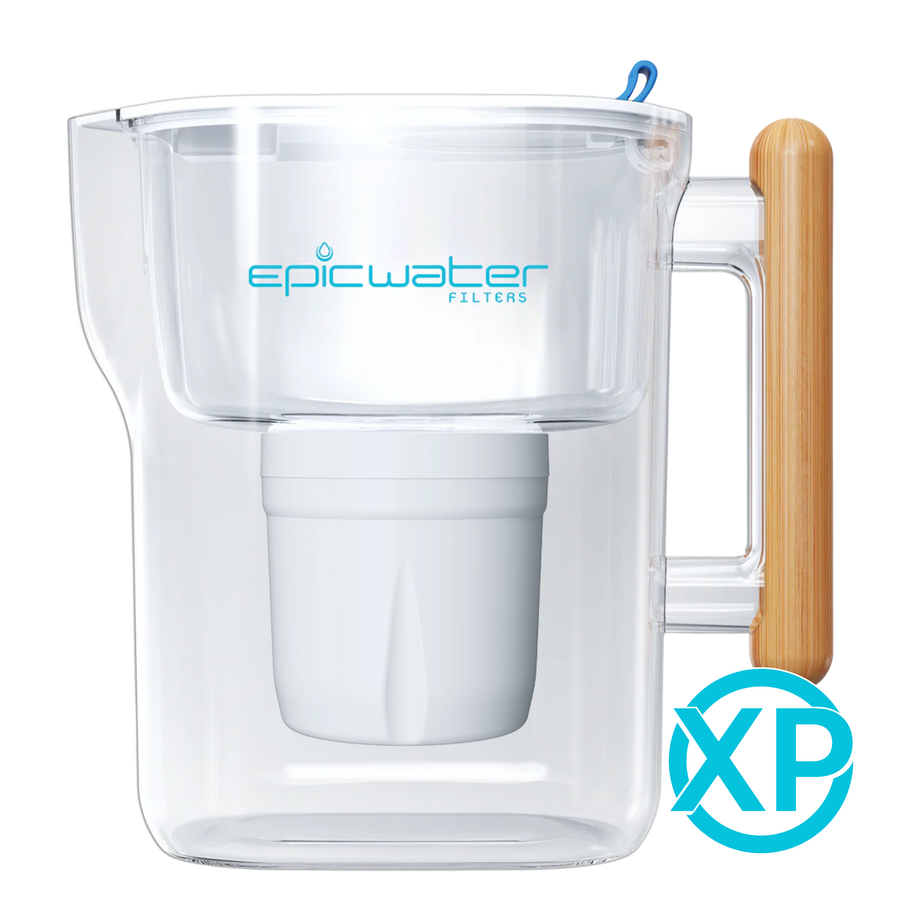
Epic’s independent laboratory testing on the Pure XP filter reports 99.4 percent reduction of trihalomethanes and 99.8 percent of haloacetic acids under test conditions.9 Those are independently tested results, not certifications. Pure XP’s official NSF listings cover Standard 42 for material safety and NSF/ANSI/CAN 372 for lead content.78 Keep the two apart.
Carbon is a consumable. Adsorption sites are finite, and a cartridge past its rated capacity stops performing long before it stops producing water. Pure XP is rated for 100 gallons, and gallons, not months is the number to track.
What a filter cannot do is fix the system. It does not move the running average, it does nothing about what you breathe in the shower, and it is no substitute for an official advisory. If a pitcher or dispenser fits your household, explore Epic’s pitchers, dispensers and bundles.
Questions about disinfection byproduct notices
Is water with a trihalomethane violation safe to drink?
Utilities issuing these notices generally state that the water remains usable and no alternative source is required, because the risk is cumulative rather than immediate. The effects named, including increased cancer risk, are tied to long term consumption above the standard. If you are pregnant or mixing formula, using bottled or filtered water and asking your physician is reasonable.15
Should I boil the water during a disinfection byproduct notice?
No. Boiling is for bacterial advisories. These compounds are volatile, so boiling moves them into the air and concentrates what remains in the pot. If you are heating water anyway, run the exhaust fan.5
Why did my utility wait months to tell me?
Compliance is a running annual average of the four most recent quarters at each monitoring location, so the violation does not exist until the fourth sample is averaged in. An exceedance is then a Tier 2 notice with up to 30 days to reach customers. The lag is built into the rule.34
What is the difference between TTHM and HAA5?
Two families of byproducts with separate limits. Total trihalomethanes are volatile and regulated at 0.080 mg/L. The five regulated haloacetic acids are not volatile and are regulated at 0.060 mg/L. Because HAA5 does not evaporate, ventilation advice applies to trihalomethanes only.35
Does a pitcher filter remove disinfection byproducts?
Granular activated carbon and reverse osmosis are the recognized technologies for reducing trihalomethanes at the tap. Epic’s independent testing on Pure XP reports 99.4 percent and 99.8 percent reduction of trihalomethanes and haloacetic acids. Replace the cartridge on rated capacity, not on taste.59
Sources & references
Reviewed October 2, 2026
-
WIS News 10 / Whitmire drinking water violates state standards ↗October 2, 2026. The notification timeline, the August 27 state alert, and the town’s response.
-
WIS News 10 / Town of Whitmire reports drinking water as contaminated ↗September 29, 2026. Four quarters of exceedance, the equipment causes, and the repair schedule.
-
EPA / Disinfectants and Disinfection Byproducts Rules plain English guide (PDF) ↗The 0.080 and 0.060 mg/L limits and how the locational running annual average is calculated.
-
EPA / Public Notification Rule ↗Tier 1, Tier 2 and Tier 3 categories and the 24 hour, 30 day and annual deadlines.
-
Massachusetts Department of Public Health / HAA5 and TTHM consumer factsheet (PDF) ↗Health effects, ventilation and shower guidance, bottled water advice, and treatment technologies.
-
EPA / Consumer Confidence Reports ↗Where to find your system’s annual report and the averages it publishes.
-
NSF / Official Standard 42 component listing ↗Pure XP listed for material safety requirements only.
-
NSF / Official Standard 372 listing ↗Lead content certification of the listed filter components.
-
Epic Water Filters / Testing documents ↗Independent laboratory reports behind the trihalomethane and haloacetic acid reduction figures.
-
Arizona’s Family / Goodyear notifies residents of drinking water violation months after issue began ↗May 2026. A utility director explaining why the annual average delays notification.
Notices differ by system and state. Follow the current notice from your own utility and your state drinking water program rather than any article. This piece describes disinfection byproduct notices as a category and is not advice about a specific water system. The treatment plant and kitchen tap photographs are generated editorial illustrations. The Pure XP image is an official product photograph.
Share:
Is Well Water Safe After Flooding? Stop, Disinfect, Then Test
Is Softened Water Safe to Drink? And Do You Still Need a Filter?