
A report published on October 13 found PFAS at 83 percent of the 1,602 river, lake and stream monitoring sites it examined.1 The reasonable next question is what filter your kitchen needs. The honest answer depends on what is in your water, not on which technology sounds strongest.
Two options dominate that search. Reverse osmosis installs under the sink and pushes water through a membrane. A carbon pitcher sits on the counter. They are not two versions of the same product: they remove different things and cost different amounts to run.
What the October report measured
The analysis, from Environment America Research & Policy Center, the U.S. PIRG Education Fund and Frontier Group, pooled surface water monitoring data from 2022 to 2024. PFAS turned up at 1,329 of 1,602 locations, and 114 of the 174 compounds tested were detected at least once.1
One detail matters before you shop. The analysis excluded records labeled as drinking water, so it describes rivers, lakes and streams, not treated water at your tap. Many of those waters are sources for public systems, so the finding matters, but a creek detection is not a measurement of your faucet. We covered that distinction in a separate piece.
PFOA and PFOS, the two PFAS with enforceable federal limits, are capped at 4.0 parts per trillion each, with compliance due by 2029.2 What the report cannot tell you is the number your decision turns on: what has been detected in the water delivered to your address. That lives in your annual water quality report.6

What reverse osmosis actually removes
A reverse osmosis membrane is strong on dissolved inorganic contaminants. Connecticut's health department lists dissolved sodium salts, ferrous iron, nitrate, lead, fluoride and uranium among them, along with some pesticides and some other organic chemicals.3
It is weaker where buyers assume it is strongest. The same guidance notes that reverse osmosis does not remove dissolved gases or most volatile and semi volatile organic chemicals, and that an RO unit alone is not recommended for treating bacteria and other microorganisms.3 Most systems add a sediment prefilter to protect the membrane and a carbon stage after it, and that carbon stage does the taste and odor work.3
Reverse osmosis is also point of use. It treats one tap, so a whole house problem needs a different device.3

What reverse osmosis costs to run
The figure most buyers never see is the drain ratio. EPA's WaterSense program says a standard point of use system sends five gallons or more down the drain per gallon of treated water. Labeled systems must hold that to 2.3 gallons or less and be independently certified against EPA criteria.4
If your home is on septic, that reject water has to go somewhere. Connecticut's guidance strongly recommends keeping RO discharge to a septic system below 30 gallons a day.3
Then there is upkeep. Membranes and filters get replaced on the manufacturer's schedule, and the guidance calls for testing treated and untreated water at a state certified lab after install and annually after.37 None of this makes reverse osmosis a bad choice. It makes it a choice worth making for a specific reason.
What a carbon pitcher does, and what it does not
A carbon block pitcher has no plumbing, no drain line and nothing to clear with a landlord. The trade is scope. Carbon works by adsorption, which suits many organic chemicals, chlorine taste and odor, and fine particles, and does little for dissolved minerals.
Certification and performance testing are two separate things. Pure XP and Nano XP are listed by NSF under Standard 42 for material safety and under NSF/ANSI/CAN 372 for lead content.89 Contaminant reduction is documented in independent testing: lead at 99.9 percent under the NSF/ANSI 53 protocol, PFOA and PFOS under the NSF P473 protocol, and over 99.9 percent of microplastics.10
Here is what a carbon pitcher will not do. It will not bring down nitrate, arsenic or fluoride, it will not lower total dissolved solids, and it is not a barrier against bacteria or viruses. The federal limits for nitrate, 10 milligrams per liter as nitrogen, and arsenic, 10 parts per billion, belong to a different decision for that reason.5 A nitrate warning and a boil water advisory both call for something other than a pitcher.
How to choose, in one pass
Start with the finding rather than the catalog. The contaminant decides the technology.
Nitrate, arsenic, fluoride or high dissolved solids: look at reverse osmosis.
These are dissolved inorganics, and a carbon pitcher is the wrong tool. Price in the drain ratio, the install and the retesting, then check the model's certified claim for the specific contaminant.34
Lead, chlorine taste, PFOA and PFOS, microplastics: a tested carbon filter is usually enough.
Match the documentation to your concern, read the method behind each figure, and confirm the filter was tested for the thing you care about. A water softener is its own question, covered here.
Find your water quality report
Find a certified drinking water lab
For an area level picture, Epic's What's in Your Water lookup shows contaminants reported near you. It is not a test of your own tap.
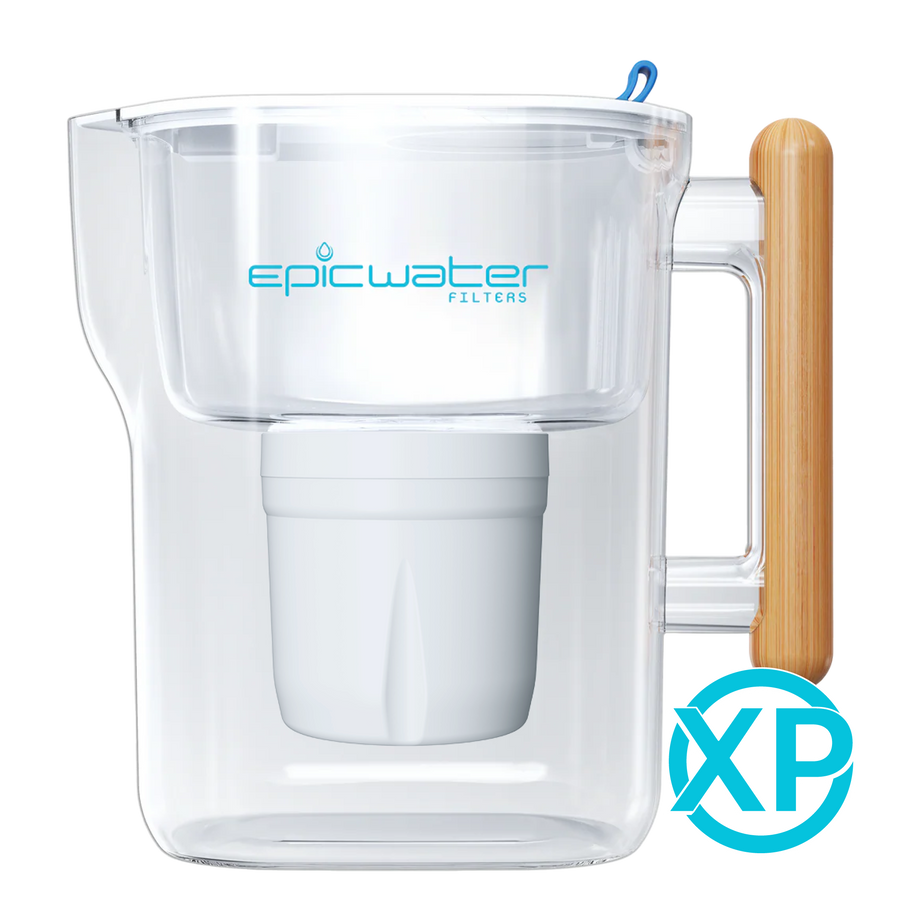
If a counter top filter fits the finding, explore Epic's pitchers, dispensers and bundles, and read the testing documents for that filter before relying on any single claim.
Questions about reverse osmosis and pitcher filters
Is reverse osmosis better than a pitcher filter?
Neither is better in the abstract. Reverse osmosis covers dissolved inorganics such as nitrate and fluoride that carbon does not touch. A pitcher needs no plumbing and wastes no water. The right answer is whichever matches your water report.
Does a pitcher filter remove PFAS?
It depends on the filter and on which PFAS. Epic's Pure XP and Nano XP cartridges are independently tested for PFOA and PFOS under the NSF P473 protocol. That is testing, not an NSF certification for contaminant reduction. Ultra short chain PFAS behave differently, so check the compound list for any filter.
How much water does reverse osmosis waste?
EPA's WaterSense program estimates five gallons or more to the drain per gallon of treated water on a standard point of use system. Labeled models must stay at or below 2.3 gallons. On septic, Connecticut's guidance recommends keeping discharge under 30 gallons a day.
Do I need reverse osmosis because of the new PFAS report?
Not on its own. The October analysis measured surface water and excluded records labeled as drinking water. Read your system's report first. If PFOA or PFOS are reported near or above the federal limit of 4.0 parts per trillion, that is when to compare treatment options.
Can I use a pitcher filter in a rental?
Yes, and that is often the practical reason to choose one. No installation, no drain connection, no permission needed. A renter cannot replace a lead service line, but can change what they pour from.
Is Pure XP NSF certified to reduce contaminants?
No, and the distinction matters. Pure XP is listed by NSF under Standard 42 for material safety and under NSF/ANSI/CAN 372 for lead content. Reduction performance is documented in separate independent testing.
Sources & references
Reviewed October 23, 2026
- Environment America Research & Policy Center, U.S. PIRG Education Fund and Frontier Group / PFAS found in America's lakes and streams, October 13, 2026 ↗The anchor analysis: 1,602 surface water monitoring locations, 2022 to 2024, with drinking water records excluded.
- EPA / Per- and polyfluoroalkyl substances in drinking water ↗Enforceable limits of 4.0 parts per trillion for PFOA and PFOS, with compliance required by 2029.
- Connecticut Department of Public Health / Reverse osmosis treatment of private drinking water systems (PDF) ↗What a membrane removes and does not remove, prefilter and post-filter stages, septic discharge and maintenance.
- EPA WaterSense / Point-of-use reverse osmosis systems fact sheet (PDF, November 2024) ↗Drain ratios for standard and labeled systems and the average annual water saving.
- EPA / National Primary Drinking Water Regulations ↗Federal limits for nitrate and arsenic, used here as the benchmark a carbon filter does not address.
- EPA / Consumer Confidence Reports ↗Where to find the annual water quality report for your own water system.
- EPA / Certified drinking water laboratories ↗State certification programs and laboratory contacts for testing at your tap.
- NSF / Official Standard 42 component listing ↗Epic cartridges listed for material safety requirements only.
- NSF / Official NSF/ANSI/CAN 372 listing ↗Lead content certification of the listed filter components.
- Epic Water Filters / Testing documents ↗Independent performance reports, data sheets and certification resources.
Treatment performance depends on the model, the contaminant and the test method. Reverse osmosis water use figures are EPA estimates for point of use systems, not a measurement of any one product. This article compares technologies, not brands. The pouring and under-sink photographs are generated editorial illustrations. The Pure XP image is an official product photograph.
Condividi:
Why your tap water is chlorinated, and what a filter is actually for