
The faint pool smell in a glass of cold tap water is the one part of water treatment you can detect without equipment. It is also the part most people want a filter to deal with. Both of those can be true at once, and the order matters.
Chlorine is not an afterthought in your water. Utilities in the United States first used it to kill germs in tap water in 1908, and a measured amount is deliberately left in the water so that it keeps working through the miles of pipe between the treatment plant and your kitchen.3
That leftover amount has a name, a legal floor and a legal ceiling. It is called the residual, and federal rules for surface water systems require at least 0.2 mg/L where treated water enters the distribution system, with the residual not undetectable in more than 5 percent of distribution samples in a month.5 At the top end, EPA sets a maximum residual disinfectant level of 4.0 mg/L for chlorine.4
What the chlorine in your glass is doing
Treating water at the plant is only half the job. Germs can enter from the source water or anywhere along the pipes, which is why the disinfectant is carried forward rather than stripped out at the plant.3 CDC states that chlorine or chloramine at levels up to 4 mg/L are considered safe in drinking water, the same ceiling EPA writes into the regulations.34
The residual is also a signal. Because the rule requires it to stay detectable throughout the system, routine sampling reports on the condition of the pipes, not just the water that left the plant.5
Most people smell chlorine well below the regulatory ceiling, and that smell shifts with the season and your distance from the plant. A stronger pool note in autumn usually says more about what is happening in the reservoir than about the dose.

What happens when the residual stops
The clearest recent illustration is not an American one. The Bronkhorstspruit treatment works outside Pretoria, South Africa, ran without chlorination from 24 September to 14 October 2026 after a chlorine supply dispute, and residents were not told the water was unchlorinated.12
Health authorities recorded 408 cases of acute gastrointestinal illness between 7 and 18 October in the affected region, most of them in children under four, with no deaths reported. Stool specimens returned norovirus, campylobacter and shigella, and water testing on 14 October found very high levels of E. coli and total coliforms.12
That is a notification failure as much as a chemistry one, and the American rules exist to make such a gap visible rather than silent. The everyday version here is far smaller: a main breaks, pressure drops, and the utility issues a precautionary boil advisory. West Columbia, South Carolina, issued one on 20 October 2026, telling customers to boil vigorously for one full minute.7 Those notices arrive in tiers, and the tier tells you how urgent it is.
Disinfection is a trade, not a free lunch
Chlorine reacts with naturally occurring organic material in water and forms byproducts, and EPA is explicit that those byproducts, consumed above the standard over many years, may raise health risks.6 So the regulations hold two risks at the same time: enough disinfectant to inactivate pathogens, and a cap on what the disinfectant creates.
The caps are specific: total trihalomethanes at 0.080 mg/L and five haloacetic acids at 0.060 mg/L, both as running annual averages.46 If your system goes over, you get a notice, and a byproduct violation notice is not the same as unsafe water today. Both the residual and the byproduct numbers appear in your annual water quality report.8

What a filter is actually for
The residual needs to survive the distribution system. It does not need to survive the last thirty seconds before you drink. A pitcher filter works at the glass, after the chlorine has finished the job it was dosed to do, which is why treating taste at the sink is a different decision from treating a whole house.
It is also why a filter is not a substitute for the residual. A carbon pitcher filter is not a microbiological barrier. It does not replace boiling during an advisory, and it is not designed to handle bacteria. When an advisory lifts, the right move is to flush the lines and replace the cartridge before you trust the pitcher again.
Read certification and performance separately. Pure XP and Nano XP are listed by NSF under Standard 42 for material safety and under NSF/ANSI/CAN 372 for lead content.910 Contaminant reduction, including chlorine taste and odor, sits in separate independent testing rather than in those listings: lead at 99.9 percent under the NSF/ANSI 53 protocol, and PFOA and PFOS under the NSF P473 protocol.11
In one case taking the chlorine out is the point. Chlorine and chloramine suppress the cultures that fermenting and canning depend on, so filtered water is the usual starting point.
Find your water quality report
Epic's What's in Your Water lookup can help you explore what has been reported near you. It is not a test of the water at your own tap.
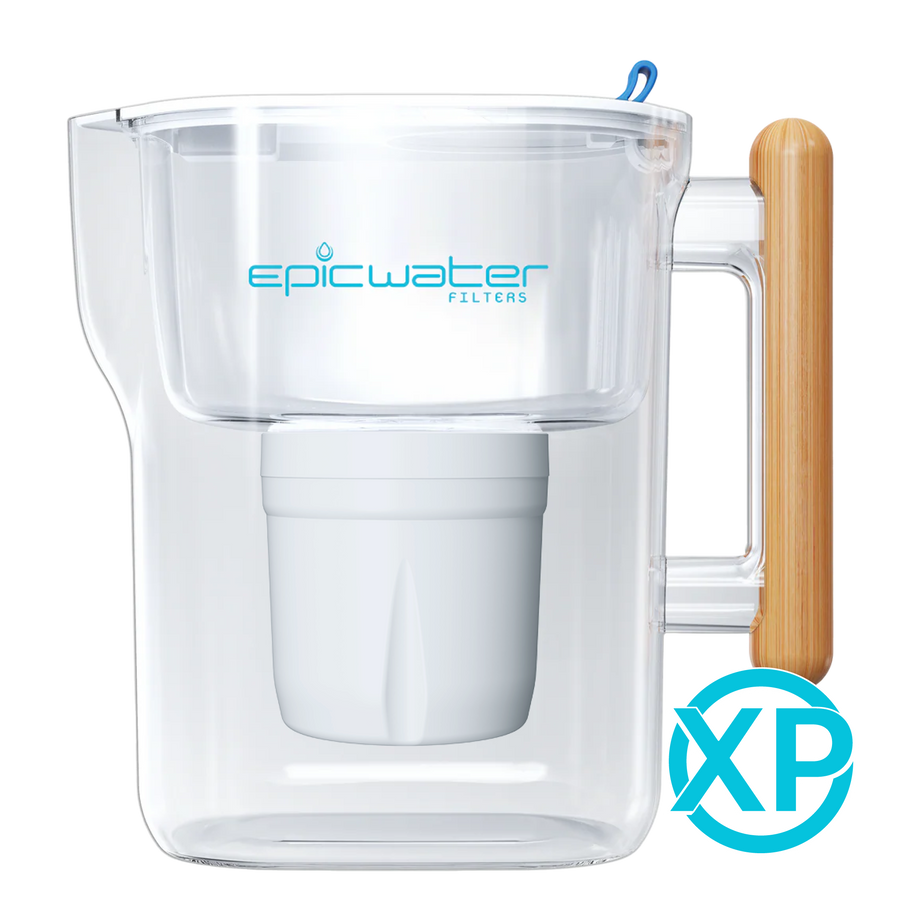
If a pitcher or dispenser fits how you drink water, explore Epic's pitchers, dispensers and bundles. Check the documentation for the exact filter before relying on any single reduction figure.11
Questions about chlorine in tap water
Why does my tap water smell like a swimming pool?
Because a disinfectant residual is meant to still be present at your tap. Most people detect it well under the regulatory ceiling of 4.0 mg/L, and the smell varies with the season and the source water.
Is the chlorine in tap water safe to drink?
CDC states that chlorine or chloramine at levels up to 4 mg/L are considered safe in drinking water, and EPA sets the maximum residual disinfectant level for chlorine at 4.0 mg/L. Separate standards limit the byproducts that disinfection forms.
Does a water filter remove chlorine?
Activated carbon is the usual approach to chlorine taste and odor. Epic documents that performance in independent testing, not in its NSF listings, which cover material safety under Standard 42 and lead content under NSF/ANSI/CAN 372.
If I filter out the chlorine, is my water less protected?
The residual protects water travelling through the distribution system and your plumbing, and filtering at the glass happens at the end of that journey. Filtered water keeps no residual, which is why a filled pitcher belongs in the refrigerator.
Can I use a filter instead of boiling during a boil water advisory?
No. A carbon pitcher filter is not a microbiological barrier and is not a substitute for an advisory. Follow the instruction your utility gives, which is typically a vigorous boil for at least one full minute.
How do I find out how much chlorine is in my water?
Your utility publishes an annual water quality report, also called a Consumer Confidence Report, which lists the disinfectant residual and the regulated byproducts. EPA maintains a lookup for finding yours.
Sources & references
Reviewed October 21, 2026
- GroundUp / Hundreds of children fall ill after Tshwane fails to chlorinate water (19 October 2026) ↗Dates of the chlorination gap, 408 recorded cases, and the pathogens found in stool specimens.
- Business Day / Hundreds of children fall ill after Tshwane fails to chlorinate water (20 October 2026) ↗The supply dispute, the 14 October E. coli and coliform results, and the plant reopening.
- CDC / About water disinfection with chlorine and chloramine ↗Why disinfectant is carried through the pipes, the 1908 start date, and the 4 mg/L statement.
- EPA / National Primary Drinking Water Regulations ↗Chlorine maximum residual disinfectant level of 4.0 mg/L, TTHM 0.080 mg/L and HAA5 0.060 mg/L.
- eCFR / 40 CFR 141.72 disinfection requirements ↗The 0.2 mg/L entry-point residual and the 5 percent undetectable limit in distribution samples.
- EPA / Stage 1 and Stage 2 Disinfectants and Disinfection Byproducts Rules ↗The balance between inactivating pathogens and limiting the byproducts disinfection creates.
- City of West Columbia, South Carolina / Boil water advisory issued 20 October 2026 ↗A routine main-break advisory and the one-minute vigorous boil instruction.
- EPA / Consumer Confidence Reports ↗Where to find your system's annual water quality report and its reported results.
- NSF / Official Standard 42 component listing ↗Epic filter cartridges listed for material safety requirements only.
- NSF / Official NSF/ANSI/CAN 372 lead content listing ↗Lead-content certification of the listed filter components.
- Epic Water Filters / Testing documents ↗Independent performance reports, data sheets and certification resources.
Disinfection practice, dose and taste vary by water system. This article describes chlorine and chloramine as a category and is not a statement about any one utility's current water. Follow any advisory your utility issues. The treatment basin and kitchen tap images are generated editorial illustrations, not photographs of specific facilities or demonstrations of water quality. The Pure XP image is an official product photograph.
Condividi:
TFA in Tap Water: The Ultra-Short PFAS Most Filters Miss
Reverse Osmosis or a Pitcher Filter: Which Do You Actually Need?