
A water softener and a drinking water filter get bought for the same reason and solve different problems. One looks after your pipes, water heater and glassware. The other looks after what you drink. Knowing which job you have already solved is the whole question.
Softening is an ion exchange. Water passes through resin beads loaded with sodium. Calcium and magnesium, the minerals that make water hard, stick to the resin, and sodium goes into the water in their place. Nothing is filtered out. Two minerals are traded for a third.1
That trade is why the question keeps coming up. For most households the sodium added is small next to what comes from food. For a few it is large enough to plan around, and those households deserve a number, not reassurance.23
What your softener is actually doing
Hardness is measured as calcium carbonate, in milligrams per liter or in grains per gallon, where one grain is about 17 mg/L. The sodium a softener adds scales with the hardness it strips. Virginia Tech's guidance puts the exchange at roughly 1 mg/L of sodium for every 2.1 mg/L of hardness removed.2
So the figure is not a constant. A moderately hard home lands on a moderate number; very hard well water lands much higher, from the same equipment working properly.
Softeners are also rarely plumbed to every tap. Minnesota's health department notes that toilets, hose bibs, basement sinks and other cold taps are often left unconnected, and that many homes soften only the hot water. Whether your kitchen cold tap runs through yours has a definite answer, worth settling first.1

Is softened water safe to drink
For most people, yes. EPA's drinking water advisory for sodium sets a guidance level of 20 mg/L, and says plainly it was developed for individuals restricted to 500 mg of sodium per day and should not be extrapolated to the general population. On taste grounds alone it suggests 30 to 60 mg/L.3
New York's health department uses two reference points: 20 mg/L for very low sodium diets and 270 mg/L for moderately restricted ones. Vermont applies 250 mg/L to sodium and chloride on aesthetic grounds. None of it is a pass or fail line.45
If someone in the house is on a sodium restriction, on dialysis, or being fed infant formula, that belongs with their clinician, with the measured figure in hand. A public system reports sodium in its annual report; a certified laboratory can measure it for a well.67
The part most people miss
Softening also changes how water behaves in your pipes. Minnesota's health department notes that corroded metal from plumbing ends up in drinking water, and can contribute to elevated lead and copper at the tap. In an older home that makes the lead question more relevant, not less. Vermont separately treats sodium above 100 mg/L and chloride above 25 mg/L as a sign a softener needs checking.15

What a softener does not touch
An ion exchange softener is built for calcium and magnesium. It is not a chlorine filter, a lead filter, a PFAS filter or a microplastics filter. Softened water still carries the chlorine taste you dislike, the disinfection byproducts your utility reports, and whatever plumbing adds downstream.1
Those are separate questions with separate documentation. If the taste bothers you, that is usually chlorine or chloramine, not hardness. If lead is the worry, hardness says nothing about it. Our guides to what a TDS reading means and why water tastes metallic cover that, and the lead service line guide covers your own pipe.
Find your water quality report ↗
Epic's What's in Your Water lookup gives area level background, not a test of your own tap. How to test your tap water covers the next step.
Choosing a filter to work alongside a softener
Match the filter to the finding, not to the softener. Pure XP is listed by NSF under Standard 42 for material safety and NSF/ANSI/CAN 372 for lead content. Contaminant reduction is documented separately in independent testing: lead at 99.9% under the NSF/ANSI 53 protocol, PFOA and PFOS under the NSF P473 protocol, and over 99.9% of microplastics.8910
The boundary runs both ways. A carbon block pitcher is not a softener. It is not designed to reduce sodium or hardness, so it will not stop scale on your kettle or lower the sodium a softener added. It is built for the job the softener was never doing.
If the sodium figure itself is the problem, the fix has to target sodium: a cold tap for drinking and cooking, softening only the hot lines, or a potassium chloride system, which Virginia Tech notes costs more.2
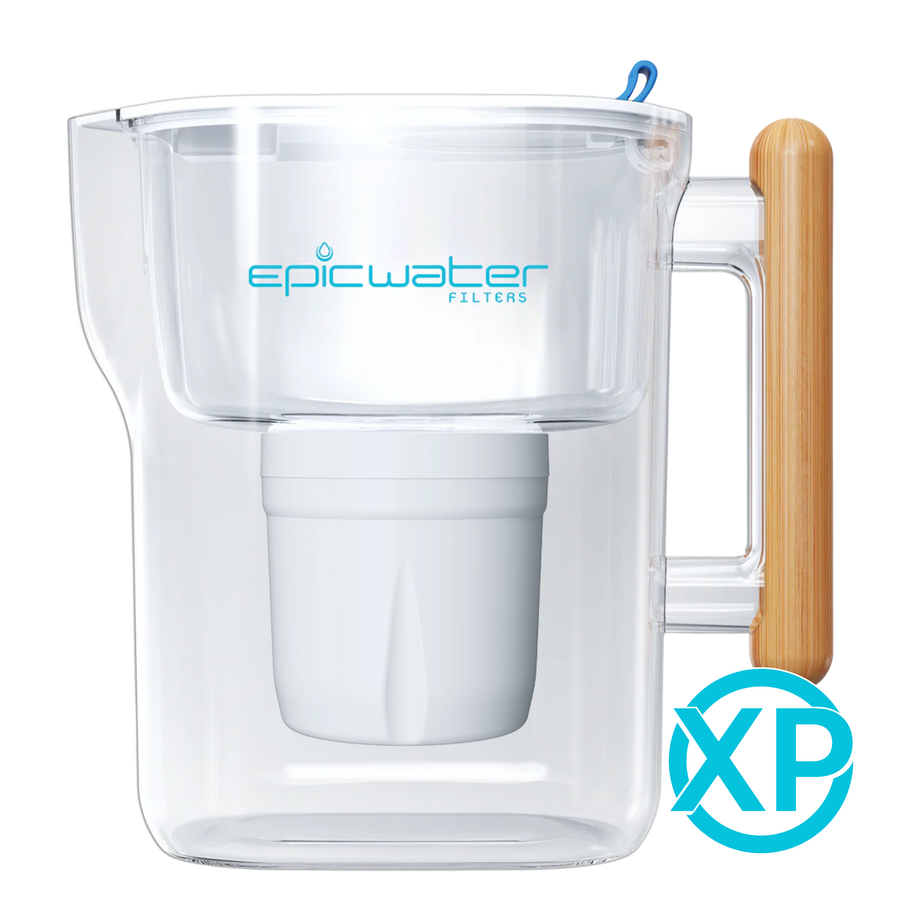
If a pitcher or dispenser fits, explore Epic's pitchers, dispensers, and bundles, and read the filter documentation first.
Questions about softened water
Is softened water safe to drink?
For most people it is. The sodium added scales with the hardness removed, and EPA's 20 mg/L guidance level was written for people restricted to 500 mg of sodium per day, not for everyone. If anyone has a sodium restriction, get the measured figure and discuss it with a clinician.
How much sodium does softening actually add?
Roughly 1 mg/L of sodium for every 2.1 mg/L of hardness removed, per Virginia Tech's guidance. Removing 200 mg/L of hardness, about 12 grains per gallon, lands near 95 mg/L. Your figure follows your starting hardness.
Do I still need a water filter if I have a softener?
If your concern is chlorine taste, lead, PFAS or microplastics, yes, because a softener is not designed for any of them. If scale was the only concern, the softener is the right tool.
Can softened water affect lead in my plumbing?
Indirectly. Minnesota's health department notes that corroded metal from plumbing ends up in drinking water and can contribute to elevated lead and copper, which makes a sample from your own tap more useful in an older home.
Should I use softened water for infant formula?
Ask your pediatrician, and bring the sodium number rather than a general answer. Many households keep an unsoftened cold tap for drinking and cooking, which takes softened water out of it.
Sources & references
Reviewed October 5, 2026
-
Minnesota Department of Health / Home water softening ↗Ion exchange, unsoftened taps, corrosion.
-
Virginia Tech / Sodium and chloride in household drinking water (PDF) ↗Sodium added per unit of hardness removed.
-
EPA / Drinking Water Advisory: sodium (PDF) ↗The 20 mg/L guidance level and taste range.
-
New York State Department of Health / Salt and drinking water ↗Reference points for restricted diets.
-
Vermont Department of Health / Sodium and chloride in drinking water ↗Thresholds suggesting a softener problem.
-
EPA / Consumer Confidence Reports ↗Find a public system's annual report.
-
EPA / Certified drinking-water laboratories ↗Certified laboratories by state.
-
NSF / Official Standard 42 component listing ↗Material safety requirements only.
-
NSF / Official Standard 372 listing ↗Lead content of listed components.
-
Epic Water Filters / Testing documents ↗Independent performance reports.
Hardness, sodium and plumbing differ house to house. Figures here are reference points, not a reading of your water. Sodium restriction is a clinician's question. The utility room and faucet images are generated illustrations.
Condividi:
What a Disinfection Byproduct Violation Notice Actually Means
Your Water Bill Is Up 62 Percent. Here Is What It Buys.