On Wednesday, October 7, 2026, Global Water Resources told its customers in Maricopa, Arizona, to boil their tap water. Two preliminary samples had come back indicating possible E. coli. The advisory was cancelled the following afternoon after repeat samples found none.12 In the hours between, a lot of households asked the same practical question: I own a filter pitcher, does that count?
The utility’s answer was carefully worded. Customers needed no special precautions for household filtration systems, and should keep following the manufacturer’s instructions.2 That is accurate, and easy to misread. It does not say a filter replaces boiling.
The CDC is more direct. Boil your tap water even if you filter it.3 Here is why that sentence exists.
What one positive sample sets in motion
Under the EPA’s Revised Total Coliform Rule, a positive result is not a verdict. It is a trigger. A routine total coliform positive obliges the system to collect repeat samples within 24 hours. A routine sample positive for E. coli adds an immediate call to the primacy agency on top of that same window.4
An E. coli maximum contaminant level violation is declared on the pattern of results rather than one number: certain combinations of positive routine and repeat samples, or a failure to collect the required repeats. A violation calls for Tier 1 public notice to every customer within 24 hours, and a boil advisory is the usual form that notice takes.4
That explains the shape of the Maricopa week. The utility said a false positive was possible, and the third-party repeat samples found no E. coli, so the advisory was cancelled at 2 p.m. the next day.12 The notice still went out, because the rule asks a utility to act on the possibility of contamination rather than wait for proof of it.

Our guide to Tier 1, Tier 2, and Tier 3 notices covers how utilities assign urgency.
What the CDC says about filtering during an advisory
The CDC’s advisory guidance asks people to bring tap water to a full rolling boil for one minute, or three minutes above 6,500 feet, then let it cool. It names the uses that need boiled or bottled water: drinking, cooking, infant formula, ice, and brushing teeth.3
It also addresses filters by name. Boil your tap water even if you filter it, the guidance says, including water that has been through a home filter or a pitcher that filters water.3 Filtering is a different step aimed at different things.
The EPA’s Tier 1 template, the text many utilities adapt, comes at it from the other side. It tells the public to boil for three minutes or use bottled water, and explains the finding in one line: E. coli are bacteria whose presence indicates that the water may be contaminated with human or animal wastes.5 Filtration is not offered as an option anywhere in it.

Why a drinking-water filter is not a microbiological barrier
The reason is mechanical. A carbon pitcher filter is built for what is dissolved in water or suspended as fine particles: chlorine taste and odor, certain metals, certain organic chemicals, microplastics. Those are the claims independent testing documents, filter by filter.8
Pathogen control is a different job with a heavier standard of proof. A point-of-use product claiming to handle bacteria, viruses, and protozoa is evaluated against a microbiological purifier protocol. Without that documentation for your exact filter, assume it is not rated for pathogens.
A word about our own line, because this is where filter marketing blurs. Pure XP and Nano XP are NSF certified to Standard 42 for material safety and to NSF/ANSI/CAN 372 for lead content.67 Those certifications cover the filter itself. They are not pathogen claims and not contaminant-reduction certifications. The reduction figures, including lead at 99.9 percent under the NSF/ANSI 53 protocol and PFOA and PFOS under the NSF P473 protocol, come from independent testing.8 None of it makes a pitcher a substitute for a boil notice.
A second reason: a filter in service while the water was suspect is itself suspect afterwards. That is why replacing the cartridge appears in the after-the-advisory playbook.
What to do, in order
While an advisory is in effect.
Use boiled or bottled water for the uses the CDC lists, and keep using it until your utility lifts the advisory, not until the story leaves the news.3 Our step-by-step on what to do during a boil water advisory covers ice makers, dishwashers, and pets.
After it is lifted.
Flush the cold lines, dump and remake the ice, and replace the cartridge that was in service while the advisory stood. Cloudy water in the first glass after a flush is usually dissolved air, which our two minute glass test explains.
In a normal week.
Read the annual water quality report for your system. It is free, and it names your source and the contaminants detected during the year.10
Find your water quality report ↗
For area-level background, Epic’s What’s in Your Water lookup shows what has been reported near you. It is not a test of your own tap. For that, use a laboratory certified for the tests you need,9 as our guide to testing your tap water walks through.
Find a certified drinking-water lab ↗
The routine job of a drinking-water filter is ordinary water: taste and odor, and the metals and chemicals its test reports cover. Match a filter to a finding, not to a general worry.8
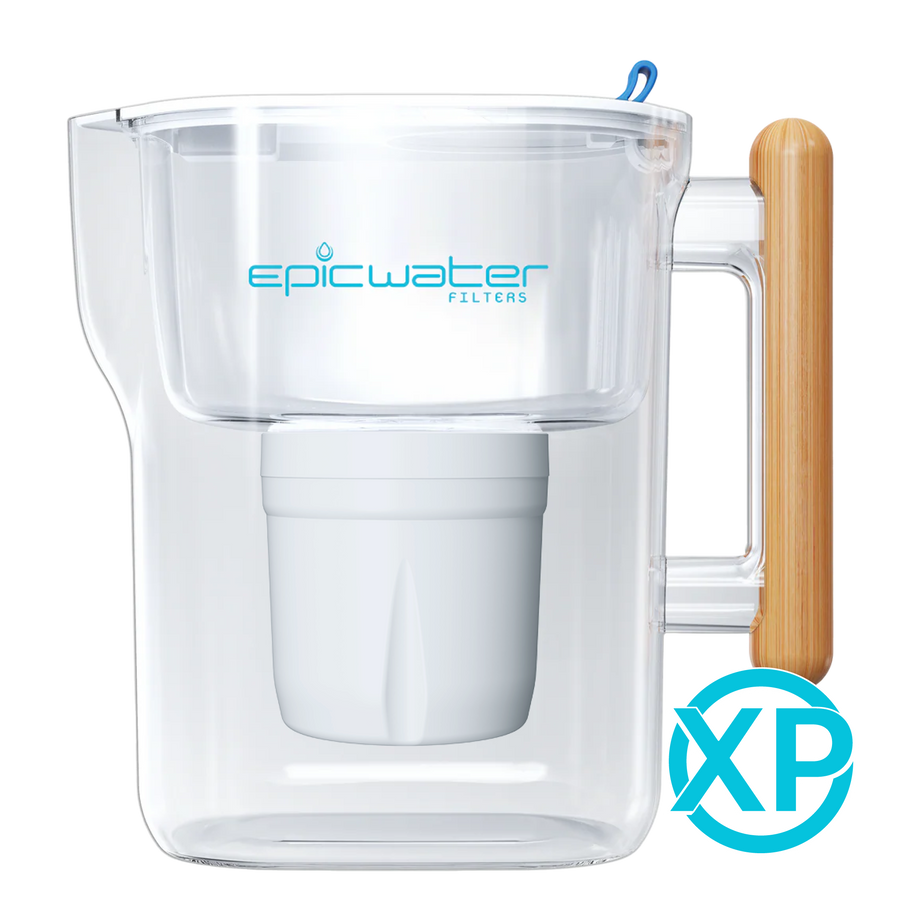
If a pitcher or dispenser fits your household, explore Epic’s pitchers, dispensers, and bundles, and read the documentation for the exact filter first. None of them is a microbiological purifier, and none replaces a boil notice.
Questions about filters and bacteria
Does a water filter remove bacteria?
Most drinking-water filters sold for taste and chemical reduction are not rated for bacteria. A product tested against a microbiological purifier protocol says so in its documentation. During an advisory the question is settled for you: the CDC says to boil your tap water even if you filter it.3
Can I drink filtered water during a boil water advisory?
No. Use boiled or bottled water for drinking, cooking, infant formula, ice, and brushing teeth until the advisory is lifted. Running suspect water through a filter first does not change that.35
My utility said filter users need no special precautions. What did that mean?
That you do not have to remove or bypass the filter, and should keep following its instructions. It is not a statement that filtered water is safe to drink unboiled while the advisory stands.2
Why issue an advisory if the follow-up tests found nothing?
Because the rule acts on the possibility of contamination. A positive routine sample triggers repeat sampling within 24 hours, and a violation requires Tier 1 notice to every customer within 24 hours. Utilities cannot wait for the repeats.4
Should I replace my filter cartridge after an advisory?
Replace the cartridge that was in service while the advisory stood, after flushing your cold lines.
What are Pure XP and Nano XP certified and tested to do?
Both are NSF certified to Standard 42 for material safety and to NSF/ANSI/CAN 372 for lead content. Reduction performance, such as lead under the NSF/ANSI 53 protocol and PFOA and PFOS under the NSF P473 protocol, is documented separately in independent testing. Neither is NSF certified for contaminant reduction, and neither is a microbiological purifier.678
Sources & references
Reviewed October 12, 2026
-
AZFamily / Maricopa boil water advisory canceled after negative E. coli tests ↗The October 7 issuance, the possible false positive, and the October 8 cancellation.
-
ABC15 Arizona / No E. coli found after Maricopa boil water advisory placed, lifted ↗Independent confirmation of the timeline and the utility’s guidance to filter owners.
-
CDC / Drinking water advisories: an overview ↗Rolling boil times, affected uses, and the instruction to boil even if you filter.
-
EPA / Addressing total coliform positive or E. coli positive sample results ↗Repeat sampling inside 24 hours, what counts as an E. coli violation, and Tier 1 timing.
-
EPA / Tier 1 E. coli boil water advisory notice template (PDF) ↗The public-notice language utilities adapt, including what an E. coli finding indicates.
-
NSF / Official Standard 42 listing ↗Epic filter certification for material safety requirements only.
-
NSF / Official NSF/ANSI/CAN 372 listing ↗Lead-content certification of the listed filter components.
-
Epic Water Filters / Testing documents ↗Independent performance reports, data sheets, and certification resources.
-
EPA / Certified drinking-water laboratories ↗State certification programs and laboratories for drinking-water analysis.
-
EPA / Consumer Confidence Reports ↗What the annual water quality report covers and how to find the one for your system.
Advisory instructions vary by utility and by the reason for the notice. Follow the notice your own system issued. This article discusses filtration and pathogens as a category and does not describe the performance of any particular competing product. The sample-bottle and boiling photographs are generated editorial illustrations. The Pure XP image is an official product photograph.
Aktie:
Is Tap Water Safe During Pregnancy? What to Check, in Order
PFAS Found in Your Local Creek. Is It in Your Tap Water?