

A state agency tested fish from a creek outside Philadelphia last week and told people not to eat them. Within a day the question in local threads had stopped being about fishing. It was whether the kitchen tap was safe.
Those are two measurements of two different things, and the honest answer to the second one is not in the fish report.1 It is in your own utility's records, and most of those are already public.
What Pennsylvania actually found
On October 7, Pennsylvania's Department of Environmental Protection and its Fish and Boat Commission issued a “Do Not Eat” advisory covering every fish species in the Wissahickon Creek basin, across Montgomery and Philadelphia counties.3 The trigger was PFOS, one of the PFAS compounds, found in fish tissue above the 0.04 parts per million level that prompts that advisory, with reported levels reaching roughly 0.057. The tissue came from sampling near Fort Washington State Park and included archived samples collected between 2013 and 2021.1
The Commission then canceled an October 15 trout stocking on a Philadelphia stretch, though officials said the stocked trout themselves likely carry no PFAS, and set a public meeting for November 5.1 The department has not identified the source, says there are no other public health concerns at present, and will keep monitoring.2
One detail explains why the story landed the way it did. The Wissahickon is also a drinking water source, feeding the supply for roughly one in four Philadelphians.2 A notice about fish read, to many households, like a notice about their tap. It was not one.

A fish is not a faucet
PFOS readily bioaccumulates in fish tissue.4 A fish is exposed continuously and does not clear the compound quickly, so what is present in the creek concentrates in the animal over years. Federal guidance for health assessors says PFOS can accumulate in edible tissues to levels that could be of human health concern, and warns that PFAS do not follow the bioaccumulation patterns of older advisory contaminants such as PCBs and mercury.5
Treated drinking water travels a different path: drawn from a source, run through a plant, piped to your house, and measured as a concentration in water at a sampling point. A fish result describes the creek and years of accumulation in an animal, not what the plant removed.
None of which makes a watershed finding irrelevant to your kitchen. If a creek carrying PFAS feeds a plant that serves your house, that is a sound reason to go and read the plant's own results. It is a reason to check, not a result.
How to find out what is in your tap

Your utility's annual report.
Every community water system publishes a Consumer Confidence Report listing what it detected and at what level.8 PFAS is new to that document: under the federal rule, systems must finish initial PFAS monitoring and begin reporting PFAS levels publicly in 2027, with any required reductions in place by 2029.6
Find your water quality report ↗
The national PFAS sampling already done.
You do not have to wait for 2027. EPA's fifth Unregulated Contaminant Monitoring Rule had systems sample for 29 PFAS compounds plus lithium between January 2023 and December 2025, and the final dataset arrived in August 2026, searchable by water system. Two caveats come from EPA itself: systems serving fewer than 3,300 people were sampled only if randomly selected, and the results do not indicate compliance or noncompliance.7
Search the UCMR 5 PFAS results ↗
On a private well, none of that covers you.
A private well has no utility behind it and no routine monitoring, so the only way to get a number is a state-certified laboratory. Our guide to testing your tap water covers what that involves. Epic's What's in Your Water lookup shows what has been reported nearby, which is background, not a test of your own tap.
What a filter can and cannot do
Start with what not to do. Minnesota's health department is direct: boiling will not remove PFAS. The same guidance names what does, when properly installed and maintained: granular activated carbon and reverse osmosis, with some ion exchange resins also effective. Softeners and iron filtration systems are not likely to.9 More on that mistake in what boiling does and does not remove.
“Properly maintained” is the load-bearing phrase. Carbon capacity is finite, and a cartridge past its rated life is not doing what its data sheet describes. If you already run one, check how often yours needs replacing first.
Certification and testing are two different documents.
Pure XP and Nano XP are listed by NSF under Standard 42 for material safety and under NSF/ANSI/CAN 372 for lead content.1011 Those cover material safety and lead-free limits. Neither is a contaminant-reduction certification, and we do not present them as one. PFAS reduction is documented in independent laboratory testing instead, so read the report for the exact filter before relying on any PFAS figure.12
Read Epic's testing documents ↗
And the limit worth saying out loud: a pitcher treats the water you pour through it, not every tap in the house, not the fish in the creek, and not the source. If you are pregnant or mixing formula, the order of the checks matters more than the hardware, which is why we wrote what to check during pregnancy, in order. If a notice does arrive, the tier printed on it tells you the schedule, not how alarmed to be.
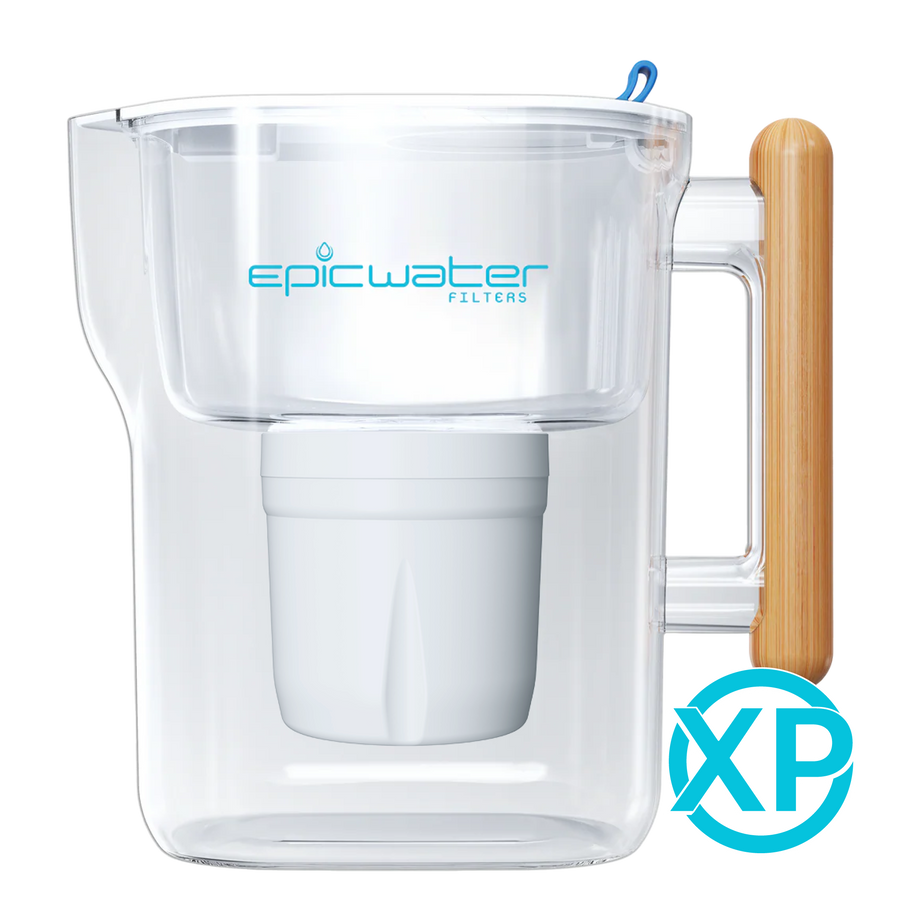
If a pitcher or dispenser fits how your household drinks water, explore Epic's pitchers, dispensers, and bundles. Read the documentation for the exact cartridge first.
Questions about PFAS findings near you
PFAS was found in a creek near me. Is it in my tap water?
Not necessarily, and a fish or surface water report cannot answer it. Treat it as a reason to check your own system: your utility's annual report and the UCMR 5 results, compared against the drinking water limit for that compound.
Why can a fish hold more PFAS than the water it swims in?
Because PFOS bioaccumulates. The fish is exposed continuously and does not clear the compound efficiently, so tissue concentrations build over years while the water stays comparatively low.
Can I compare the fish number to the drinking water limit?
No. Fish advisories are expressed in parts per million of tissue, drinking water limits in parts per trillion of water. They measure different media by different methods, so comparing or converting them produces a figure that does not mean anything.
Does boiling remove PFAS?
No. Minnesota's health department states that boiling will not remove PFAS. Boiling removes water and leaves dissolved compounds behind. It is the right response to a bacteriological advisory, not to a chemical one.
How do I find my own system's PFAS results today?
Use EPA's UCMR 5 data, the PFAS sampling systems did between January 2023 and December 2025. Note EPA's limits: small systems were sampled only if randomly selected, and the results do not establish compliance.
Is Pure XP certified to remove PFAS?
No. Pure XP and Nano XP hold NSF listings for Standard 42 material safety and NSF/ANSI/CAN 372 lead content. Neither is a contaminant-reduction certification. PFAS performance is addressed in separate independent laboratory testing, so read the report for the exact filter.
Sources & references
Reviewed October 14, 2026
-
The Philadelphia Inquirer / Do-not-eat advisory for Wissahickon fish, October 8, 2026 ↗PFOS levels, the 0.04 parts per million advisory trigger, archived 2013 to 2021 samples, and the canceled October 15 trout stocking.
-
WHYY / Anglers warned not to eat PFAS contaminated fish from the Wissahickon, October 9, 2026 ↗DEP sampling and monitoring, the unidentified source, and the creek as a drinking water source for about one in four Philadelphians.
-
CBS News Philadelphia / Do-not-eat advisory for all fish in the Wissahickon Creek basin, October 7, 2026 ↗The agencies involved and the geographic scope across Montgomery and Philadelphia counties.
-
Pennsylvania DEP / Neshaminy Creek fish advisory ↗The department's statement that PFOS readily bioaccumulates in fish tissue, from an earlier advisory in the same region.
-
ATSDR / Guidance for assessment of PFAS in fish (PDF) ↗Accumulation in edible tissue, and why PFAS patterns differ from PCBs and mercury.
-
EPA / PFAS national primary drinking water regulation ↗The 4.0 parts per trillion limits for PFOA and PFOS, the goal of zero, and the 2027 and 2029 deadlines.
-
EPA / Fifth Unregulated Contaminant Monitoring Rule ↗29 PFAS plus lithium sampled 2023 to 2025, the August 2026 final dataset, the Data Finder, and EPA's own caveats.
-
EPA / Consumer Confidence Reports ↗What your utility's annual water quality report contains and how to find yours.
-
Minnesota Department of Health / PFAS and home treatment of water ↗Boiling will not remove PFAS; which treatment classes do, and which are unlikely to.
-
NSF / Official Standard 42 component listing ↗Epic filter cartridges certified for material safety requirements only.
-
NSF / Official Standard 372 listing ↗Lead-content certification of the listed filter components.
-
Epic Water Filters / Testing documents ↗Independent performance reports, data sheets, and certification resources for each filter.
Fish consumption advisories are set by state agencies and change; check your state's current advisory before fishing. Drinking water results and limits are separate measurements from fish tissue results and are not interchangeable. Epic's NSF listings cover material safety and lead content, not contaminant reduction; reduction performance is addressed in independent testing, and the report for a specific filter governs. The creek and faucet images are generated editorial illustrations. The Pure XP image is an official product photograph.
Aktie:
Does a Water Filter Remove Bacteria? Boil It Anyway