

Does a Water Filter Remove Fluoride? A 2026 Guide
Few water topics generate more heat and less clarity than fluoride. In 2026 the debate has moved out of the abstract: states have passed bans, city councils are taking votes, and the EPA is rereading the science on an accelerated schedule. Meanwhile, the questions households actually need answered have not changed. How much fluoride is in your tap water right now, and does your filter change it? This guide covers both, calmly, with sources.
What changed in 2026
For decades, community water fluoridation was a settled default. About 7 in 10 Americans served by community water systems received fluoridated water, following a US Public Health Service recommended level of 0.7 milligrams per liter. That default is now being reargued in public, one jurisdiction at a time.
Utah became the first state to end community fluoridation in May 2025, and Florida followed in July 2025. Since the start of 2026, roughly 15 more states have introduced legislation to restrict or end the practice, according to the CareQuest Institute's policy tracking. The decisions are also intensely local: in the last week of August 2026 alone, a Wilmington, Ohio council committee proposed surveying residents on whether to keep fluoridating, while Ridgeland, Mississippi moved to restore fluoridation after a vote to discontinue it failed.

The federal government is moving too. The EPA launched an expedited review of fluoride's health effects under the Safe Drinking Water Act, released its preliminary assessment plan in January 2026, and published the protocol for its new fluoride human health toxicity assessment in August 2026. Under the normal schedule, that analysis would not have been due until 2030.
The numbers on both sides
Reasonable people land in different places on fluoride, and the honest version of this article shows both columns of the ledger.
- The caution column. The National Toxicology Program's 2024 monograph concluded, with moderate confidence, that fluoride exposures above 1.5 mg/L are associated with lower IQ in children. That is about twice the US recommended fluoridation level, and the monograph judged the data at 0.7 mg/L insufficient to draw a conclusion. In September 2024, a federal court found the evidence concerning enough to order the EPA to respond with a regulatory process, without banning fluoridation or finding harm at typical US levels.
- The benefit column. The American Dental Association credits fluoridation with roughly 25 percent fewer cavities in children and adults. A 2025 modeling study in JAMA Health Forum projected that a nationwide stop would mean about 25.4 million additional decayed teeth in children and adolescents within five years, concentrated among kids with the least access to dental care.
Levels sit at the center of the whole debate. The EPA's enforceable ceiling is 4.0 mg/L, a 1986 standard aimed at preventing known harms. The recommendation where systems choose to fluoridate is 0.7 mg/L. The NTP findings concern exposures above 1.5 mg/L. Keeping those three numbers straight makes almost every headline easier to read.
How much fluoride is in your water?

Here is the step most people skip: your own number is public information. If you are on a city system, your utility's annual water quality report lists the fluoride level actually measured in your water, whether it is added or naturally occurring. Some groundwater carries meaningful natural fluoride regardless of local policy, which is why a lookup beats an assumption. You can start with your zip code using our What's in Your Water tool, then confirm with the utility report itself.
On a private well, the report does not exist, so a state certified lab test is the reliable route. We would steer you away from home test strips for this question; fluoride at fractions of a milligram per liter is not something a color chart resolves well.
What filters actually do about fluoride
Now the product question, answered plainly. Fluoride is a dissolved ion, and the loose activated carbon granules inside most basic pitchers are not designed to capture it. That is why the honest industry answer to "does a water filter remove fluoride" has usually been no, followed by a pitch for reverse osmosis, activated alumina, or a distiller. Boiling, for the record, removes none of it and can slightly concentrate what remains as water evaporates.
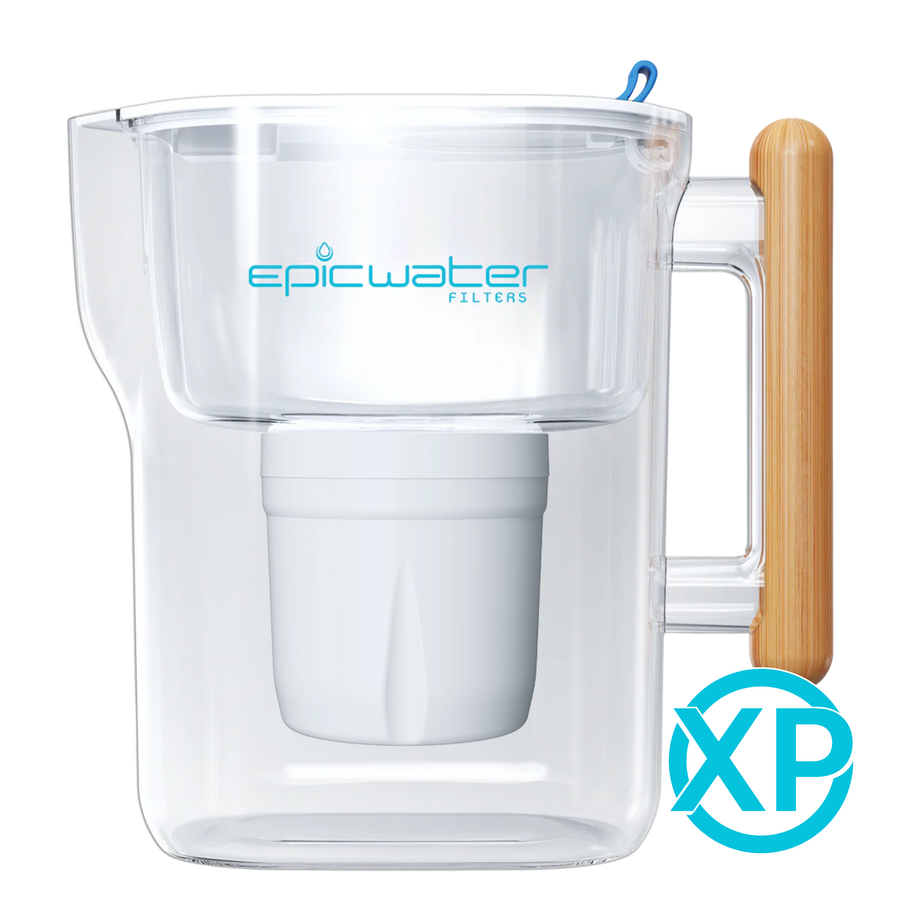
Our approach is to publish testing and let you match the filter to your decision. The Epic Pure XP uses a solid CoreXchange carbon fiber block, and an independent laboratory ran it under the NSF/ANSI 53 test protocol at 1.93 mg/L influent, measuring 99.2 percent fluoride reduction. To be precise about language: Pure XP is NSF certified to NSF/ANSI 42 and NSF/ANSI/CAN 372, which cover material safety and lead free components. The fluoride number is an independently tested claim, not an NSF certification, and the data sheet is published so you can check it.
If your household lands on the other side of the debate, that is a legitimate answer too. Our Nano XP was designed to maintain fluoride while focusing on concerns like microplastics and microbiological contaminants, so choosing to filter does not have to mean giving up fluoride. Whichever direction you pick, replace cartridges on schedule; tested reduction percentages describe a filter within its rated life, and Pure XP is rated for 100 gallons.
The bottom line
The fluoride question is being decided in city council chambers, state legislatures, and a federal review that is still underway. You do not have to wait for any of them. Look up the level in your own water, talk with your dentist or pediatrician about your household, and if you change anything, choose equipment with published data rather than confident vibes. The debate is loud. Your decision can be quiet.
Aktie:
Your Boil Water Advisory Just Lifted. Now What?
The Best Water for Coffee: The 98% of the Cup Most People Skip