
A study announced in mid-October put a number on a chemical most filter shoppers have never heard of. Researchers at the New Jersey Institute of Technology reported an ultra-short-chain PFAS called trifluoroacetic acid, or TFA, in 64 of 70 New Jersey tap water samples.1 The useful question is not whether that sounds alarming. It is whether the filter on your counter was ever tested for it.
PFAS is not one chemical but a family of thousands, and they are not all the same size. TFA is among the smallest, a two-carbon acid that dissolves readily and travels easily in water. That size is the whole story for treatment: the properties that let filter media hold PFOA and PFOS work far less well on a molecule this small.15
The work, published in Environmental Science and Technology Letters, covered 113 samples: 70 tap water samples from all 21 New Jersey counties and 43 bottled beverages. Of the five ultra-short-chain compounds screened, TFA turned up most often.123
What the study actually measured
Among tap samples with a detection, the median was 352 nanograms per liter and the highest single result 1,360. Every county in the state had at least one detection.3

For scale, the federal limit for PFOA and for PFOS is 4 nanograms per liter each.4 TFA has no federal limit, so that comparison describes magnitude only. A larger number for a different chemical with a different toxicity profile does not translate into a proportionally larger concern.
The bottled beverages told a sharper story. The highest result reached 94,100 nanograms per liter, in certain electrolyte waters and sports drinks, and the 12 formulated beverages averaged roughly 52 times the 31 plain bottled waters.3 A bottle is not automatically the cleaner option.
Why TFA is harder to treat
The study’s lead author put it plainly: TFA does not bind strongly to many of the filter materials that capture traditional PFAS. Granular activated carbon and ion-exchange resins, the workhorses of PFAS treatment at utility and household scale, are generally less effective against it.13
The reason is physical rather than mysterious. A very small, very water-soluble acid stays dissolved and keeps moving. The research literature describes exactly that combination of persistence and mobility through the water cycle, which is also why TFA is found widely once anyone looks.5
The practical consequence is the part marketing copy usually skips. A filter documented to reduce PFOA and PFOS is not thereby documented to reduce TFA. Different molecules, different methods, different analyte lists. Performance travels only as far as the test behind it.
What is regulated, and what is not
The 2024 federal PFAS rule set enforceable limits for six substances: 4 nanograms per liter each for PFOA and PFOS, 10 for PFHxS, PFNA, and GenX chemicals, plus a hazard index for mixtures. Systems monitor by 2027 and act on exceedances by 2029. A May 2026 proposal would keep PFOA and PFOS with an extension to 2031 and rescind the other four.4

TFA appears nowhere in that rule. There is no federal limit, and it sits outside the analyte lists used in routine PFAS monitoring, which is why the New Jersey team needed a specialized laboratory method to look for it at all.14 You will not find it in your utility’s annual Consumer Confidence Report. That absence reflects what is required to be measured, not a finding of zero.6
It is the distinction that separates a watershed sample from a tap sample. Our pieces on PFAS in a local creek versus your tap and on what Tier 1, 2, and 3 notices mean cover them in more detail.
What a filter can and cannot do here
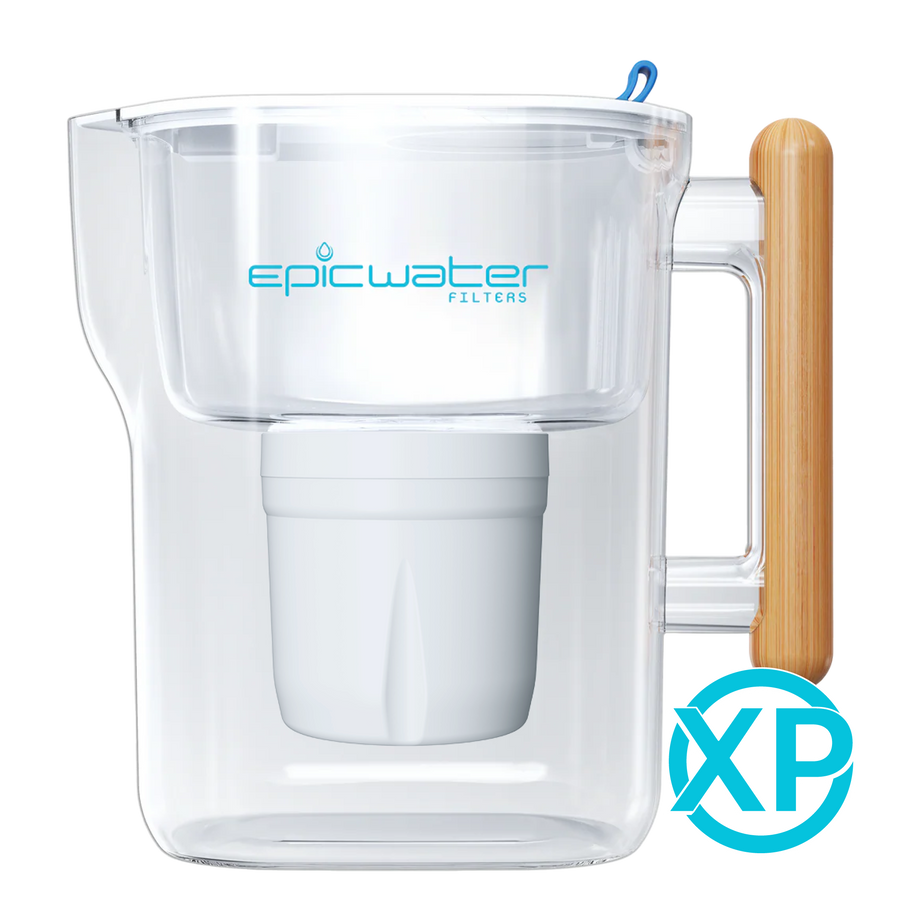
Epic’s Pure XP and Nano XP cartridges are listed by NSF under Standard 42 for material safety and under NSF/ANSI/CAN 372 for lead content.78 Those listings say the filter adds nothing harmful to your water. They are not contaminant-reduction certifications, and we do not present them as such.
Reduction performance is documented separately in independent testing: lead by 99.9 percent under the NSF/ANSI 53 protocol, PFOA and PFOS under the NSF P473 protocol, and over 99.9 percent of microplastics.9 Each of those results names the substance it was measured against. TFA is not among them.
So the honest answer is no. We are not aware of any pitcher filter, ours included, with documented TFA reduction, and the treatment research suggests household carbon and ion exchange are the wrong tools for this molecule.15 Ask anyone claiming otherwise for the test report.
That does not make a filter pointless; it makes it specific. Chlorine taste, lead from plumbing, microplastics, and the regulated PFAS are real concerns with documented answers. One unregulated compound does not erase them, and it is no reason to switch to bottled water, which fared worse here.3
For reported contaminants in your area, Epic’s What’s in Your Water lookup is a starting point, though it reports area-level data rather than a test of your tap. Our guides to testing your tap water and to what to check first if you are pregnant follow the same order of operations.
If a pitcher or dispenser suits your household, explore Epic’s pitchers, dispensers, and bundles, and read the documentation for the exact filter before relying on any single claim.
Questions about TFA in drinking water
What is TFA?
Trifluoroacetic acid is an ultra-short-chain PFAS: a very small, very water-soluble member of the same family as PFOA and PFOS. Its size makes it mobile, persistent, and hard to capture.
Was TFA found in my tap water?
The study sampled New Jersey, so it cannot tell you what is at your tap, and your annual report will not address it because TFA is not part of required monitoring.
Does a water filter remove TFA?
Not in any documented way we are aware of, our own filters included. Carbon and ion-exchange media are generally less effective against TFA than against longer-chain PFAS. Verify any claim to the contrary against a test report.
Is bottled water the safer choice instead?
This study points the other way. TFA turned up in about four of five bottled beverages tested, and the formulated drinks averaged roughly 52 times the plain bottled waters.
How concerned should I be?
There is no federal limit for TFA, and its health significance at the reported levels is still an open research question. That is a reason to follow the science, not a reason to stop drinking tap water.
What should I actually do with this information?
Read your Consumer Confidence Report for the regulated contaminants, ask your utility about ultra-short-chain PFAS, and use a state-certified laboratory for numbers from your own tap. Then match a filter to the concerns that have documented answers.
What are Pure XP and Nano XP certified and tested to do?
Both are listed by NSF under Standard 42 for material safety and NSF/ANSI/CAN 372 for lead content. Reduction performance, including lead, PFOA and PFOS, and microplastics, is documented separately in independent testing.
Sources & references
Reviewed October 19, 2026
- New Jersey Institute of Technology / Study announcement, October 13, 2026 ↗Detection counts, the five compounds screened, and researcher comments on filter media.
- Environmental Science and Technology Letters / Occurrence of Ultra-Short Chain PFASs in Bottled Beverages and New Jersey Tap Water ↗The peer-reviewed study: Gu, Chitthaluri, Etsiwah, Pandey, and Venkatesan, volume 13, issue 10, page 1418.
- EurekAlert / NJIT release with reported concentrations ↗Median and maximum tap figures, bottled beverage results, and the beverage comparison.
- US EPA / PFAS in drinking water ↗The 2024 limits, the 2027 and 2029 milestones, and the May 2026 proposed revisions.
- ACS ES&T Water / Trifluoroacetic acid: an ultra-short PFAS review ↗Background on TFA persistence, mobility, and treatment difficulty.
- US EPA / Consumer Confidence Reports ↗How to find the annual water quality report for a public water system.
- NSF / Official Standard 42 component listing ↗Epic cartridge certification for material safety requirements only.
- NSF / Official Standard 372 listing ↗Lead-content certification of the listed filter components.
- Epic Water Filters / Testing documents ↗Independent performance reports, data sheets, and certification resources.
- US EPA / Certified drinking water laboratories ↗State certification programs and laboratories for drinking water analysis.
Nanograms per liter are the same units as parts per trillion. The New Jersey figures describe the samples in that study, not any other state or household. TFA has no federal drinking water limit, and this article claims no reduction performance for any filter against it. The treatment plant and kitchen tap images are generated editorial illustrations; the Pure XP image is an official product photograph.
Aktie:
PFAS Found in Your Local Creek. Is It in Your Tap Water?