
Pregnancy is when a lot of people look properly at their tap for the first time. The honest answer is not yes or no. It is an order of operations: read what your water system already reports, deal with the two contaminants where your own home is the variable, and take anything unresolved to your prenatal care provider.
Across most of the US, drinking water is treated and monitored against enforceable federal limits.2 Those limits apply to the water system, not to your kitchen sink. A utility can meet every standard at the plant while the water arriving at one house picks something up on the way. That gap, not the contaminant in the news, is where the useful answer lives.
Pregnancy also narrows the list worth your attention. Lead can cross the placental barrier, and EPA lists reduced growth of the fetus and premature birth among its effects.1 Nitrate above the federal limit is specifically dangerous to infants under six months.2 Most of the rest is handled upstream of you and reported once a year.
Start with the report you already have
Community water systems publish an annual water quality report, also called a consumer confidence report. It lists what was detected over the year and the limit each result is measured against.
Benchmarks worth knowing: the lead action level is 0.015 mg/L today and drops to 0.010 mg/L on November 1, 2027; nitrate (as nitrogen) 10 mg/L; arsenic 0.010 mg/L; total trihalomethanes 0.080 mg/L and the five haloacetic acids 0.060 mg/L.2 PFOA and PFOS each carry an enforceable level of 4.0 parts per trillion under the 2024 federal rule.3
Find your water quality report
A system figure is not a measurement of your tap. For area-level background, try Epic’s What’s in Your Water lookup. Neither tests your own plumbing, the part a report cannot see.

For a measurement rather than a report, use a laboratory certified for drinking water testing. Skip strips and mail-in water scores: the sample is the weak link, as we covered in our piece on home test kits.
On a private well, the schedule is yours to set
A private well gets no routine utility reporting. EPA advises annual testing for total coliform bacteria, nitrates, total dissolved solids and pH, and more often when someone in the house is pregnant or nursing, through a state-certified lab.5
The two where your own home is the variable
Lead does not come from the river. It comes from the pipe between the street and the house, brass fittings and pre-1986 solder, which is why two homes on one block can differ. If you do not know what your service line is made of, start with our guide on identifying a lead service line.
Two habits matter more than any purchase: use only cold water for drinking, cooking and making baby formula, and flush the tap after the water has sat.1 Hot water pulls more metal from plumbing, which is why the kettle should be filled from the cold tap. Boiling does not remove lead.1

PFAS, and what the 2026 rules actually say
The 2024 federal rule requires systems to complete initial PFAS monitoring by 2027 and to comply by 2029.3 On May 18, 2026, EPA announced two proposals: one keeping the PFOA and PFOS limits while allowing systems two more years, to 2031, and one rescinding the limits for PFHxS, PFNA, GenX and the hazard index mixture.3 Both are proposals, not final rules: the two best-known limits stand, and the compliance date may move.
A 2025 study in the Proceedings of the National Academy of Sciences compared 11,539 New Hampshire births by whether the household well sat downgradient or upgradient of a PFAS-contaminated site. Low birthweight was 43 percent higher downgradient, and average birthweight about 50 grams lower.4 Groundwater flow was modeled from topography, and the sample is one state.
Disinfection byproducts are the quieter item on the same page, reported as running annual averages. If a notice lands in your mailbox, our explainer unpacks the arithmetic.
What a filter changes, and what it does not
A pitcher is the one change you can make this week without touching the plumbing, and it is narrower than the marketing suggests.
Epic’s Pure XP filter is NSF certified to NSF/ANSI Standard 42 for material safety and to NSF/ANSI/CAN 372 for lead content.67 Its contaminant-reduction figures come from independent laboratory testing rather than certification: 99.9 percent of lead under the NSF/ANSI 53 protocol, PFOA and PFOS under the NSF P473 protocol, and over 99.9 percent of microplastics. EPA advises choosing a filter certified to remove lead, and not running hot water through it.1
What it will not do. It is not built for nitrate or arsenic, and it is not a microbiological purifier, so it cannot stand in for boiling during an advisory. Those arrive without warning: on October 7, 2026 Georgia’s Jackson County Water and Sewerage Authority put customers on a precautionary boil water advisory after pump failures, with lab results still pending.8 If that happens where you live, follow the utility, then read our guide on what to do once an advisory lifts.
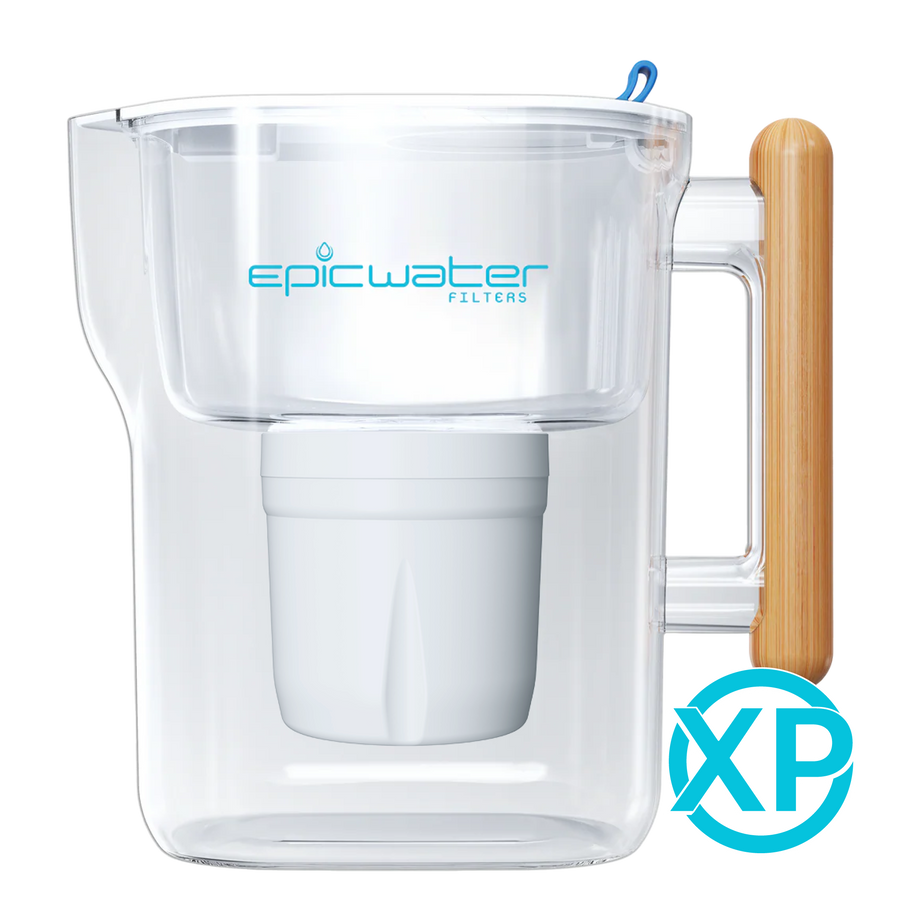
If a pitcher or dispenser fits how your kitchen works, explore Epic’s pitchers, dispensers and bundles. Replace the cartridge on schedule: past its rated life it is no longer performing to the data sheet.
Questions people ask during pregnancy
Is tap water safe to drink during pregnancy?
In a system meeting federal standards, tap water is generally considered safe to drink. The qualifiers are local: lead from your plumbing, nitrate on a well, and any active advisory. Read your annual report, then raise what is unresolved with your provider.
Does boiling make the water safer while pregnant?
Boiling handles bacteria, viruses and parasites. It does not remove lead, and it concentrates nitrate. Boil when your utility says to, not as a general precaution.
What about hot tap water for tea or cooking?
Use the cold tap and heat it yourself. EPA advises cold water only for drinking, cooking and making baby formula, because hot water held in plumbing picks up more metal.
Which contaminants should I ask my doctor about?
Lead and nitrate have the clearest pregnancy-specific guidance; PFAS has the most active research. Bring the reported values, not just the names: the number against the limit is what makes the conversation useful.
Do I need a different filter once the baby arrives?
Not necessarily, but the stakes shift: formula is mixed with a lot of water relative to body weight, so the cold-water and lead precautions matter more.
Sources & references
Reviewed October 9, 2026
- EPA / Lead in drinking water ↗Placental transfer, reduced fetal growth and premature birth, cold-water and flushing guidance, and filter advice.
- EPA / National Primary Drinking Water Regulations ↗Enforceable limits and listed health effects for lead, nitrate, arsenic, trihalomethanes and haloacetic acids.
- EPA / PFAS under the Safe Drinking Water Act ↗The 4.0 ppt levels for PFOA and PFOS, the monitoring and compliance timeline, and the May 2026 proposals.
- Baluja et al. / PNAS, 2025 ↗Birth outcomes for 11,539 New Hampshire births by well position relative to PFAS-contaminated sites.
- EPA / Protect your home’s water ↗Annual well testing, more frequent testing when someone is pregnant or nursing, and certified laboratories.
- NSF / Official Standard 42 component listing ↗Pure XP certification for material safety requirements only.
- NSF / Official Standard 372 listing ↗Lead-content certification of the listed filter components.
- Atlanta News First / Jackson County advisory, October 7, 2026 ↗A precautionary advisory issued after pump failures, with lab results pending.
Regulatory limits apply to water systems, not individual taps, and benchmarks change. Epic’s NSF certifications cover material safety under Standard 42 and lead content under NSF/ANSI/CAN 372; contaminant-reduction figures are from independent laboratory testing, not NSF certification. General information, not medical advice.
Share:
Your Water Bill Is Up 62 Percent. Here Is What It Buys.
Does a Water Filter Remove Bacteria? Boil It Anyway