
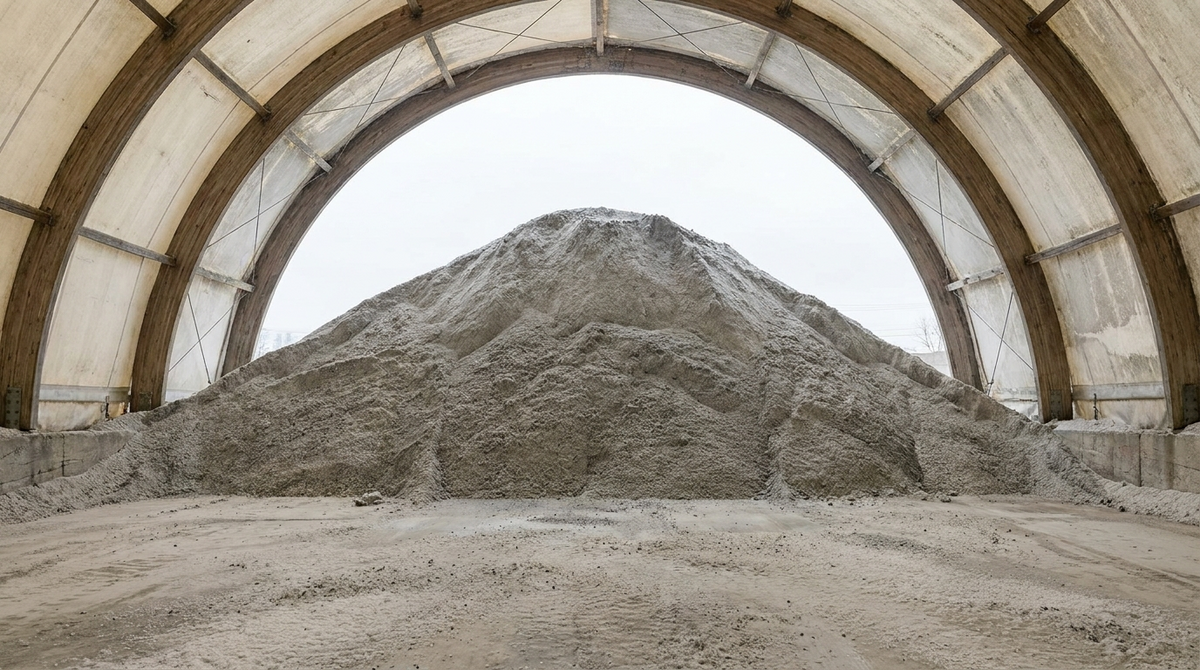
Across the snow belt, municipal salt sheds are already full. That salt will do its job on the roads. Then it goes somewhere: the water your utility treats, or the aquifer under your well.
Chloride behaves differently from most contaminants people read about. It does not break down, settle out, or get treated away in a conventional plant. It dissolves and accumulates over years. One local group puts the scale in kitchen terms: a tablespoon of salt can permanently contaminate roughly five gallons of water.1
Where the salt actually goes
Monitoring picks chloride up year round, not just during storms. The Ecology Action Center, a nonprofit serving McLean County, Illinois, has sampled local waterways for about three years and called the findings alarming, partly because chloride stayed elevated in spring and summer, when nobody is salting. Local levels have not crossed federal thresholds, but the baseline has moved.1
The pattern is not local. U.S. Geological Survey modeling across the Chesapeake Bay watershed found roughly two thirds of freshwater stream reaches carrying salinity above natural background, with the saltiest areas expanding over fifteen years alongside impervious cover.2
Much of that salt is not applied by highway crews. Private lots, sidewalks, and driveways are a large and routinely over-salted share. A 12 ounce coffee mug of salt is enough for an average 500 square foot driveway.1

The taste you notice, and the number behind it
EPA sets a secondary standard for chloride of 250 mg/L and 500 mg/L for total dissolved solids. Secondary standards are non-enforceable guidelines for aesthetic effects: taste, color, and odor. The chloride figure is roughly where water starts to taste salty, which is why taste is usually the first signal.3
Sodium has no federal health-based limit. EPA does recommend 20 mg/L for people on a physician-prescribed no-salt diet, and most dietary sodium comes from food rather than the tap.4
Background matters more than the standard. In undeveloped areas sodium is typically below 20 to 30 mg/L. A reading well above that points to a human source: road salt, softener discharge, or septic systems. You can be nowhere near 250 mg/L and still be reading a clear signal.4
One caveat before blaming the road: a softener adds sodium by design, so rule it out first. See is softened water safe to drink.
The part that matters more than taste
Chloride also does something you cannot taste: it makes water more aggressive toward metal plumbing. Two measures describe this, the chloride-to-sulfate mass ratio and the Larson Ratio. Both indicate how corrosive water is likely to be inside a distribution system and a house.6
A USGS analysis of rivers across the lower 48 found chloride and both ratios rising between 1992 and 2012. Nationally the increase was slight; at urban sites it was much larger, with median values above the levels associated with corrosion in distribution systems, and the link was strongest in snowy regions. The probability of a lead action level exceedance at a water facility rose along with the chloride-to-sulfate mass ratio in its raw surface water.6
Read that carefully: it is an association across many systems, not a prediction about your tap. But the mechanism is familiar. Lead does not come from the reservoir. It comes from the service line, solder, and fixtures between the main and your glass, and water chemistry decides how readily they give it up. If you have not checked, whether you have a lead service line is a more useful question than the chloride number. A new metallic edge to the taste is worth reading about too, in why your tap water tastes metallic.

If you are on a private well
A private well comes with no annual report and nobody tracking the trend. The exposed case is a shallow well downgradient of a salted road or salt storage yard. Your local health department is the first call.7
New Hampshire's drinking water program recommends a standard analysis, including sodium and chloride, every three to five years for private wells. Take a baseline before the season, so a later result has something to compare against.4 If your well has been through high water this year, the post-flood protocol comes first.
Find your water quality report
Epic's What's in Your Water lookup shows what has been reported near you, but it is not a test of your tap.
What a filter can and cannot do here
The honest part first. Sodium and chloride are dissolved ions. A carbon pitcher filter is not a demineralizer and is not designed to reduce them. Reverse osmosis, distillation, and deionization remove dissolved salts, and state guidance points to point-of-use reverse osmosis certified to NSF/ANSI 58.4 If that is your situation, reverse osmosis or a pitcher filter walks through the trade-offs.
Where a pitcher earns its place is the downstream problem: the metals corrosive water pulls out of your own plumbing. Pure XP is independently tested to reduce lead by 99.9% under the NSF/ANSI 53 protocol, and over 99.9% of microplastics.8
The certification scope, plainly: Pure XP and Nano XP are listed by NSF under Standard 42 for material safety and NSF/ANSI/CAN 372 for lead content. Those listings cover the filter's own materials, not certified contaminant reduction. The reduction figures come from independent testing.910
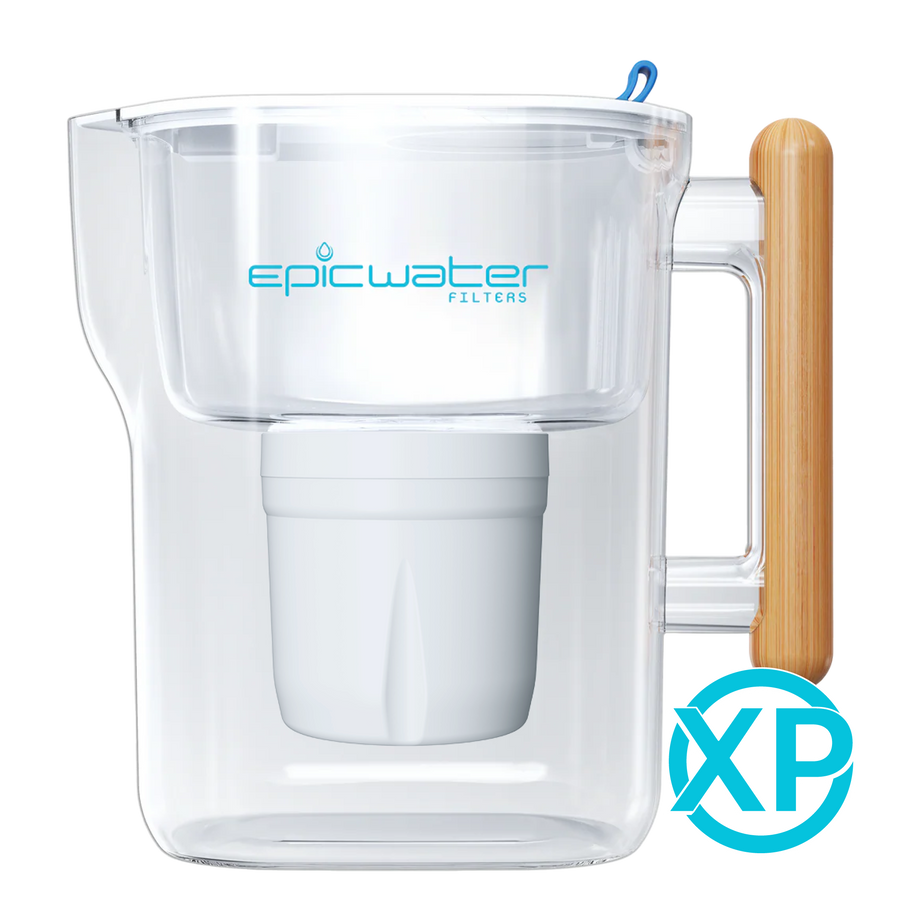
If a pitcher fits what your water needs, explore Epic's pitchers, dispensers, and bundles. Match the documentation to your finding first.
Questions about road salt and drinking water
Why does my tap water taste salty in winter?
Chloride becomes noticeable in taste around EPA's secondary standard of 250 mg/L, and de-icing runoff can raise chloride in a source water or shallow well during and after the salting season. A softener is the other common explanation, and easier to check first.
Is salty tasting tap water dangerous?
Chloride and sodium have no federal health-based limits. EPA recommends 20 mg/L of sodium for people on a physician-prescribed no-salt diet, so the answer depends on your own medical guidance. The indirect concern is plumbing corrosion, a separate question from drinking the salt.
Does a water filter pitcher remove sodium or chloride?
No. Dissolved salts are not what a carbon pitcher filter is designed to reduce. Reverse osmosis, distillation, and deionization remove them, and state guidance commonly points to a point-of-use unit certified to NSF/ANSI 58.
Can road salt cause lead in my water?
Not directly. Chloride raises the chloride-to-sulfate mass ratio, a measure of how corrosive water is toward metal plumbing, and USGS found a higher ratio in raw surface water was associated with more lead action level exceedances across systems. Any lead comes from your service line, solder, or fixtures.
I have a softener. Is that the salt I am tasting?
Quite possibly. Ion exchange softening trades hardness minerals for sodium, so softened water carries more sodium than the water entering the house. Testing before and after it separates that from a source water problem.
Sources & references
Reviewed October 30, 2026
- 25 News Now / Ecology Action Center on sensible salting, October 23, 2026 ↗Three years of local chloride monitoring, the five gallon figure, and the coffee mug application rate.
- USGS / Road salt elevates salinity above background levels ↗Two thirds of stream reaches above background salinity, and the link to impervious cover.
- EPA / Secondary drinking water standards ↗Chloride at 250 mg/L and total dissolved solids at 500 mg/L, as non-enforceable aesthetic guidelines.
- New Hampshire DES / Sodium and chloride in drinking water (PDF) ↗Background levels, the EPA 20 mg/L sodium recommendation, sources, testing intervals, and reverse osmosis treatment.
- Shaw Local / Wilmington, Illinois winter projects list, October 24, 2026 ↗The tonnage, price per ton, and council date behind the specific example.
- Stets, Lee, Lytle and Schock, 2018 / Increasing chloride in U.S. rivers and linkages to corrosivity and lead ↗Science of the Total Environment 613 to 614, pages 1498 to 1509. Chloride and corrosivity trends and the lead action level association.
- EPA / Protect your home's water ↗Private well responsibilities and working with a local health department.
- Epic Water Filters / Testing documents ↗Independent performance reports behind the lead and microplastics figures.
- NSF / Official Standard 42 component listing ↗Certification for material safety requirements only.
- NSF / Official NSF/ANSI/CAN 372 listing ↗Lead content certification of the listed filter components.
Sodium and chloride vary by source, season, and plumbing. This article covers road salt as a category, not conditions at any address, and is not medical advice on sodium intake. The road and kitchen photographs are generated editorial illustrations; the Pure XP image is an official product photograph.
Condividi:
Your Lead Pipe Is Being Replaced. What to Do Next.
Not detected is not the same as zero: the PFAS line on your water report