
A plain envelope from the water utility is easy to put on the pile. If one arrived this month, open it. Utilities are working through a federal deadline to identify what every service line in their system is made of, and the letter at your door is the one part of that job that asks something of you.
These letters are short, and they use four pieces of vocabulary that mean very specific things. One of them, "unknown", worries people most and explains the least.
Why the letters are arriving now
EPA’s Lead and Copper Rule Improvements require water systems to identify the material of every service line, publish what they find, and replace lead and certain galvanized lines within ten years.14 The inventory has to cover the utility-owned portion and the customer-owned portion, and it has to reach the state and the public by November 1, 2027. Missing that date is a treatment technique violation.2 That is less than a year out, which is why outreach picked up sharply this autumn.8
Three examples from the past two weeks. On November 16, Pennsylvania American Water announced door-to-door canvassing in parts of Washington County, where roughly 6,900 customer-side materials in the McMurray area are still unidentified.5 On November 5, St. Louis began asking residents by letter to check their own lines.6 On November 11, the Sewerage and Water Board of New Orleans presented its first replacement schedule, targeting 1,500 lines by July 2027.7
None of that is an emergency notice. It is records work, and it reaches you because nobody has a reliable file on the pipe running into your house.

The four words on your letter
Every line in a federal inventory gets one of four standardised classifications.2 Lead. The line is lead. Non-lead. An evidence-based record, method or inspection shows it is neither lead nor galvanized requiring replacement. Galvanized requiring replacement. A galvanized steel line that is, or was at any point, downstream of a lead line. Lead status unknown. No documented evidence supports any of the other three.2
Whichever phrase your letter uses, it describes a records category, not a test result from your tap. The separate system of urgent notices is covered in what Tier 1, Tier 2 and Tier 3 mean.
Unknown is a paperwork gap, not a verdict
"Lead status unknown" means the utility has no evidence-based record for that line.2 In many American cities the pipe went in before anyone kept the kind of record that now counts, or the record covers the utility side and stops at the property line. Roughly 6,900 unidentified lines in one service area is an ordinary number, not a scandal.5
That is why the letters ask for help. Clearing unknowns out of the inventory before November 1, 2027 is the task, and the fastest way to clear one is for the person standing next to the pipe to look at it.8
Expect the letter again. Customers served by a lead, GRR or unknown line must be notified within 30 days of inventory completion and then annually, by December 1, while the classification stands.2 A second letter next year is the rule working.
One number worth knowing: the improved rule lowers the lead action level from 0.015 mg/L to 0.010 mg/L.4 EPA and CDC hold that there is no known safe level of lead in a child’s blood, and EPA sets the health goal at zero.3 An action level triggers utility-wide treatment steps; it is not a safety line for your kitchen, a gap we covered in legal limits versus health goals.
What to do with the letter this week
Start by looking. The service line usually enters through a basement or crawlspace wall, and the stretch just before the shut-off valve is the piece to examine. A coin scratch and a magnet settle most cases in a minute. Our walkthrough on how to identify a lead service line has the method.

Then report what you found, through whatever channel the letter names.6 If you find lead or galvanized pipe, ask who pays for the customer-owned portion. Policies differ: Pennsylvania American Water says it will work with the customer to replace an identified line at no direct cost.5
Until a line is confirmed or replaced, EPA’s advice is practical rather than dramatic. Use cold water for drinking, cooking and formula. Run the tap before drawing water that has been sitting. Clean the aerator, where lead particles collect. Boiling does not remove lead.3
For a tap-level answer rather than a pipe-level one, a certified laboratory is the route; home strips and overall water scores are not. Our guide to testing your tap water explains how.
Where a filter fits, and where it does not
EPA’s guidance for households with possible lead plumbing includes using a filter certified to reduce lead, replacing the cartridge on schedule, and never running hot water through it.3
Being precise about our own product: Pure XP is listed by NSF under Standard 42 for material safety and under NSF/ANSI/CAN 372 for lead content.910 Contaminant reduction is separate, documented in independent testing rather than carried by those listings. Pure XP is independently tested to reduce lead by 99.9 percent under the NSF/ANSI 53 protocol.11
What a pitcher cannot do is worth saying plainly. It treats the water you pour through it and nothing else. It does not change the pipe and is not a substitute for replacing a lead or GRR line. After a replacement there is a flushing routine to follow, covered in what to do after your lead pipe is replaced.
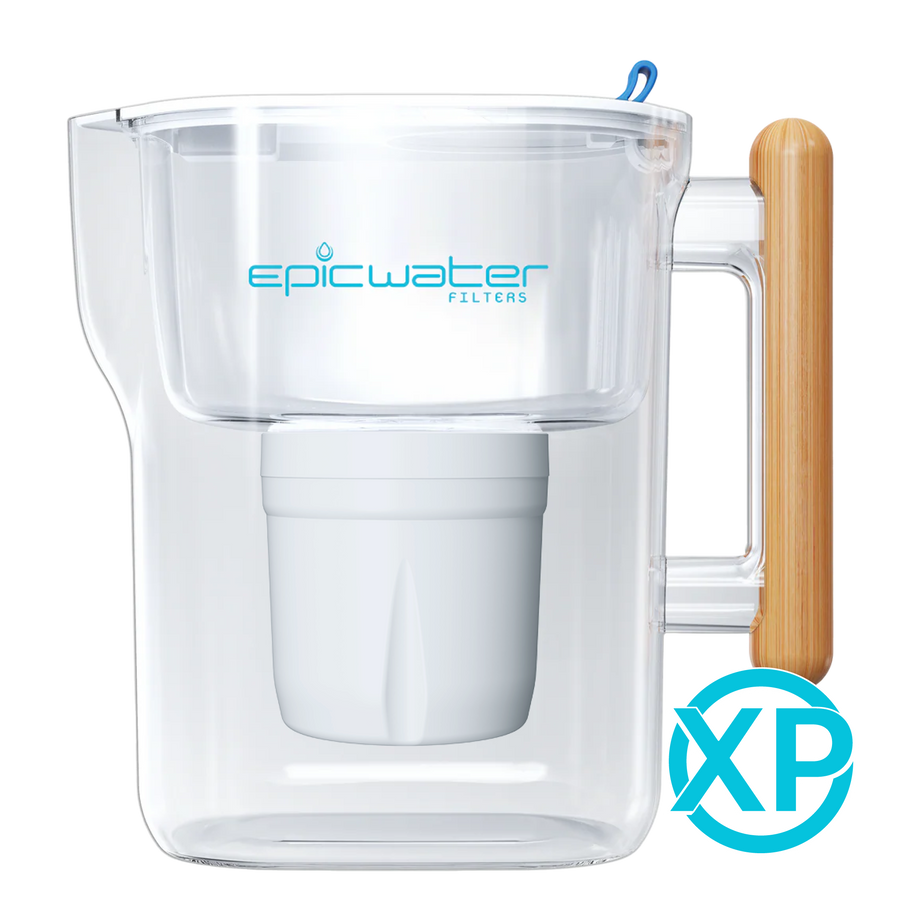
If a pitcher or dispenser suits your household, see Epic’s pitchers, dispensers and bundles. Read the documentation for the exact filter before relying on any single figure.
Questions about service line letters
My letter says “unknown”. Does that mean I have a lead pipe?
No. Unknown means the utility has no evidence-based record for that line, so it cannot classify it either way. It may well be copper or plastic. The label is about documentation, not a measurement at your tap.
What does “galvanized requiring replacement” mean?
A galvanized steel line that is, or once was, downstream of a lead line, or that sits downstream of a line of unknown status. If the records cannot prove it was never downstream of lead, the system must presume it was.
Who pays to replace the part of the line I own?
It depends on the utility and its funding. Some systems replace the customer-owned portion at no direct cost, others cost-share or reimburse. Ask your utility directly, and ask about the schedule for your street.
Will this letter come every year?
Yes, while your line is classified as lead, galvanized requiring replacement or unknown. Systems must notify affected customers within 30 days of completing an inventory and then annually by December 1.
Can I just boil the water in the meantime?
No. Boiling does not remove lead. Use cold water for drinking, cooking and formula, run the tap after periods without use, clean the aerator, and use a filter documented to reduce lead.
Sources & references
Reviewed November 18, 2026
- EPA / Lead and Copper Rule Improvements ↗The federal requirement to identify, publish and replace lead service lines.
- Washington State Department of Health / Lead and Copper Rule Improvements FAQ (PDF) ↗The four inventory classifications, the GRR presumption, the November 1 2027 deadline and the 30-day and annual notification rules.
- EPA / Basic information about lead in drinking water ↗Health goal of zero, cold water, flushing, aerator cleaning, certified filters, and why boiling does not help.
- EPA / Lead and Copper Rule Improvements comparison table (PDF) ↗The action level moving from 0.015 mg/L to 0.010 mg/L and the ten-year replacement requirement.
- Pennsylvania American Water / Service line identification outreach, November 16 2026 ↗Door-to-door canvassing, about 6,900 unidentified customer-side materials, and replacement at no direct cost.
- First Alert 4 / St. Louis residents to receive service line letters, November 5 2026 ↗A city asking residents by letter to check their own lines and report the result.
- Fox 8 New Orleans / SWBNO initial replacement schedule, November 11 2026 ↗Replacement targets of 1,500 lines by July 2027 and 7,500 by July 2028.
- AE2S / Lead service line inventory final deadline, November 2026 ↗The November 1 2027 completed-inventory deadline described from the utility side.
- NSF / Official Standard 42 component listing ↗Pure XP listed for material safety requirements only.
- NSF / Official Standard 372 listing ↗Lead-content certification of the listed filter components.
- Epic Water Filters / Testing documents ↗Independent performance reports, including lead reduction under the NSF/ANSI 53 protocol.
Classifications and replacement policies are set by your own water system under the federal rule, so check your letter and your utility’s inventory for your address. Nothing here is a statement about the water at any specific property. The service line and basement photographs are generated editorial illustrations, not photographs of a specific project. The Pure XP image is an official product photograph. NSF listings cover material safety under Standard 42 and lead content under NSF/ANSI/CAN 372; contaminant-reduction figures come from independent testing.
Aktie:
Your Water Filter Slowed Down This Week. Cold Water Is Why.