
A copper notice is an unusual kind of water notice. The copper in your glass almost certainly did not arrive from a reservoir or a treatment plant. It came out of the plumbing between the street and your tap, and much of it belongs to you.
That is why a copper result reads differently from most numbers on a water report. It is measured at customer taps, and when it runs high the answer involves two parties: the utility, which controls how corrosive the water is, and the building, which supplies the metal.34
Fort Fairfield, Maine published one of these notices on November 9, 2026. Routine monitoring in August returned copper at 1.75 milligrams per liter, above the federal action level of 1.3. The district told customers this was not an immediate public health emergency, that they did not need bottled water, and that it is reviewing its corrosion control plan.12
Where the copper actually comes from
Copper is one of the commonest plumbing materials in American homes, and it generally reaches drinking water as the water passes through that plumbing rather than from the source. Well water on its own usually contains very little.6
How much ends up in the water depends on the water as much as the pipe. Acidic water with a low pH pulls more, and so do soft water low in calcium and magnesium, a high chlorine residual, a warm pipe, and water left standing for hours.7 Softeners sit on that list, which we covered in whether softened water is safe to drink, and so does seasonal road salt runoff.
The counterintuitive part is age. Copper pipe builds a natural coating on its inner wall, and that coating is what keeps the metal out of the water. Plumbing less than about three years old has usually not formed it, so a new build can read higher than the house next door.6

What 1.3 means, and what it does not
EPA lists copper with a goal of 1.3 milligrams per liter and regulates it through a treatment technique with an action level at the same number. Long term exposure above it is associated with liver or kidney damage, and people with Wilson’s disease are told to consult their own doctor.3
An action level is not a cap on a single glass. The trigger is copper above the level in more than ten percent of the taps sampled, and crossing it obliges the system to take further corrosion control steps rather than declaring the water unusable.4 It is a different instrument from the enforceable limits in legal limits versus health goals, and a different letter from the ones in our guide to utility notice tiers.
A second, quieter number sits below it. EPA’s secondary standard for copper is 1.0 milligrams per liter, set for taste and staining rather than health, and it is guidance, not an enforceable rule.5
Blue-green stains and a metallic taste
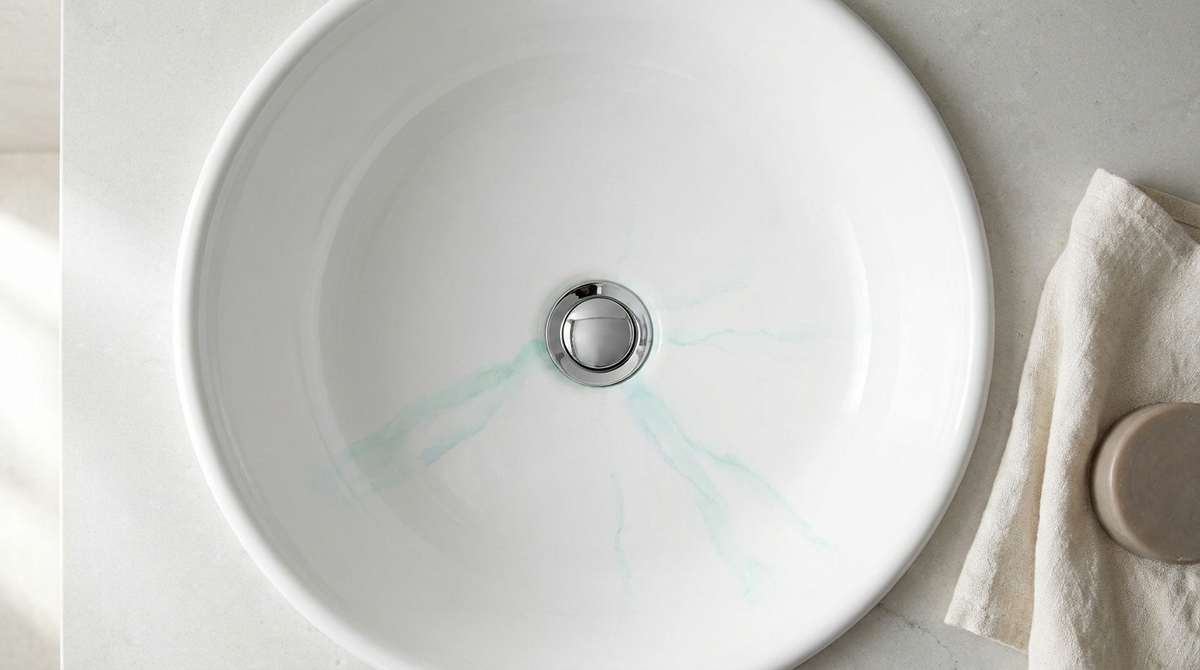
The visible sign is a blue-green stain where water sits or drips: around a basin drain, under a dripping tap, in a tub. Vermont’s health department puts the staining threshold near 1.0 milligrams per liter and adds a caution worth repeating. A stain does not by itself mean the copper level is too high to drink.8 Copper is also an essential nutrient at ordinary dietary amounts, so the concern at an exceedance is sustained intake, not one glass.7
Taste is weaker still. Copper can give water a metallic edge, but so can iron, manganese and zinc, each with its own secondary standard for that reason.5 Our piece on why water tastes metallic covers the others.
What to do in your own home
Flush the standing water first. If a tap has not run for more than six hours, give it 30 to 60 seconds before drinking or cooking. The point is to clear water that sat against metal overnight.67
Use the cold tap. Hot water releases more copper from plumbing than cold, so cold is the one for drinking, cooking and baby formula.6

Test rather than guess. Copper is measured by an accredited laboratory, not a strip or an overall score. If it comes back elevated, test for lead too: the two move through the same corrosion mechanism.86 Our guide to identifying a lead service line covers that.
On a private well, nobody is sampling for you. Vermont recommends testing for copper every five years with an inorganic chemical panel, and acidic shallow wells are the likeliest to dissolve it.8
Two groups need closer attention. Infants under a year old and people with Wilson’s disease cannot clear extra copper easily and may need water below the action level.63
Where a filter fits, and where it does not
A pitcher filter is a point-of-use step on the water you pour through it. It does not change the chemistry leaving the treatment plant, it does not stop pipes corroding, and it does nothing for any tap you do not filter. The durable fixes for copper are the utility’s corrosion control and, in some homes, the plumbing itself.
Within that limit, the documented performance is worth stating plainly. Epic’s Pure XP data sheet reports copper reduced from 3,009 micrograms per liter to 127, a 95.80 percent reduction, in testing under NSF/ANSI 42 and 53 protocols.9 That is independent laboratory testing, not an NSF certification of copper reduction. Pure XP’s NSF listings cover Standard 42 for material safety and NSF/ANSI/CAN 372 for lead content.1011
For area-level background, Epic’s What’s in Your Water lookup shows what has been reported near you. It is not a measurement of your own tap.
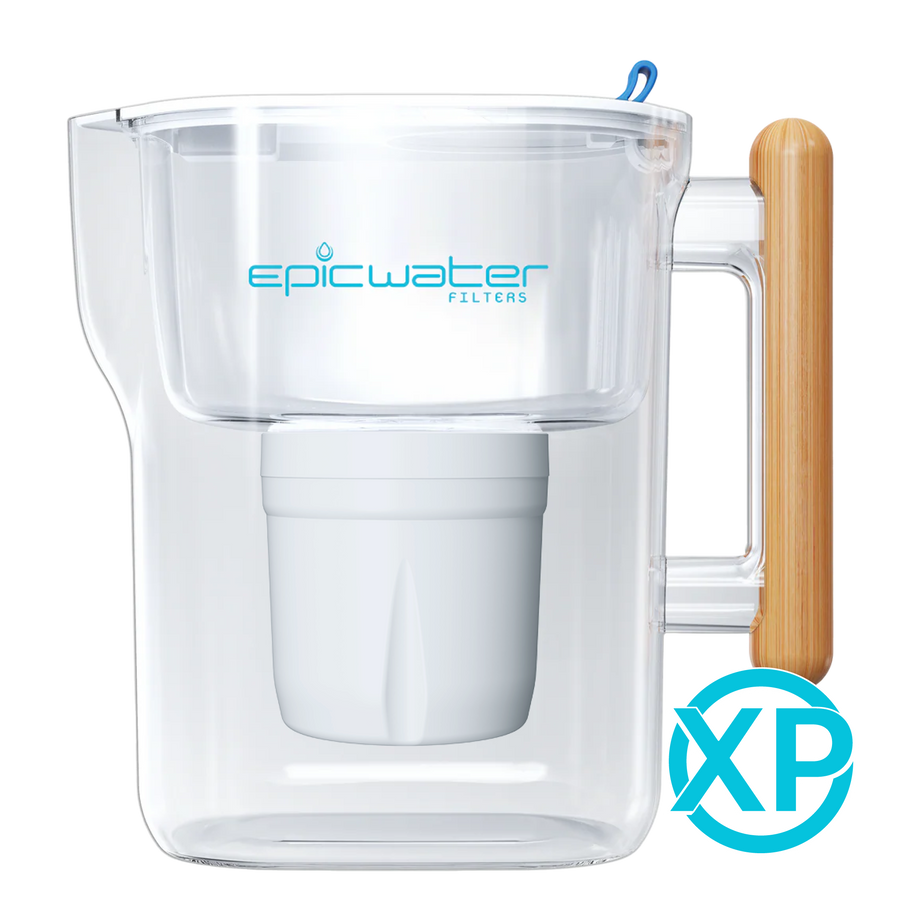
If a pitcher or dispenser suits your household, explore Epic’s pitchers, dispensers and bundles. Read the data sheet before relying on a single figure.
Questions about copper in tap water
Is copper in drinking water dangerous?
Copper is an essential nutrient and most healthy people are not harmed by the amounts in tap water. EPA associates long term exposure above the 1.3 milligrams per liter action level with liver or kidney damage. Infants and people with Wilson’s disease need lower levels.
What does a blue-green stain in my sink mean?
It usually means copper is dissolving out of your plumbing, and staining generally begins around 1.0 milligrams per liter. Vermont’s health department is explicit that a stain alone does not mean the water is too high in copper to drink.
My utility sent a copper notice. Do I need bottled water?
Read the notice. A copper action level exceedance is not a boil water advisory, and notices of this kind commonly state that alternative water is not required. If yours says otherwise, follow it.
Why would brand-new plumbing give higher copper?
Copper pipe builds a protective coating on its inner surface over time, and plumbing less than about three years old has usually not formed one. A new build or recent repipe can read higher than much older plumbing nearby.
Does an Epic filter reduce copper?
Epic’s Pure XP data sheet reports a 95.80 percent copper reduction, from 3,009 to 127 micrograms per liter, in testing under NSF/ANSI 42 and 53 protocols. That is independent testing. The NSF listings cover Standard 42 material safety and NSF/ANSI/CAN 372 lead content, not certified copper reduction.
Sources & references
Reviewed November 11, 2026
- Fort Fairfield Utilities District / Public notice on copper levels, November 9, 2026 ↗The primary notice: the August 2026 monitoring result, the action level comparison and the advice to customers.
- WAGM-TV / Fort Fairfield water exceeds standard copper level, November 10, 2026 ↗Local coverage with the district’s corrosion control review and the March 2027 timeline.
- EPA / National Primary Drinking Water Regulations ↗Copper MCLG and action level of 1.3 mg/L, the treatment technique, and the health effects listed.
- EPA / Lead and Copper Rule ↗How an action level works: monitoring at customer taps and the ten percent trigger for corrosion control.
- EPA / Secondary drinking water standards ↗The non-enforceable 1.0 mg/L copper standard for metallic taste and blue-green staining.
- Minnesota Department of Health / Copper in drinking water ↗Household plumbing as the source, the three-year coating, flushing, cold water and sensitive groups.
- Washington State Department of Health / Copper in drinking water ↗Corrosivity factors and copper’s share of dietary intake relative to food.
- Vermont Department of Health / Copper in drinking water ↗Staining thresholds, the caution about reading stains, and private well testing intervals.
- Epic Water Filters / Pure performance data sheet (PDF) ↗Independent testing results, including the copper reduction figure cited above.
- NSF / Official Standard 42 component listing ↗Pure XP certification for material safety requirements only.
- NSF / Official NSF/ANSI/CAN 372 listing ↗Lead-content certification of the listed filter components.
Copper results describe a water system or a single tap at a single moment, not every tap in a home. Follow your utility’s notice and your laboratory’s instructions. This article discusses copper as a category and does not assess any particular water system. The basin, spigot and pipe-yard images are generated editorial illustrations, not photographs of real water systems; the Pure XP image is an official product photograph.
Share:
Why Your Water Can Meet Every Federal Limit and Still Show Up as Contaminated