
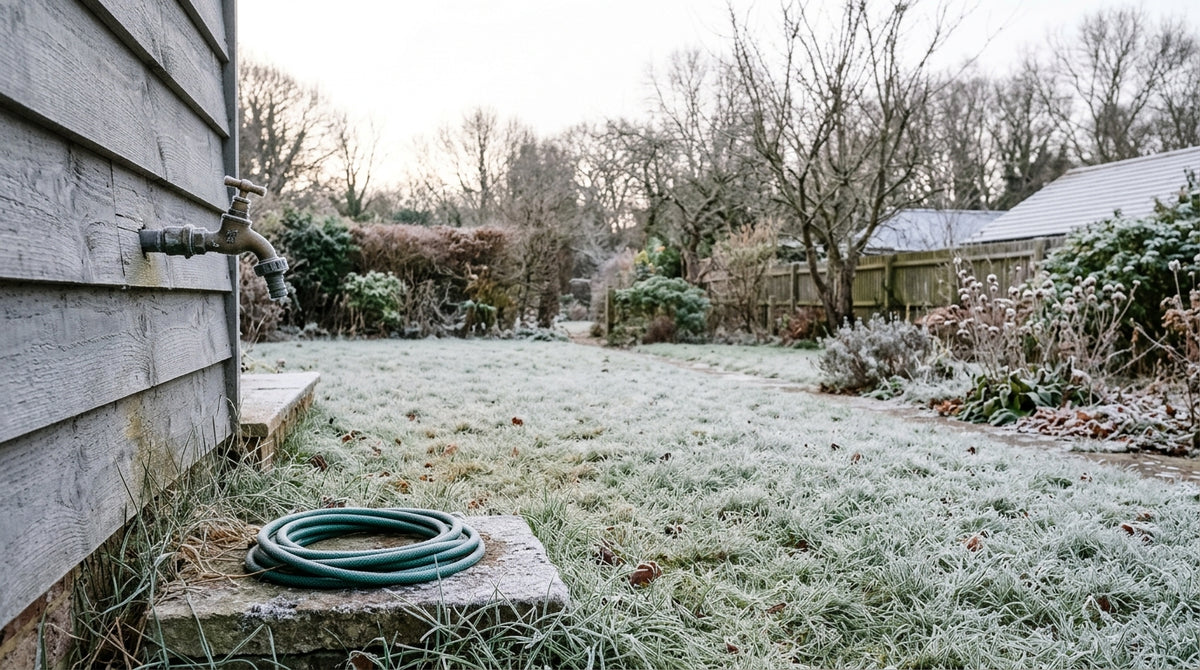
The coldest air of the season settled over more than thirty states this week, and for a long list of cities it was the first hard freeze of the year.1 Most of what that does to your water happens where you cannot see it: in the main under the street, and in the pipe between it and your sink.
Water in a distribution system tracks the ground around it, and the ground tracks the air with a lag of weeks. By the first freeze, the water reaching a kitchen tap has given up most of its summer warmth. That one change explains much of what people notice this month.3
What they notice is rarely taste. It is speed. A pitcher that filled in four minutes in July takes six or seven in November, and the natural conclusion is that the cartridge has failed. Usually it has not.
Why cold water moves through a filter more slowly
Water thickens as it cools. At 25 degrees Celsius, a summer tap in a warm state, its dynamic viscosity is about 0.89 millipascal seconds. At 5 degrees Celsius it is about 1.52, roughly seventy percent thicker.2
A gravity pitcher has no pump and no line pressure behind it. The only force moving water through the filter is the weight of the column in the upper reservoir. Push a thicker liquid through the same carbon bed and less comes out per minute. The filter has not changed. The water has.

Telling a cold filter from a spent one
The useful distinction is reversibility. A filter slowed by temperature speeds up again when the water warms. One slowed by age does not.
The check: fill a covered jug from the cold tap, leave it out overnight, then run that room-temperature water through the pitcher and time the fill. If it comes close to the summer speed, the cartridge is fine.
Do not reach for the hot tap to speed things up. Hot water sits against your plumbing and inside the heater, with more opportunity to pick up metals. We covered the reasoning in why cold is the only tap for the kettle.
Two other explanations are worth ruling out. A new cartridge can hold trapped air, which a soak and a refill clears. And a cartridge reaches the end of its rated life, a question of gallons rather than weather. See how often to replace a water filter.
What the freeze does to the system around you
Buried pipe has a harder winter than most people realise. Cleveland Water, one of the few large utilities that publishes the numbers, averages three to five main breaks a day most of the year and five to seven in winter. As the frost line drives past three feet, the load on a pipe roughly doubles.4
Louisville Water adds that the risk tracks falling temperature rather than cold alone: water is densest near 39 degrees Fahrenheit and expands below it.3

At the tap you see the downstream effect: a pressure drop while a crew isolates a section, then discoloured water when flow returns and lifts settled material off the pipe wall. The colour is usually iron and manganese, which EPA covers under non-enforceable aesthetic guidelines rather than health limits.6
Autumn is also flushing season, when utilities deliberately scour their mains. Illinois American Water ran a program in Jerseyville from November 3 through 17, warning customers to expect low pressure or discoloured water.7
Massachusetts publishes the clearest guidance on what to do next. Run the cold tap nearest your meter for up to fifteen minutes and judge clarity in a white container. If it is still coloured, wait half an hour and try again, with the hot tap off meanwhile.5
One line matters more than the rest here: do not run a tap with a filter attached while the water is discoloured. Sediment clogs it.5
Related reading: why tap water turns brown, why it turns cloudy, usually dissolved air in cold weather, and what road salt season does to source water.
What a pitcher filter can and cannot do this month
Start with the limits, because those are what people get wrong in a cold snap. A pitcher filter does not restore pressure. It is not a response to a boil water notice, where the instruction is to boil whatever filter you own. And it will not make rusty water fit to pour.
What it is for is the everyday water between those events: taste and odour, and the contaminants named in its own test reports. In November it works more slowly. That is the honest answer, not a defect.
Keep the certification distinction straight. Pure XP is listed by NSF under Standard 42 for material safety and NSF/ANSI/CAN 372 for lead content. Those cover the materials, not a reduction claim. Contaminant reduction is documented separately in independent testing, the source of figures such as 99.9 percent of lead under the NSF/ANSI 53 protocol. Understating that is recoverable; overstating it is not.8910
Read EPA on secondary standards for iron and manganese
For what has been reported locally, Epic's What's in Your Water lookup is a starting point. It describes a system, not the water standing in your own pipes, which is worth a thought after a stretch away from home. See how long to run your taps after a trip.
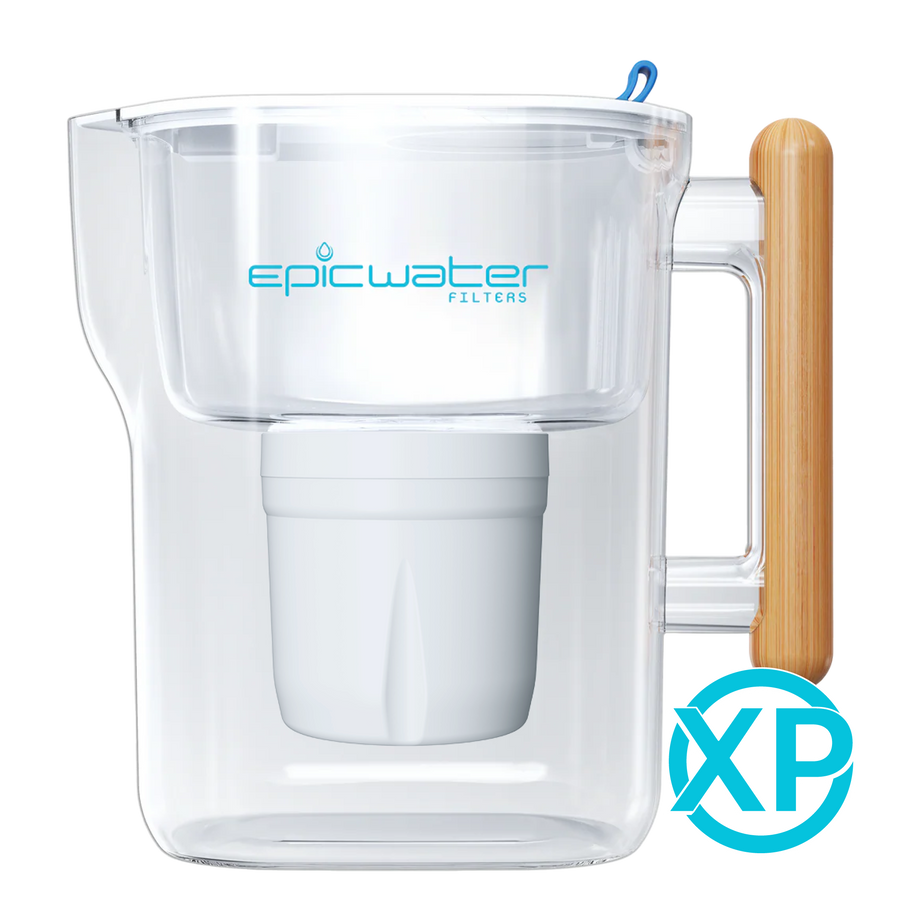
If a pitcher or dispenser suits your household, explore Epic's pitchers, dispensers and bundles, and read the documentation for the exact filter.
Questions about cold weather and your tap water
Why has my water filter suddenly got so slow?
In November the likeliest answer is water temperature. Colder water is more viscous, and a gravity pitcher has only the weight of the water above the filter to push it through. A fill half again as long as in summer is expected.
Is my cartridge broken if the pitcher takes twice as long?
Not necessarily. Run water that has stood at room temperature overnight. If the fill time recovers, temperature was the cause. If it stays slow, check the gallons the cartridge has handled.
Can I use warm or hot tap water to speed up a pitcher filter?
No. Hot water has more contact with your plumbing and heater, more opportunity to pick up metals, and pitcher filters are not designed for it.
My water came out brown after a main break. Can I just filter it?
No. Massachusetts guidance is explicit: do not run a tap with a filter attached while the water is discoloured, because sediment clogs it. Run the cold tap nearest your meter first and judge clarity in a white container.
Why do water mains break more in winter?
Frost drives into the soil and roughly doubles the load on buried pipe. Cleveland Water's daily break count goes from three to five in most seasons to five to seven in winter.
What is Pure XP certified and tested to do?
Pure XP is listed by NSF under Standard 42 for material safety and NSF/ANSI/CAN 372 for lead content. Contaminant reduction is documented in independent testing, not by those listings.
Sources & references
Reviewed November 13, 2026
- Fox Weather / Coldest air of the season reaches more than 30 states (November 11, 2026) ↗The first freeze of the year for Chicago, Detroit, Omaha, Kansas City, Indianapolis and Louisville.
- Anton Paar / Viscosity of water by temperature ↗Dynamic viscosity of 1.5182 mPa·s at 5 degrees Celsius and 0.8900 mPa·s at 25 degrees Celsius.
- Louisville Water / The science behind water temperature and main breaks ↗Falling water temperature as the risk factor, and water reaching peak density near 39 degrees Fahrenheit.
- Cleveland Water / Why more water main breaks occur in winter ↗Three to five breaks a day outside winter against five to seven in winter, frost line depth and pipe loading.
- Massachusetts DEP / Water main flushing fact sheet for consumers (PDF) ↗How long to run the cold tap, judging clarity, the hot tap warning and the instruction not to run a tap with a filter attached.
- EPA / Secondary drinking water standards ↗Non-enforceable aesthetic guidelines, including 0.3 mg/L iron and 0.05 mg/L manganese.
- Illinois American Water / Hydrant flushing notice, November 2, 2026 ↗A November 3 to 17 flushing program and the warning given to customers about low pressure and discoloured water.
- NSF / Official Standard 42 component listing ↗Pure XP certified for material safety requirements only.
- NSF / Official NSF/ANSI/CAN 372 listing ↗Lead content certification of the listed filter components.
- Epic Water Filters / Testing documents ↗Independent performance reports, data sheets and certification resources.
Flushing schedules and main break rates vary by utility. Follow your own utility's notices and any official advisory rather than the figures quoted here. The frost and water main images are generated editorial illustrations. The Pure XP image is an official product photograph.
Aktie:
Flush Before You Pour: What a Week Away Does to the Water in Your Pipes
Your Service Line Is Listed as “Unknown.” Here Is What That Means.