
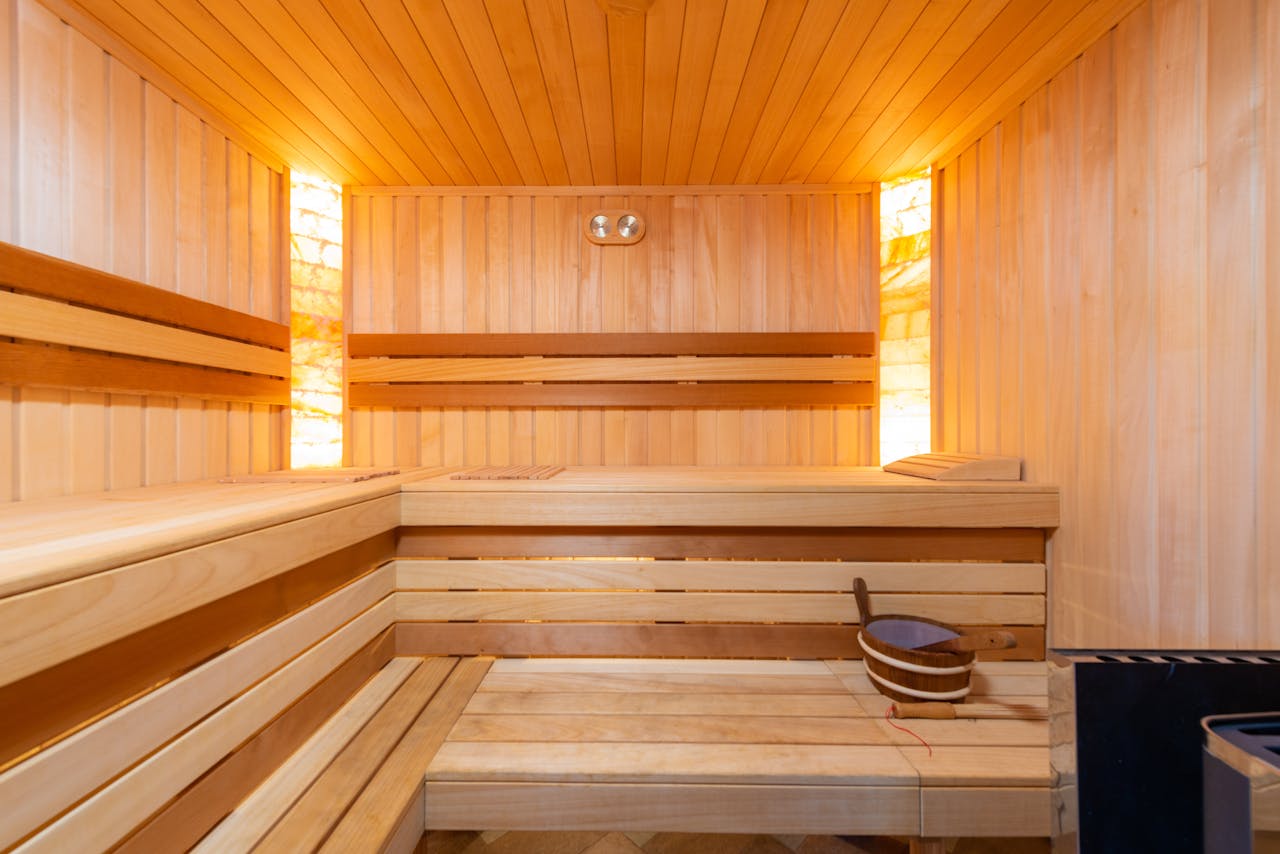
Quick answer: Infrared saunas are relaxing, generally safe for healthy adults, and easier to tolerate than traditional saunas because they run at lower temperatures. The best supported benefits are relaxation and short term relief of sore muscles, along with some encouraging cardiovascular signals from sauna research in general. The bigger marketing claims, including detox, meaningful weight loss, and cellular healing, are not well supported by evidence. Whatever your reason for using one, the most important habit is simple: rehydrate well before and after every session.
What is an infrared sauna?
A traditional sauna heats the air around you. An infrared sauna uses infrared heating panels to warm your body directly, which lets you work up a serious sweat at lower air temperatures, typically 120 to 150 degrees F instead of the 160 to 200 degrees F of a traditional sauna. For many people that milder heat is the whole appeal: sessions feel more comfortable, so they last longer and happen more often.

Infrared sauna vs regular sauna
| Feature | Infrared sauna | Traditional sauna |
|---|---|---|
| Heat source | Infrared heating panels | Electric or wood fired heater |
| Temperature | 120 to 150 degrees F | 160 to 200 degrees F |
| How it heats you | Warms your body directly | Heats the surrounding air |
| Comfort | Milder, easier to sit longer | Hotter, can feel intense |
| Warm up time | About 5 to 15 minutes | About 30 to 40 minutes |
| Typical cost to install | Often lower | Often higher |
One honest caveat: most of the published research on sauna health benefits, including the well known Finnish studies, was done with traditional saunas. It is reasonable to expect some overlap, since both raise your core temperature and heart rate, but the two are not interchangeable in the research.
Infrared sauna benefits: what the evidence actually says
Relaxation and stress
This one is the safest claim. Sitting in gentle heat with nothing to do is relaxing, people reliably report feeling calmer afterward, and a regular session can double as screen free downtime. Some users say it helps their sleep. The formal evidence on sleep is thin, but as a low risk wind down ritual, it earns its spot.
Muscle soreness and recovery
A small controlled study found that an infrared sauna session after resistance training improved recovery of neuromuscular performance and reduced muscle soreness. That fits with what athletes have long reported about heat and recovery. The studies are small, but this is one of the better supported benefits.
Cardiovascular health
Long running Finnish research on frequent sauna bathing has found associations with better cardiovascular outcomes, and small studies of far infrared sauna use suggest possible benefits for blood pressure and blood vessel function in some groups. These are promising signals, not proof. Association is not causation, and the infrared specific studies are small. A sauna is not a substitute for exercise, medication, or medical care.
Claims that outrun the evidence
Some popular claims deserve a plain answer:
- Detox. Sweat is mostly water and electrolytes. Your liver and kidneys do the real detox work. Trace amounts of metals and other compounds do show up in sweat, but sweating is not a meaningful way to remove them, and you do not need to buy anything to detox.
- Weight loss and calorie burn. The weight you lose in a sauna is water, and it comes back when you rehydrate, which you should. Claims of 200 to 600 calories burned per session are not reliable. Any real calorie burn is modest, closer to sitting in warm weather than to a workout.
- Skin health and cellular healing. There is little quality evidence here. Better circulation during a session is real, lasting skin transformation is not established.

How often should you use an infrared sauna?
There is no medically established dose. A sensible pattern for healthy adults:
- Starting out: 2 to 3 sessions per week, 20 to 30 minutes each
- Experienced users: 4 to 6 sessions per week if you feel good
- Every session: drink water before and after, and cut a session short if you feel dizzy, lightheaded, or unwell
Daily use is common among enthusiasts and appears well tolerated in healthy adults, but more is not automatically better. Listen to your body.
Infrared sauna blanket vs dome vs full cabin
Infrared sauna blanket
Portable and the cheapest entry point. It wraps around your body while you lie down. Typical cost is $150 to $600.
Infrared sauna dome
Semi portable. It covers your torso and legs while your head stays out, with more heat coverage than a blanket. Typical cost is $800 to $2,000.
Infrared sauna cabin
The full body, walk in experience found in homes and spas. It is the most immersive option and the most expensive, usually $1,500 to $7,000 or more.
Can infrared saunas cause cancer?
There is no evidence that infrared saunas cause cancer. Infrared is non ionizing radiation, meaning it warms tissue but does not damage DNA the way UV light can. Heat itself is the main thing to respect, which is why moderation and hydration matter.
Who should skip it or ask a doctor first
Sauna heat is a real physiological stressor. Check with your doctor before using one if any of these apply:
- You are pregnant
- You have a heart condition, low blood pressure, or a history of fainting
- You have a pacemaker or other implanted device
- You take medications that affect sweating, blood pressure, or heat tolerance
And for everyone: do not mix saunas with alcohol, and step out at the first sign of dizziness or nausea.

Hydration: the part everyone agrees on
Whatever else a sauna does or does not do, it makes you sweat, and a single session can cost you a pint of fluid or more. The one non negotiable habit is replacing that water. Drink a full glass before you get in, keep water within reach, and rehydrate again afterward. Plain water covers electrolyte needs for normal sessions; you do not need a sports drink for 20 minutes of sitting still.
The bottom line
An infrared sauna is a pleasant, likely safe habit for healthy adults, with honest benefits around relaxation and muscle recovery and some promising but unproven cardiovascular signals. It is not a detox device or a weight loss tool, and nothing about it heals cells. If you enjoy it, the consistency and the wind down time are probably where the real value lives.
Since sauna use means drinking noticeably more water, the quality of that water starts to matter. The Pure XP pitcher is independently tested to reduce lead, PFAS, chlorine, and over 99.9% of microplastics, and the Epic filtered bottle is an easy way to keep filtered water next to the sauna or in the gym bag. For a household of sauna users, the Pure XP Dispenser keeps a larger supply cold and ready.
Related reading
- How much weight will I lose on a 3 day water fast?
- Benefits of baking soda in water
- Plastic water bottles and microplastics
- Is Gatorade Zero bad for you?
Sources
- Canadian Family Physician (via PMC): Far-infrared saunas for treatment of cardiovascular risk factors
- National Library of Medicine (PMC): Far-infrared therapy for cardiovascular, autoimmune, and other chronic health problems: a systematic review
- National Library of Medicine (PMC): The cardiometabolic health benefits of sauna exposure in individuals with high-stress occupations: a mechanistic review
- National Library of Medicine (PMC): A post-exercise infrared sauna session improves recovery of neuromuscular performance and muscle soreness after resistance exercise training
This article is for educational purposes and is not medical advice. Talk to your doctor before starting sauna use if you are pregnant, have a heart or blood pressure condition, or have any other medical concern.
Share:
Dead Hang Benefits
How To Rid Your Body Of Parasites