
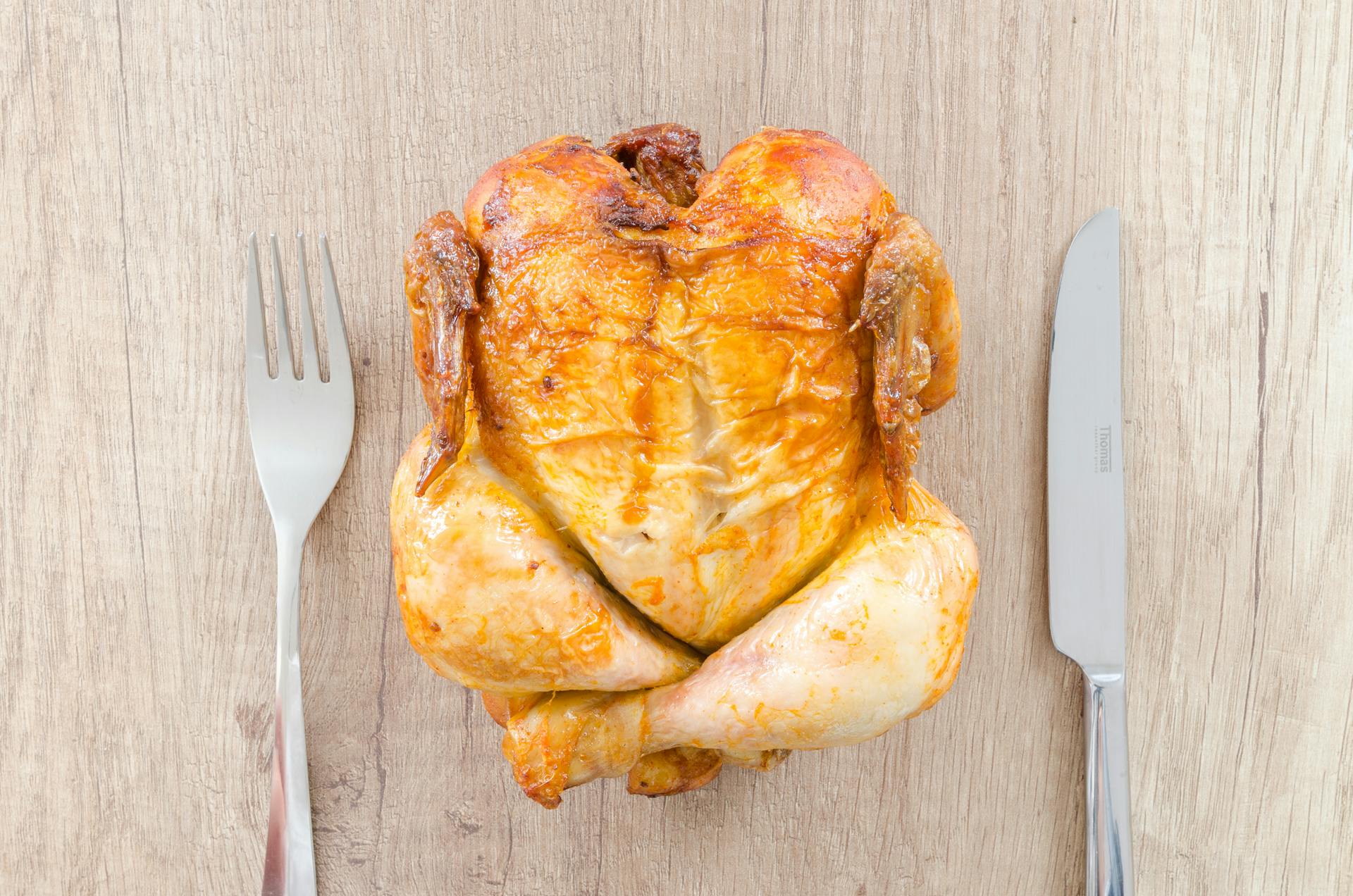
Quick answer: Rotisserie chicken is not bad for you in moderation. It is a convenient, affordable source of lean protein, and it is usually a better choice than fast food. The catch is what makes it so juicy and shelf-stable: most grocery store birds are injected with a salt solution and seasoned with additives like sodium phosphate, modified food starch, and carrageenan. A single serving can carry over 500 mg of sodium, several times more than plain roasted chicken, and that adds up fast if rotisserie chicken is a weekly staple. If clean eating matters to you, choose minimal-ingredient birds or roast your own.
Rotisserie chicken has become a grocery store staple. It is hot, ready to eat, cheap, and genuinely high in protein. Costco's bird is so popular it has its own fanbase, and Costco famously sells it at a loss to get you in the store. None of that makes it unhealthy. But if you are buying one every week as your "healthy" option, it is worth knowing exactly what you are getting.
What is in a Costco rotisserie chicken?

The 10 listed ingredients
- Chicken: conventionally raised unless the label says otherwise
- Water: added through injection or marination to increase weight and juiciness
- Salt: the main driver of the high sodium content
- Sodium phosphate: a moisture retainer and texture enhancer
- Modified food starch: a binder that helps hold the added moisture in the meat
- Potato dextrin: a starch-derived binder that also helps with browning
- Carrageenan: a seaweed-derived thickener that binds water in the meat
- Sugar: a trace amount used for flavor and browning
- Dextrose: another simple sugar used the same way
- Spice extractives: concentrated seasoning
To be fair about the sugars: the amounts here are tiny and nutritionally insignificant. The ingredients that deserve attention are the salt solution and the phosphates.
Why grocery store rotisserie chicken has 10+ ingredients
For a chicken to sit under heat lamps for hours and still taste moist, it needs help. That help is a brine or injected solution of water, salt, and binders that hold moisture inside the meat. Every ingredient is FDA-permitted at the levels used. The honest concern is not any single bird, it is the pattern: phosphate additives are absorbed more completely than the phosphorus that occurs naturally in food, which researchers have flagged as a concern for people with kidney problems and possibly for cardiovascular health at high intakes. And research on food-grade carrageenan and gut health is genuinely mixed, which is why some people with digestive sensitivities choose to avoid it. Neither is a reason to panic. Both are reasons to read labels if processed foods make up a lot of your diet.
The sodium problem
This is the real health issue with rotisserie chicken. A chicken you roast at home contains a modest amount of naturally occurring sodium. A grocery store rotisserie bird has been salted inside and out by that injected solution, so a 3 ounce serving can carry around 550 mg of sodium, more than 20 percent of the roughly 2,300 mg daily limit many health authorities recommend.
Portion context matters here. Almost nobody eats exactly 3 ounces. Pull a quarter of the bird apart over dinner and you can take in well over 1,000 mg of sodium from the chicken alone, before sides, sauces, or anything else you eat that day. High sodium intake is consistently linked to high blood pressure and cardiovascular disease, which is why the habit matters more than the occasional bird.
Tip: removing the skin and visible fat cuts both the sodium and the fat substantially, since the seasoning concentrates on the surface.
Rotisserie chicken nutrition: a breakdown
| Item | Calories | Protein | Fat | Sodium |
|---|---|---|---|---|
| 3 oz (skin-on) rotisserie chicken | ~170 | 23 g | 8 g | ~550 mg |
| Whole chicken (avg. Costco) | ~1,000 to 1,200 | ~120 g | ~60 g | ~2,500 to 3,000 mg |
Walmart rotisserie chicken nutrition
Walmart's birds are similar: chicken, water, salt, modified food starch, sugar, and natural flavorings, with sodium phosphate and dextrose appearing in some versions. Expect roughly 170 to 180 calories and 550 to 600 mg of sodium per 3 ounce serving. The birds are slightly smaller than Costco's and cost a bit more per pound. Not awful in moderation, but not clean eating either.
What about the plastic packaging?

Rotisserie chickens typically sit in plastic containers under heat lamps for hours. Heat can encourage plastics to shed chemicals and particles into food, and fatty foods like chicken skin are the most receptive to that kind of migration. To be clear, we are not aware of published lab testing on rotisserie packaging specifically, so this is a reasonable caution rather than a documented harm.
The parallel that is well documented is bottled water: studies have found microplastic particles in many major bottled water brands, shed from the packaging itself. Warm plastic plus food or drink plus time is simply a combination worth minimizing. An easy fix: transfer the chicken out of the plastic tray when you get home instead of storing leftovers in it.
Is rotisserie chicken healthy?
It depends on where you get it and how often you eat it.
Pros:
- High in protein and genuinely convenient
- Cheaper than takeout and better than most fast food
- Relatively lean if you remove the skin
Cons:
- High in sodium from the injected salt solution
- Contains phosphates, starches, and other additives most home cooks would not use
- Sold and often stored in warm plastic packaging
- Conventionally raised chicken unless labeled organic
How long is rotisserie chicken good in the fridge?

Rotisserie chicken keeps for 3 to 4 days in the fridge when stored in an airtight container or tightly wrapped. Reheat leftovers to an internal temperature of 165 F, checking the thickest part of the meat with a thermometer. A 350 F oven for 20 to 25 minutes works well, with a splash of broth in a covered dish to keep it moist. Avoid low-temperature reheating under 250 F, which can let bacteria multiply instead of killing them. If the chicken smells sour, feels slimy, or looks discolored, throw it out. For longer storage, it freezes well for up to 4 months.
The best rotisserie chicken options
Cleaner birds exist, and you will pay for them.
Whole Foods Market: often organic options with a short label. The plain bird's ingredient list is essentially just chicken. Around $8.
Sprouts Farmers Market: the non-herbed version is just chicken; the herbed version adds sea salt, vinegar, onion and garlic extract, and some soybean oil. Around $9 to $10.
The other option is roasting a chicken yourself. It takes about an hour of mostly hands-off time, and you control every ingredient, including the salt.
The bottom line
You do not need to stop eating rotisserie chicken. In a pinch it beats fast food and frozen meals comfortably. If it is a weekly habit, rotate in minimal-ingredient birds or home-roasted chicken, watch your sodium for the rest of the day, and get the chicken out of the warm plastic tray when you get home. And since sodium-heavy convenience foods make your daily hydration matter more, it is worth making sure the water you drink all day is clean too. A Pure XP pitcher covers that without adding anything to your diet.
Related reading
- Plastic water bottles and microplastics
- Benefits of baking soda in water
- Which diet sodas do not contain aspartame?
- Are Celsius drinks bad for you?
Sources
- NCBI (PubMed Central): High sodium diet intake and cardiovascular diseases: An attributable death study
- NCBI (PubMed Central): Phosphate Additives in Food: a Health Risk
- PubMed: Food-grade carrageenans and their implications in health and disease
- Food Hydrocolloids (ScienceDirect): A comprehensive review on food hydrocolloids as gut modulators
- ScienceDirect: Effects of potato dextrin on the composition and metabolism of the gut microbiota in rats
- Cleveland Clinic: What You Should Know About Glucose and Dextrose
Costco, Walmart, Whole Foods Market, and Sprouts Farmers Market are trademarks of their respective owners, which are not affiliated with and do not endorse Epic Water Filters. This article is for educational purposes and is not medical advice.
Share:
Folic Acid Side Effects
Dead Hang Benefits