

Every autumn, lakes and reservoirs quietly turn themselves over. Surface water cools, grows heavier, and sinks, mixing with the low oxygen water that has sat near the bottom all summer. If your utility draws from a reservoir, that event arrives at your kitchen tap a week or two later.
It shows up as one of two complaints. The water tastes or smells earthy, musty, a little like a damp basement. Or it carries a faint brown tint, and the pitcher filter you replaced two weeks ago has slowed to a trickle. Neither is dramatic. Both are easy to misread.2
On September 8, 2026, City of Bloomington Utilities in Indiana published a notice that named the pattern plainly. Customers were reporting discolored water and a more frequent need to replace household filters. The cause was seasonal conditions in Monroe Reservoir: current conditions required drawing water from a lower level of the lake, where naturally occurring manganese is more prevalent.1
What turnover actually does
Through the summer, a deep reservoir separates into layers. Warm, lighter water floats on top. Colder, denser water stays below, and as oxygen is used up down there, minerals bound into the sediment become soluble. When autumn cools the surface, the layers mix, and what was at the bottom moves toward the intake.2
Two things ride that mixing up. The first is manganese, a natural mineral that gives water a brown cast and a bitter, metallic edge.13 The second is a pair of taste and odor compounds made by algae and bacteria, geosmin and 2-methylisoborneol. Cary, North Carolina, which draws from Jordan Lake, tells customers these arrive in parts per trillion and read as earthy, musty, or dirty.2
Utilities plan for this. Cary uses activated carbon and ozone, and says levels are sometimes high enough that treatment cannot remove all of it.2 Bloomington named its own constraint: the plant has limited capacity to fully remove manganese at the levels it was seeing.1
Separate this from the other common cause of discoloration. When rust and scale are scoured out of the mains by hydrant flushing or a main break, the problem is in the pipes. Turnover starts upstream of the plant.

Why your filter slows down
A pitcher filter is a chemical device and a physical one at once. Carbon and ion exchange media handle taste, odor, and dissolved contaminants, while the bed also catches fine particulate. Oxidized manganese loads that bed faster than clear water does. Flow slows. The filter is not defective. The water changed.
That makes a shortened filter life information rather than a fault. If a cartridge that lasted its rated life in July is struggling in October, and your utility draws from a reservoir, turnover is a reasonable first explanation.1
It also means a tired cartridge is the wrong tool for the moment. Cary notes that home filtration containing fresh carbon may help with the taste and odor, which puts the emphasis on fresh.2 A filter near the end of its life has least to give when the water asks most.

Unpleasant is not the same as unsafe
EPA sets a secondary standard for manganese of 0.05 mg/L. Secondary standards are non enforceable guidelines aimed at aesthetic effects such as taste, odor, and staining, not at health risk.3 Separately, EPA has a non enforceable lifetime health advisory of 0.3 mg/L, and a one day and ten day advisory of 1 mg/L.4
State guidance is more specific about who is most sensitive. The Minnesota Department of Health advises that where an infant drinks tap water or formula made with it, a safe level is 100 micrograms per liter or less, and 300 micrograms per liter or less where everyone is over a year old. Minnesota also notes the nuisance side: staining, scaling, and water that looks or tastes off.5
The only way to know your own number is to ask. Your water system can say whether it monitors manganese, and community systems publish an annual Consumer Confidence Report.6 If nobody is testing for it, an accredited lab can run the sample.5
Read EPA on secondary standards
For area level background, Epic’s What’s in Your Water lookup is a useful starting point. It reports on an area, not on your own tap on a given morning.
What to do between now and the thaw
Run the cold tap for several minutes when the water looks tinted, the step Bloomington gave its own customers.1 Check before starting laundry, since manganese is the mineral behind brownish black staining.5 Judge the filter by flow rather than the calendar, and keep a spare cartridge through the fall.
If an infant in your household drinks tap water or formula made with it, ask your utility for its manganese numbers rather than waiting for next year’s report.56
Read certification and performance testing as two separate things. Epic’s Pure XP is listed by NSF under Standard 42 for material safety and under NSF/ANSI/CAN 372 for lead content.78 Contaminant reduction is documented separately through independent testing, and that report is what any reduction claim should rest on.9
A pitcher is also not a cure for everything turnover brings. It treats drinking and cooking water at the point of use. It does not change the reservoir, does not replace a utility advisory, and is not a microbiological purifier. When the taste and tint pass, that is the source water settling.2
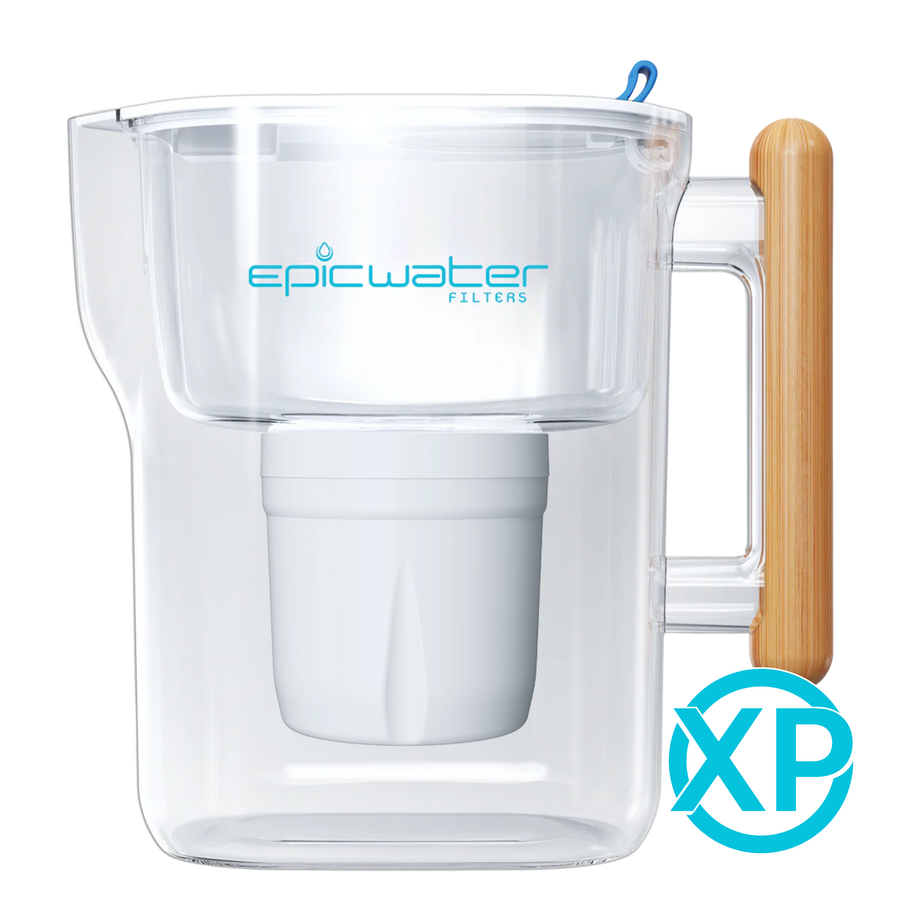
If a pitcher or dispenser fits your household, explore Epic’s pitchers, dispensers, and bundles, and read the documentation for the exact filter first.
Questions about seasonal turnover
Why does my tap water taste earthy in the fall?
If your utility draws from a reservoir, autumn mixing lifts geosmin and 2-methylisoborneol toward the intake. Cary describes the taste as earthy, musty, or dirty, arriving in parts per trillion. Treatment reduces it, but at peak levels some reaches the tap.
Is water with a brown or yellow tint from manganese safe to drink?
Manganese affects appearance and taste well below the levels that raise health questions, which is why EPA treats 0.05 mg/L as an aesthetic guideline rather than a health standard. A separate lifetime health advisory sits at 0.3 mg/L.
Why is my water filter clogging faster than usual?
Oxidized manganese forms fine particles that load a filter bed faster than clear water. Bloomington told customers to expect shortened filter life until reservoir conditions normalized. Slow flow is a signal about the water, not proof of a bad filter.
Does a pitcher filter remove manganese?
Household treatment units may reduce manganese, and how much depends on the technology, the form the manganese is in, and the concentration. Minnesota points households toward testing rather than a blanket answer.
How long does turnover season last?
Cary reports that past taste and odor episodes lasted a few weeks, with the peak customers notice generally a few days up to a couple of weeks. Improvements at the plant also take time to reach every address.
Sources & references
Reviewed September 18, 2026
- City of Bloomington, Indiana / Temporary Water Discoloration Linked to Seasonal Conditions ↗September 8, 2026 utility notice on Monroe Reservoir manganese, filter life, and flushing.
- Town of Cary, North Carolina / Seasonal Variations in the Taste of Drinking Water ↗Fall turnover, earthy and musty taste compounds, treatment limits, and episode duration.
- EPA / Secondary Drinking Water Standards ↗Non enforceable aesthetic guidelines, including the 0.05 mg/L value for manganese.
- EPA / Drinking Water Health Advisory for Manganese (PDF) ↗The lifetime health advisory of 0.3 mg/L and the shorter term advisory of 1 mg/L.
- Minnesota Department of Health / Manganese in Drinking Water ↗Guidance values for infants and other households, staining effects, and testing advice.
- EPA / Consumer Confidence Reports ↗How to find the annual water quality report your community water system publishes.
- NSF / Official Standard 42 component listing ↗Pure XP certification covering material safety requirements only.
- NSF / Official NSF/ANSI/CAN 372 listing ↗Lead content certification of the listed filter components.
- Epic Water Filters / Testing documents ↗Independent performance reports, data sheets, and certification resources.
Seasonal conditions vary by reservoir, by system, and by year. Follow your own utility’s notices and guidance, which describe your water rather than the general pattern. This article discusses turnover as a seasonal phenomenon, not the performance of any specific treatment plant. The reservoir and drinking glass images are generated editorial illustrations. The Pure XP image is an official product photograph.
Share:
Why Is My Tap Water Cloudy? The Two Minute Glass Test
Why Is My Tap Water Cloudy? The Two Minute Glass Test