
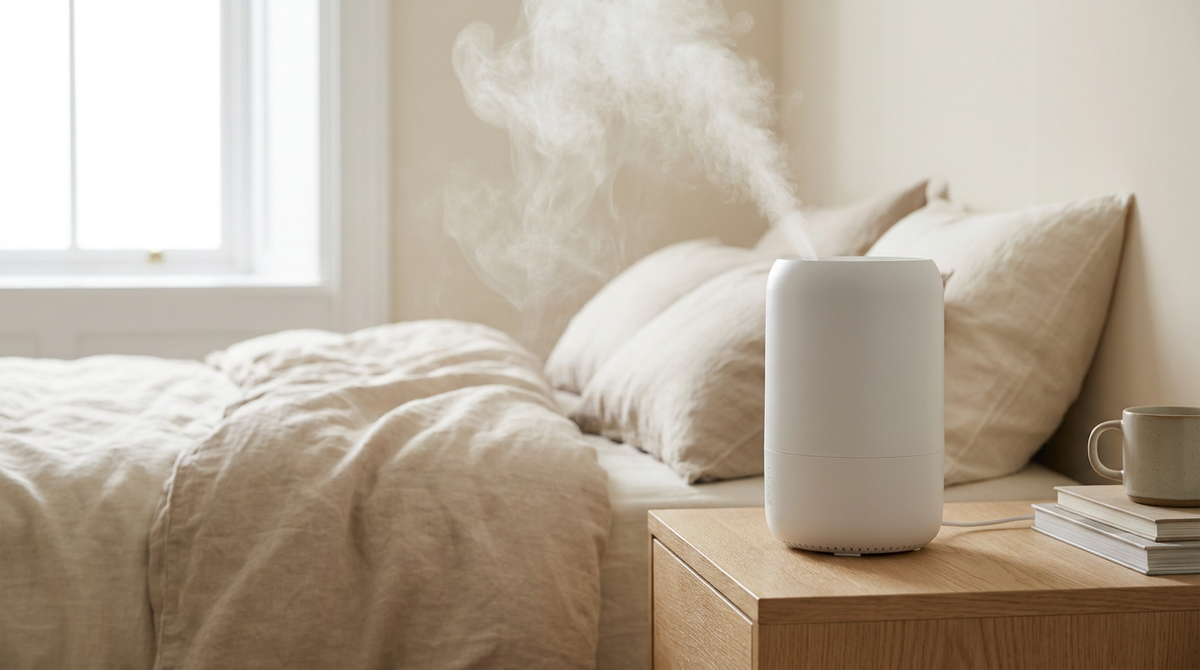
The humidifier comes out of the closet on the first cold night of the year, and the first question is always the same: can you just fill it from the kitchen tap? You can. What the water carries decides what settles on your furniture and what grows inside the tank.
Much of the country crossed that line in the past two weeks. National Weather Service offices issued freeze watches and warnings across at least six states for the mornings of October 16 and 17, the coldest of the season so far for the Plains and Upper Midwest.4 Furnaces came on, indoor air dried out, and humidifiers went back on nightstands.
Respiratory season arrived alongside it. CDC's surveillance report for the week ending October 17, published October 23, put outpatient respiratory illness at 2.2 percent of visits against a 2.9 percent baseline, with 5.7 percent of clinical specimens positive. Activity is still low, but early-season indicators are running higher than is typical for this point in the year.3 More households run a humidifier now than at any other time.
What your tap water leaves behind
Tap water is not only water. Dissolved calcium and magnesium are what make water hard, measured as calcium carbonate: 0 to 60 milligrams per liter is soft, 121 to 180 is hard, and above 180 is very hard.5 Those minerals are not toxic, which is why EPA has set no legal limit for hardness.5 In a drinking glass they are a non-issue.
A humidifier changes what they do. Ultrasonic and impeller units are very efficient at dispersing the minerals in tap water into the air, and EPA's instruction is direct: use water with low mineral content, such as distilled water, to prevent releasing minerals into the air.1 The pale film that shows up on a dresser a week into heating season is the mineral content of your water, carried out of the tank and dropped around the room.

Not every bottle on the shelf solves it. Distillation is the most effective demineralization method. Deionized, reverse osmosis, and water sold as purified generally retain more minerals, and water labeled spring, artesian, or mineral is not demineralized at all.1 If your unit uses a demineralization cartridge, white dust is the signal that it has stopped removing minerals.1
Scale is not a cosmetic problem
The same minerals build scale inside the reservoir and on the heating element or nebulizer. EPA makes the consequence plain: scale can be a breeding ground for microorganisms.1 A rough mineral crust gives biofilm a surface to hold that clean plastic does not.
The Consumer Product Safety Commission states the health concern directly: without regular cleaning, microorganisms can grow in the tank and become airborne, and they have the potential to cause respiratory problems. CPSC's schedule for a unit under five gallons is to empty leftover water, wipe all surfaces dry, and refill daily, then sanitize every seven days. Larger units are sanitized every two weeks.2

A humidifier topped up for a month without being emptied is a standing reservoir of warm water pointed at the room you sleep in. Which water went in matters less than whether the tank gets emptied and dried.
What a drinking water filter does not do here
We should be straight about our own category. A carbon pour-through pitcher filter is built to improve the water you drink. It is not a demineralizer. Calcium and magnesium pass straight through it, so filtered tap water still leaves white dust and still builds scale. Using one to fill a humidifier solves nothing the humidifier cares about.
Hold a meter over filtered water and you see it from the other side: the total dissolved solids reading barely moves, because dissolved minerals pass straight through carbon. It is the same reason a pitcher filter is not a water softener. The processes that remove minerals are distillation and reverse osmosis, built for that job and priced accordingly.
A filter will also not sterilize a tank. A pour-through pitcher is not a microbiological barrier, and nothing poured in stays sterile once it sits warm for a week. Cleaning controls that, not the water you start with.
What a pitcher filter is for is the water you drink. Pure XP is certified by NSF to NSF/ANSI Standard 42 for material safety and to NSF/ANSI/CAN 372 for lead content.78 Contaminant reduction, including independent testing of lead under the NSF/ANSI 53 protocol, is documented in separate independent reports rather than certified by NSF.9 None of that is a claim about humidifiers.
Read EPA's humidifier guidance
If you want to know what is in the water coming into your home, your utility's annual report is the free place to start,6 and Epic's What's in Your Water lookup can help you explore what has been reported in your area. Neither measures hardness at your own tap, so if scale is your question, ask your utility for that figure.
Find your water quality report
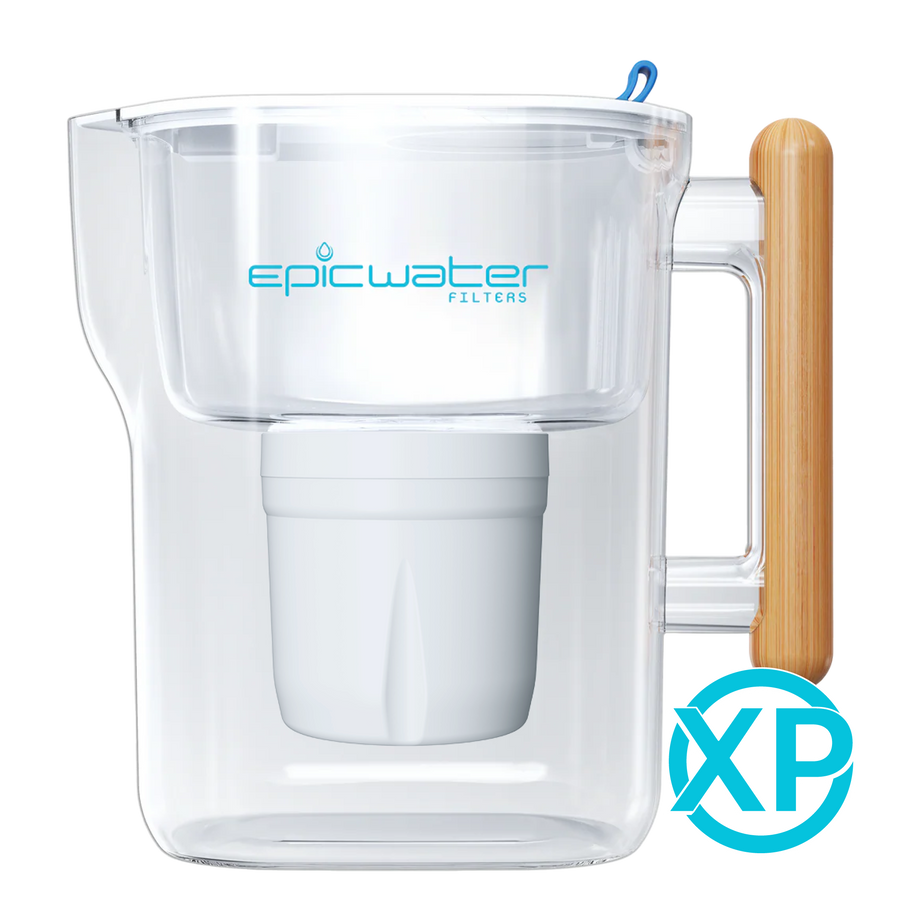
For the glass on the nightstand rather than the tank beside it, explore Epic's pitchers, dispensers, and bundles, and check the documentation for the exact filter. Filters are rated in gallons, so replacement timing follows what you pour, not the calendar.
Questions about humidifier water
Can you use tap water in a humidifier?
Mechanically, yes, and CPSC notes most humidifiers are filled with tap water. EPA recommends water with low mineral content, such as distilled, because ultrasonic and impeller units disperse the minerals in tap water into the air. Check your manufacturer's directions, since some units specify distilled water and some rely on a demineralization cartridge.
What is the white dust on my furniture?
Dissolved minerals from the water, dispersed by the humidifier and settling on nearby surfaces. It is most noticeable with ultrasonic and impeller units and with harder water. If your unit has a demineralization cartridge, white dust means the cartridge is no longer removing minerals.
Will a pitcher filter stop white dust?
No. A carbon pour-through filter is not a demineralizer, so calcium and magnesium pass through it. Filtered tap water will leave the same white dust and build the same scale. Distillation is the most effective demineralization method, and reverse osmosis removes a large share of dissolved minerals as well.
Is hard water a health problem to drink?
Hardness is a nuisance measure, not a health contaminant. Calcium and magnesium are not toxic, and EPA has set no legal limit for hardness. The reason hardness matters for a humidifier is what the mist carries into the room and what the scale does inside the tank, not what the water does in a glass.
How often does a humidifier actually need cleaning?
EPA advises emptying the tank, wiping all surfaces dry, and refilling daily, with a full clean every third day to remove scale, deposits, and film. CPSC advises daily emptying and refilling for units under five gallons, sanitizing every seven days, and every two weeks for larger units. Unplug the unit first.
Does Epic make a filter for humidifier water?
No, and we would rather say so than sell you the wrong tool. Epic makes drinking water filters. Pure XP is certified by NSF to Standard 42 for material safety and to NSF/ANSI/CAN 372 for lead content, with contaminant reduction documented in separate independent testing. For a humidifier, follow the manufacturer's instructions on water type and keep to the cleaning schedule.
Sources & references
Reviewed October 26, 2026
- EPA / Use and Care of Home Humidifiers ↗Low mineral content water, white dust, scale as a breeding ground for microorganisms, daily emptying and cleaning every third day.
- CPSC / Portable humidifiers need regular cleaning during winter months ↗Daily emptying and refilling, sanitizing intervals by tank size, and airborne microorganisms.
- CDC / FluView, week 41 ending October 17, 2026 ↗Published October 23, 2026: 2.2 percent of outpatient visits, 2.9 percent baseline, 5.7 percent laboratory positivity, early-season activity above usual.
- Orbis Weather / October 2026 cold snap and NWS freeze alerts ↗Freeze watches and warnings across at least six states for October 16 and 17, with NWS Boulder, Chicago, Pueblo, and Hastings attribution.
- USGS / Water hardness in the United States ↗Hardness as calcium and magnesium, the soft to very hard ranges in milligrams per liter as calcium carbonate, and why there is no EPA limit.
- EPA / Consumer Confidence Report search ↗Find the annual water quality report for your public water system.
- NSF / Official Standard 42 component listing ↗Pure XP certification for material safety requirements only, not contaminant reduction.
- NSF / Official NSF/ANSI/CAN 372 listing ↗Lead-content certification of the listed filter components.
- Epic Water Filters / Testing and certification documents ↗Independent performance reports, data sheets, and certification resources.
Humidifier instructions vary by unit and by manufacturer. Follow the directions supplied with your humidifier, and the EPA and CPSC guidance linked above, rather than one general rule. This article discusses humidifier water as a category and makes no performance claim for any Epic product in a humidifier. The bedside and reservoir photographs are generated editorial illustrations. The Pure XP image is an official product photograph.
Share:
Reverse Osmosis or a Pitcher Filter: Which Do You Actually Need?