
Most writing about microplastics in tap water treats them as something that arrives from outside: a river, an outfall, a landfill. A study published on November 3, 2026 looked at a shorter stretch of the journey, the pipes and linings that carry treated water from the plant to your tap, and measured what those materials shed into the water themselves.1
The pipe is part of the sample
Researchers in Portugal put six drinking water contact materials through three migration cycles and counted the plastic particles left in the water afterward: two polyester resins of the kind used in glass reinforced pipe, two polyethylene pipe materials, an oriented PVC, and a cement mortar lining.1
The counts were small in absolute terms, and not zero. Across all six, release averaged about 100 particles per litre in chlorinated water and about 60 without chlorine, most of them between 20 and 100 micrometres. The cement mortar lining and one of the polyethylene pipes were the most stable.1
That reframes the question usefully. If particles are shed downstream of treatment, no amount of work at the plant removes them. They enter the water after the plant has finished with it.

What chlorine did, and what it did not
Every material was run twice, with and without 1 mg/L of free chlorine, because chlorine is an oxidant and oxidants age plastic. Release was higher with chlorine present, but the authors are careful with that comparison: across all materials the difference was not statistically significant at the 95 percent confidence level, and the replication was small.1
The material specific results were clearer. One isophthalic polyester resin responded strongly to chlorination. One polyethylene pipe did not respond at all. The question is not whether chlorine degrades plastic in general, it is which plastic, under which conditions.
That matches work on premise plumbing. Engineers at the University of Missouri reported this year that chlorine oxidised PEX-A pipe and left microscopic cracking, and that chlorine then decayed faster in that aged pipe.3
What this study does not say
It does not say your tap water is unsafe, and it was not designed to. The authors state that their release index ranks materials against each other and is not a toxicological risk metric, and that everything they tested complies with the rules governing it today.1
Nor does it say the pipe is the main source. Water picks up particles from the source, from treatment, from storage and from the containers people pour it into. Isolating one link tells you what that link contributes.
The health question is still open. The World Health Organization assessed the risk from microplastics in drinking water as low while being clear that the evidence base is limited and that the smallest particles are the least studied. It called for research, not routine monitoring.2 Pipes and linings are already certified for health effects under NSF/ANSI/CAN 61, which evaluates what a component leaches. Particle shedding is not part of that evaluation, and the study's recommendation is that it should be.4
What you can find out about your own water
There is no home test for microplastics, and anyone selling you a strip or a score for them is selling a number that does not mean anything. What you can do is understand the water you are served and the plumbing it reaches you through.
Start with your utility's annual water quality report. It will not list microplastics, because nobody is required to monitor for them, but it gives you your disinfectant, your source and your detected regulated contaminants.5
Find your water quality report
Then ask your utility two questions: what the distribution mains in your area are made of, and when the service line to your property was installed and in what material. Utilities hold service line inventories now and generally answer directly.

For numbers on contaminants that are regulated and testable, use a laboratory certified by your state for drinking water analysis rather than a mail in grading service.6
Where a filter fits, and where it does not
A point of use filter has one structural advantage here: it sits at the end of the chain. Whatever the source water, the main and the service line each contributed, a pitcher filter is downstream of all of it.
Epic's Pure XP and Nano XP filters are independently tested to remove more than 99.9 percent of microplastics, lead at 99.9 percent under the NSF/ANSI 53 protocol, and PFOA and PFOS under the NSF P473 protocol. Both are NSF certified to Standard 42 for material safety and to NSF/ANSI/CAN 372 for lead content. We keep those separate on purpose: the certifications cover the filter's own materials, the reduction figures come from independent laboratory testing.
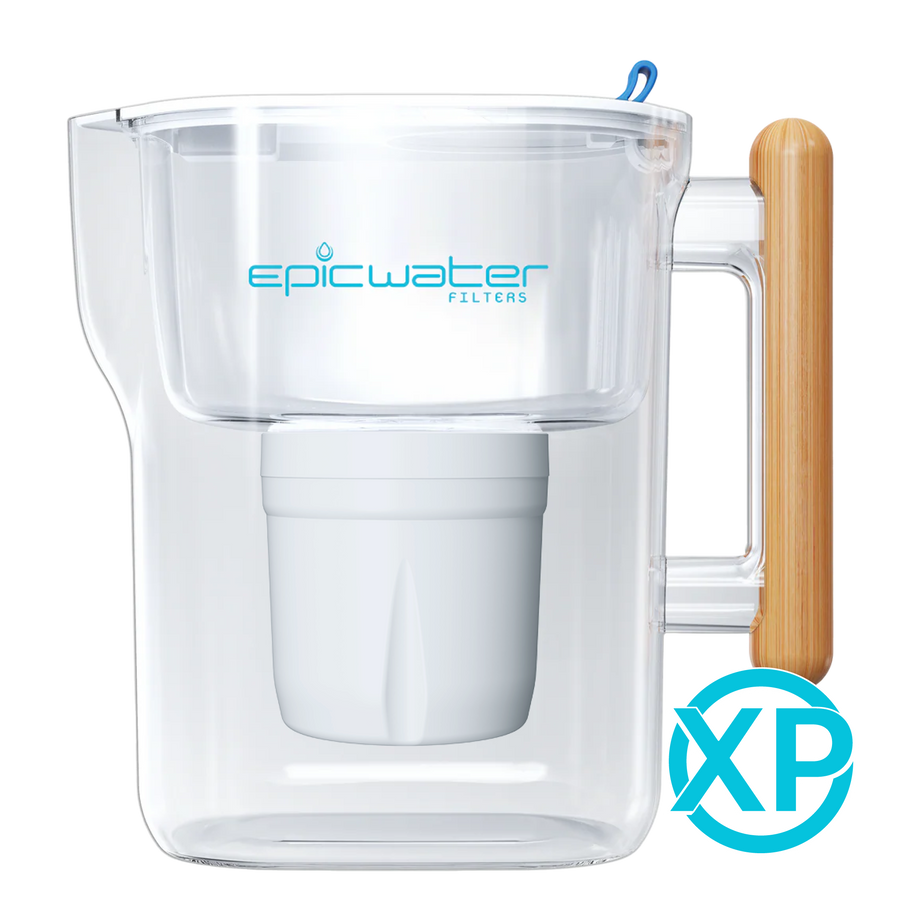
What it does not do: stop particles being shed upstream of it, treat your shower or washing machine, or tell you anything about the condition of your plumbing. It will not help with arsenic, nitrate or hardness. And a cartridge past its rated capacity is not doing the job the test report describes, which is the most common reason a good filter underperforms.
Questions about plastic pipes and microplastics
Do plastic water pipes put microplastics in my drinking water?
This study found measurable release from all six materials it tested, with large differences between them. It did not measure what reaches any particular home and set no health threshold. Read it as evidence that the distribution system belongs in the picture.
Does chlorine make it worse?
Release was higher in chlorinated water overall, but that difference was not statistically significant. The effect was material dependent: one polyester resin responded to chlorine, one polyethylene pipe did not.
Should I replace my plastic plumbing?
Not on the basis of this study. The materials tested are compliant, and the authors are explicit that their index is not a risk metric. If you are replacing pipe anyway, material choice is a fair question for your plumber.
Can I test my own water for microplastics?
Not meaningfully. There is no consumer test and no agreed method for routine monitoring. Use your utility's annual report, and a state certified laboratory if you need specific numbers.
Will boiling help?
No. Boiling addresses microorganisms. It does nothing to plastic particles, and boiling water down concentrates whatever is dissolved in it.
Does an Epic pitcher filter remove microplastics?
Epic's Pure XP and Nano XP filters are independently tested to remove more than 99.9 percent of microplastics. That is laboratory testing, not an NSF certification of microplastic reduction, and it applies to water that passes through the filter, not to every tap in the house.
Sources & references
Reviewed November 6, 2026
- Cordeiro et al., Microplastic Release from Drinking Water Contact Materials, Molecules 31(21):3960, November 3, 2026 ↗Six materials, three migration cycles, chlorinated and non-chlorinated. Particle counts, material specific chlorine response, and the authors' caveats on replication and risk interpretation.
- World Health Organization, Microplastics in drinking-water briefing ↗WHO's assessment that the health risk is low, the limits of the evidence, particle size and absorption, and the call for research rather than routine monitoring.
- University of Missouri College of Engineering, research on chlorine and aged PEX-A plumbing, 2026 ↗Chlorine oxidation and microscopic cracking in aged PEX-A pipe, and the fall in chlorine half life from 4.1 to 1.5 hours.
- NSF, NSF/ANSI/CAN 61 certification for drinking water components ↗What the health effects standard for pipes, fittings and linings evaluates, and what it does not cover.
- US EPA, Consumer Confidence Reports ↗How to find your utility's annual water quality report and what it is required to contain.
- US EPA, state drinking water laboratory certification programs ↗Contacts for finding a laboratory certified to run drinking water analyses in your state.
This article describes one laboratory study and does not characterise the water at any particular address. The authors state that their release index is not a toxicological risk metric and that all materials tested met current regulatory requirements. The pipe and desk photographs are generated editorial illustrations. Epic filter performance figures come from independent laboratory testing; NSF certification covers material safety under Standard 42 and lead content under NSF/ANSI/CAN 372.
Share:
Not detected is not the same as zero: the PFAS line on your water report