
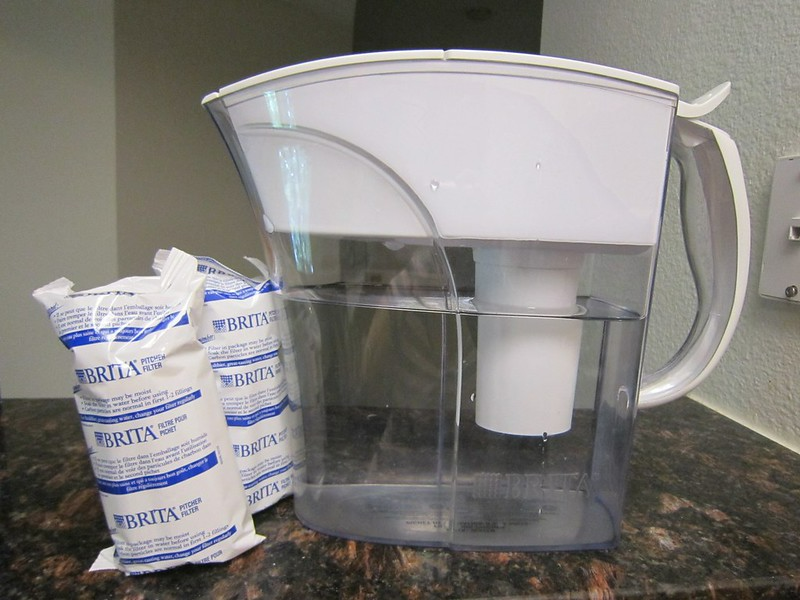
Quick answer: A standard Brita pitcher filter lasts about 40 gallons, which works out to roughly two months for the average household. The Brita Elite filter lasts about 120 gallons, or roughly six months. If your filter is past those marks, change it now: an expired carbon filter does not just stop working, it can start growing bacteria and put things back into your water. That rule applies to every pitcher filter on the market, including ours.
How often to change each Brita filter

Standard Brita filter: every 40 gallons, about 2 months
The white standard filter that ships with most Brita pitchers is rated for about 40 gallons. For a typical household that filters a few pitchers a day, that is roughly two months of use. Yes, that means changing filters six times a year. It feels frequent, but the rating exists because the filter's capacity to hold contaminants runs out.
Brita Elite: every 120 gallons, about 6 months
The Brita Elite (formerly called Longlast) is rated for about 120 gallons, or roughly six months for an average household. It costs more per filter but covers three times the water volume.
Your mileage varies
These are averages. A big household that refills constantly will hit 40 or 120 gallons well before the calendar says so. Water with heavy sediment, hardness, or strong chlorine will also exhaust a filter faster. Track gallons if you can; the two-month and six-month rules are just convenient stand-ins for water volume.
Signs it is time to change your Brita filter
- Slow filtering. When water takes noticeably longer to pass through, the filter media is clogging.
- Taste or odor returns. If you can taste chlorine again, the carbon's capacity is used up.
- The indicator says so. Most Brita pitchers have an electronic or sticker indicator. It is a timer, not a sensor, but it is still a useful reminder.
- You cannot remember your last change. If you have to think about it, it has probably been too long.
Why an expired filter is worse than no filter
This is the part most filter brands, ours included, should say more plainly. A carbon filter works by trapping contaminants and organic matter in a damp, dark cartridge that sits at room temperature. That is a comfortable environment for bacteria, and studies of household carbon filters have found microbial growth inside cartridges used past their service life. At the same time, exhausted carbon stops adsorbing new contaminants, and a saturated filter can begin releasing some of what it previously captured.
In other words, an overdue filter can leave you worse off than plain tap water. This is not a Brita problem. It is how every gravity carbon filter works, Epic filters included. Whatever pitcher you own, the replacement schedule is not upsell fine print; it is the difference between a water filter and a bacteria incubator.
What a Brita filter actually removes
The standard Brita filter is tested to reduce a short list of contaminants, just under ten, centered on chlorine taste and odor plus a few metals. That is genuinely useful if taste is your main complaint about tap water. The Elite is certified for a longer list, including lead. Neither is designed to cover the wider range of contaminants that can show up in municipal water, such as PFAS.
Before choosing any filter, it is worth knowing what is actually in your local water. Enter your zip code in the EWG Tap Water Database to see which contaminants have been detected above recommended health guidelines in your area, then pick a filter tested to address those.
Granular activated carbon vs carbon block

Standard Brita filters use granular activated carbon (GAC): loose carbon granules treated to open up millions of microscopic pores. GAC is effective at what it is rated for, mainly improving taste and smell, and it is inexpensive to manufacture. Its limitation is structural: water can channel around loose granules, reducing contact time with the carbon.
Carbon block filters compress carbon into a solid block, forcing water through a denser matrix with a much smaller effective pore size and longer contact time. That typically allows a carbon block to capture smaller particles and a wider range of contaminants than loose granular carbon. It is why Epic standardized on solid carbon block technology across our filters.
How Epic replacement filters compare

An Epic pitcher filter costs more up front, about $44 versus about $9 for a standard Brita cartridge. It is also rated for up to 150 gallons, nearly four times the standard Brita's 40, so on a per-gallon basis the costs land much closer than the sticker prices suggest. The bigger difference is coverage: Epic's carbon block filters are independently tested to reduce 200+ tap water contaminants, including lead, PFAS, chlorine, and microplastics, versus the standard Brita's short list.
And to apply our own honesty rule: Epic filters expire too. When your Epic filter hits its rated gallons or slows down, replace it for exactly the reasons described above. Fewer changes per year, but the changes still matter.
The bottom line
Change a standard Brita filter about every 40 gallons or two months, and a Brita Elite about every 120 gallons or six months. Set a recurring reminder, because a filter run past its lifespan can be worse than no filter at all, no matter whose name is on the cartridge.
If you own an Epic pitcher, or want fewer filter changes with broader coverage, you can find the right cartridge in our replacement filters collection. If you are rethinking the pitcher itself, the Pure XP pitcher is independently tested to reduce lead, PFAS, chlorine, and over 99.9% of microplastics, and our full pitcher lineup covers different household sizes and budgets.
Related reading
- Why is Dasani water bad for you?
- Plastic water bottles and microplastics
- How much does water weigh?
- Benefits of baking soda in water
Sources
- Environmental Working Group: EWG Tap Water Database
- Pitcher photo by hyhoh via Flickr; product photos by Epic Water Filters
Brita is a registered trademark of Brita LP, which is not affiliated with Epic Water Filters. This article is for educational purposes and is not medical advice.
Share:
Washington County (Abingdon), Virginia Water Quality Report
Winchester, Virginia Water Quality Report