
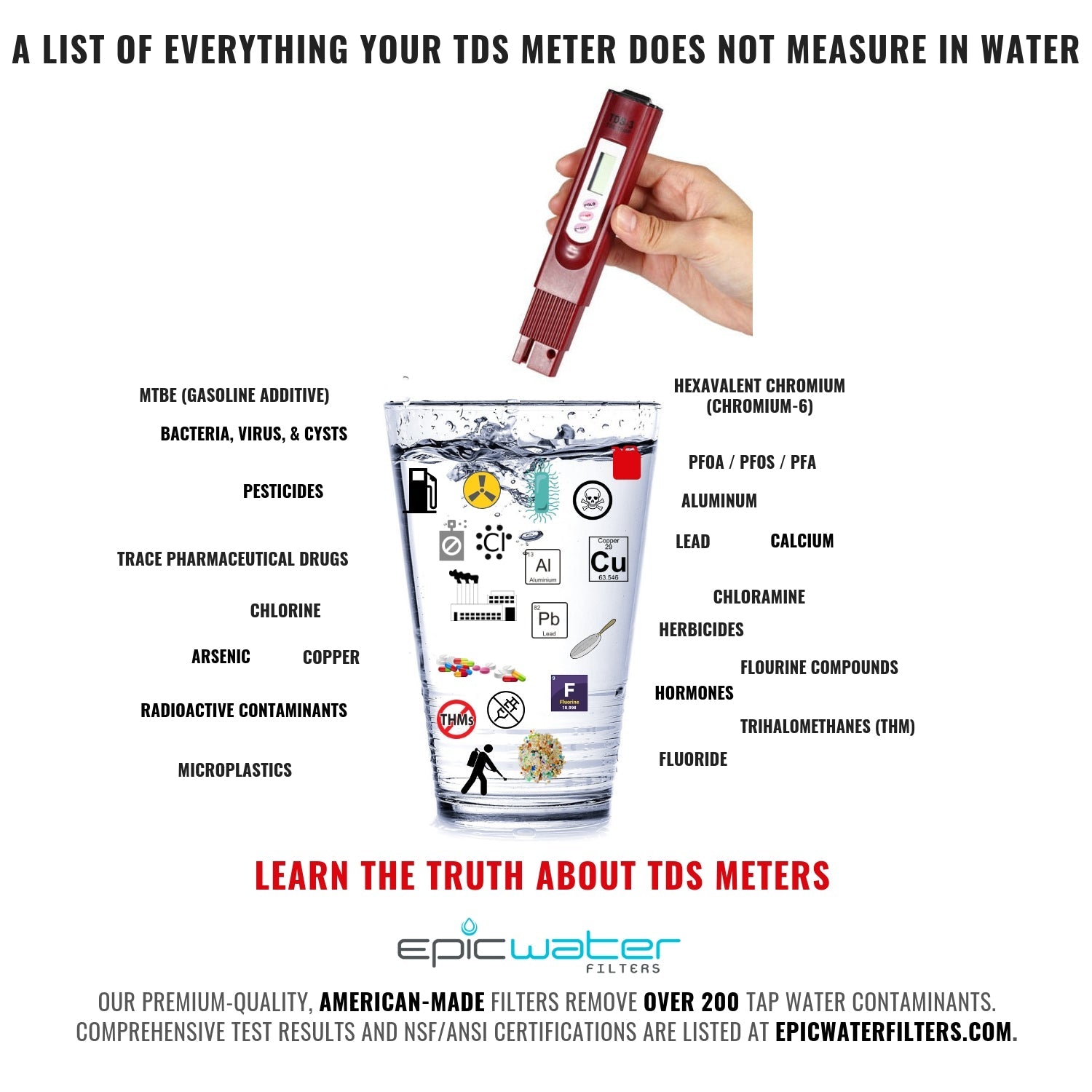
Quick answer: TDS meters work, but only for the one thing they measure: the total amount of dissolved charged minerals in water. They do not measure safety. Water can read 000 and still contain lead, PFAS, pesticides, or bacteria, and water can read 400 and be perfectly healthy. A TDS reading is a mineral count, not a purity score, and marketing that treats it as proof of clean water is misleading as a safety metric.
What does a TDS meter actually measure?

TDS stands for total dissolved solids, which is related to the total charged mineral content of water. Inexpensive handheld TDS meters estimate it by measuring the water's electrical conductivity. Start with deionized water, which has a TDS of zero, expose it to minerals containing sodium, calcium, and magnesium, and the TDS rises. That is why there is no such thing as zero TDS water in nature.
Natural TDS levels vary widely across the United States depending on regional geology, and that variability by itself says nothing about water quality, except in extreme cases where water is too salty to drink. The EPA does not even treat TDS as a health standard: it appears only in the agency's secondary guidelines, which cover aesthetic qualities like taste, at a suggested level of 500 milligrams per liter. Mineral-rich water and safe water are simply different questions.
What a TDS meter cannot tell you
Uncharged contaminants do not register at all
Because TDS is an aggregate measure of charged compounds, uncharged contaminants like motor oil, gasoline, many pharmaceuticals, and many pesticides contribute nothing to the reading. A glass of deionized water with glyphosate, the herbicide in RoundUp, dissolved at 100 times the EPA limit for drinking water will still read 000 on a TDS meter. The same blind spot applies to PFAS and to microbes: bacteria, viruses, and parasites do not show up as TDS.
Lead, arsenic, and chromium 6 hide below the meter's floor

Toxic metals like lead, arsenic, and chromium 6 are charged when dissolved in water, but a TDS meter still tells you nothing useful about them, for two reasons. First, the measurement is non-selective: the meter cannot distinguish a harmless calcium ion from a harmful one, so a reading of 184 is almost always just the water's natural mineral content. Second, the meter is not sensitive enough. TDS meters read in parts per million, while lead, arsenic, and chromium 6 are toxic at parts per billion, a thousand times lower. Using a TDS meter to check for lead is like using a yardstick to measure a child's weight: it is the wrong tool entirely.
In one lab test, water with lead at 100 times the EPA action level produced a TDS reading that teetered between 000 and 001. Meaningful lead and arsenic measurements cannot be made with a TDS meter or any other handheld device. They require an accredited laboratory with far more sophisticated equipment.
Is a 000 reading proof of pure water?
No, and this is where TDS marketing earns its criticism. Some filter brands, ZeroWater most prominently, ship a TDS meter in the box and present the 000 readout as visible proof of purity. The number itself is real: those filters do remove dissolved minerals. The problem is the implication. A 000 reading proves the calcium and magnesium are gone. It says nothing about the uncharged contaminants the meter cannot see, and nothing measurable about metals that matter at parts-per-billion levels.
There is also no health benefit to chasing a low number. Dissolved minerals are not contaminants, and there is no reason to drink demineralized water. If anything, stripping minerals just makes water taste flat. The honest way to judge any filter, ours included, is published, independent test data for specific contaminants, not a single number on a pocket meter.
Why Epic filters do not lower TDS

By design. Epic's filters are selective: they are built and tested to reduce the things that can actually hurt you, like lead, PFAS, fluoride, chromium 6, pesticides, pharmaceuticals, microplastics, disinfection byproducts, and the chlorine and sulfur compounds that make water taste and smell bad. They deliberately leave the beneficial trace minerals like calcium and magnesium in the water, because there is no reason to remove them. So if you run Epic-filtered water past a TDS meter, the number will barely move, and that is exactly what should happen.
Should you buy a TDS meter to test your water?
Not to answer safety questions. If you are concerned about what is in your water, start with your utility's annual water quality report, or pay for a test from an accredited lab, and put the meter money toward a filter with independent testing for the contaminants that concern you.
If you already own a TDS meter, give it to a school or a curious kid with an interest in science. It is a genuinely fun teaching tool: have them test distilled, rain, river, and tap water and try to explain the differences. That is what the instrument is actually good for.
The bottom line
A TDS meter is a mineral counter, and treating its readout as a water safety score is misleading. The contaminants worth worrying about are invisible to it, either because they carry no charge or because they are dangerous at concentrations a thousand times below what the meter can detect.
If clean drinking water is the goal, selective filtration with published testing is the better spend. The Epic Pure XP Pitcher is made in the USA, NSF certified to NSF/ANSI Standards 42 and 372, and independently tested to NSF/ANSI Standards 42, 53, 401, and P231, helping reduce lead, PFAS, fluoride, chlorine, microplastics, pharmaceuticals, bacteria, viruses, and parasites while leaving healthy trace minerals in place. For bigger households, the Pure XP Dispenser offers a larger countertop format, and you can browse the full home filtration lineup anytime.
Related reading
- Is Zero Dissolved Solids Water Safe To Drink?
- What Does TDS in Water Mean? Why the Number Is Not a Safety Score
- Why Is Dasani Water Bad For You?
- Are Plastic Water Bottles Giving You Microplastics?
Sources
- Secondary Drinking Water Standards: Guidance for Nuisance Chemicals — U.S. EPA
- Basic Information About Lead in Drinking Water — U.S. EPA
- PFAS Explained — U.S. EPA
ZEROWATER is a trademark of its respective owner. Epic Water Filters is not affiliated with or endorsed by ZeroWater. This article is for educational purposes and is not medical advice.
Share:
Louisville, Kentucky Water Quality Report
Bethlehem, PA Water Quality Report