
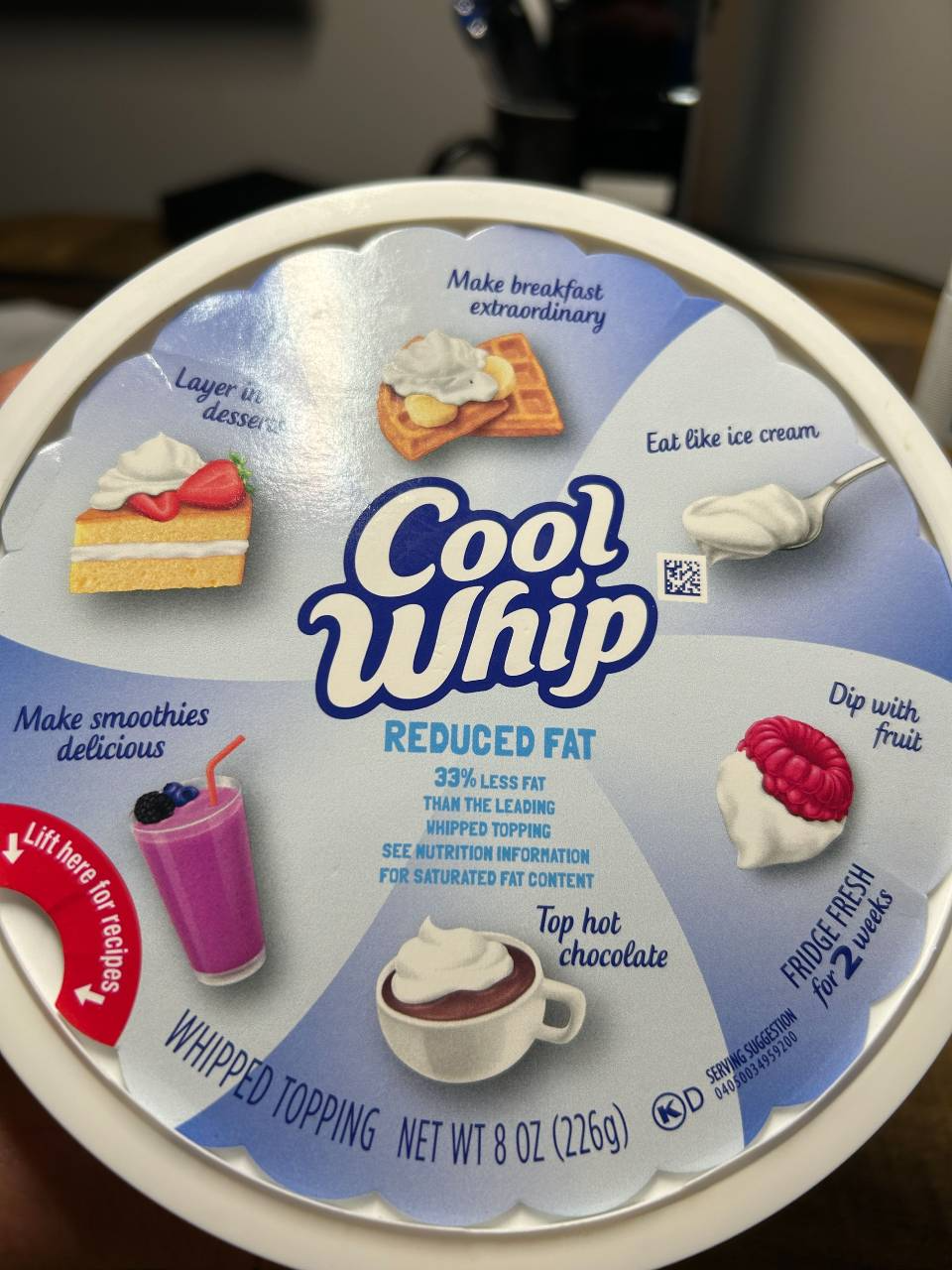
Quick answer: Cool Whip is an ultra processed dessert topping made with hydrogenated oils, corn syrups, and emulsifiers. An occasional spoonful on pie is not going to harm you, and calling it toxic would be an overstatement. But it offers no nutrition, its sweetness comes from high fructose corn syrup and corn syrup, and real whipped cream does the same job with a much shorter ingredient list. Portion size matters more than which topping you choose.
What is Cool Whip made of?
Cool Whip earned its place in refrigerators on convenience: it is pre-whipped, holds its shape, and keeps far longer than fresh whipped cream. That shelf stability comes from its formulation. The main ingredients are high fructose corn syrup, corn syrup, hydrogenated vegetable oil (usually coconut and palm kernel oils), sodium caseinate (a milk protein), natural and artificial flavors, xanthan and guar gums (thickeners), polysorbate 60 (an emulsifier), and synthetic beta-carotene (a coloring agent).

None of these ingredients is banned or considered acutely dangerous. The fair criticism is different: it is a dessert topping built from processed fats, two forms of corn syrup, and stabilizers, with essentially no nutritional upside.
Hydrogenated vegetable oil
Hydrogenation turns liquid vegetable oils into solid, shelf-stable fats. The version with the worst reputation, partially hydrogenated oil, was the main source of artificial trans fat, which raises LDL (bad) cholesterol and lowers HDL (good) cholesterol. The FDA determined partially hydrogenated oils were no longer generally recognized as safe and they have been phased out of the US food supply. The hydrogenated coconut and palm kernel oils used in products like Cool Whip today are a different, fully hydrogenated type. They are not a trans fat loophole, but they are still highly processed fats that are high in saturated fat, which is worth limiting in a heart-conscious diet.
High fructose corn syrup and corn syrup
Cool Whip's sweetness comes from high fructose corn syrup and corn syrup. Research has linked high overall intake of fructose-heavy sweeteners to weight gain, elevated triglycerides, and non-alcoholic fatty liver disease, and animal research suggests HFCS can alter gut bacteria. The honest context is dose: a spoonful of Cool Whip contributes a small amount of added sugar, and the health findings above are about sustained high intake across an entire diet. The problem is that HFCS shows up in so many processed foods that small amounts add up quickly.

Flavors, gums, and emulsifiers
The natural and artificial flavors, xanthan and guar gums, and polysorbate 60 in Cool Whip are all permitted additives, and the gums in particular are well tolerated by most people. "Natural flavors" is a broad labeling term that says little about how a flavor was actually made, which is a transparency issue more than a safety one. Research into the long-term effects of some emulsifiers is ongoing, so "generally recognized as safe" is a reasonable but not ironclad reassurance.
Is Cool Whip healthier than whipped cream?
Real whipped cream is the simpler product: heavy cream, sugar, and perhaps vanilla. It contains more saturated fat than Cool Whip because it is actual dairy fat, but it skips the corn syrups, emulsifiers, and stabilizers entirely. If you whip it at home, you also control the sugar, which usually means far less than any pre-sweetened tub.
Neither topping is a health food. Choose based on what you value: fewer ingredients and better flavor favor real whipped cream, while convenience and shelf life favor Cool Whip. If your diet is otherwise built on whole foods, the difference between the two on a slice of holiday pie is small.
Is Cool Whip good for weight loss?
No topping is a weight loss food, but Cool Whip is not uniquely fattening either. A standard serving is small and modest in calories. The realistic risks are portion creep, since few people measure dessert topping by the tablespoon, and the way regular sweet toppings keep your palate expecting dessert-level sweetness. Lighter and sugar-free varieties exist, but swapping the sweetener does not turn a topping into a weight loss tool. If you are managing your weight, the amount matters far more than the variety, and whole foods that keep you full are the better daily investment.
The bottom line
Cool Whip is an occasional-treat food, and treating it as one is a perfectly reasonable choice. It is not toxic, but it is ultra processed and nutritionally empty, and real whipped cream is the better version of the same indulgence if ingredients matter to you.
If you are looking at labels because you want to clean up your diet, start with the thing you consume most: water. Filtering your tap water removes chlorine taste along with contaminants like lead and microplastics, and it makes plain water an easier habit to keep. Our Pure XP pitcher is independently tested to reduce lead, PFAS, chlorine, and over 99.9% of microplastics, and the Pure XP dispenser does the same for bigger households.
Related reading
- Why is rotisserie chicken bad for you?
- Which diet sodas do not contain aspartame?
- Is Gatorade Zero bad for you?
- Benefits of baking soda in water
Sources
- PubMed (Journal of Hepatology): Fructose Consumption, Lipogenesis, and Non-Alcoholic Fatty Liver Disease
- Nature (npj Science of Food): Effects of High Fructose Corn Syrup on Intestinal Microbiota Structure and Obesity in Mice
- The New York Times: Are 'Natural Flavors' Really Natural?
- NPR: Is 'Natural Flavor' Healthier Than 'Artificial Flavor'?
COOL WHIP is a trademark of Kraft Foods Group Brands LLC. Epic Water Filters is not affiliated with Kraft. This article is for educational purposes and is not medical advice.
Share:
Coconut water and Diarrhea
Are Cliff Bars Good For You